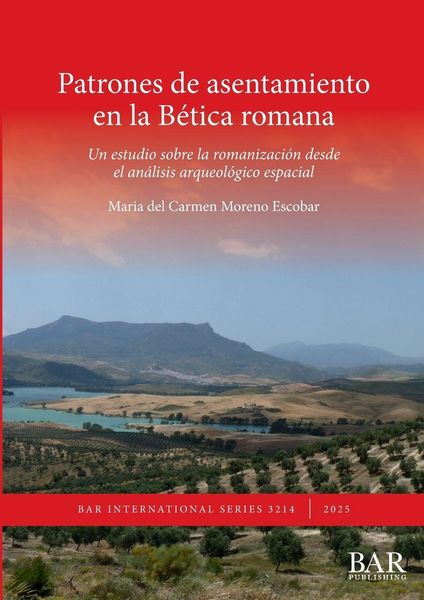
Patrones de asentamiento en la Bética romana Un estudio sobre la romanización desde el análisis arqueológico espacial
-
- Spanisch ausgewählt
182,99 €
inkl. gesetzl. MwSt.,
Beschreibung
Produktdetails
Einband
Taschenbuch
Erscheinungsdatum
31.03.2025
Verlag
British Archaeological Reports (Oxford) LtdSeitenzahl
312
Maße (L/B/H)
29,7/21/2 cm
Gewicht
1203 g
Sprache
Spanisch
ISBN
978-1-4073-5820-8
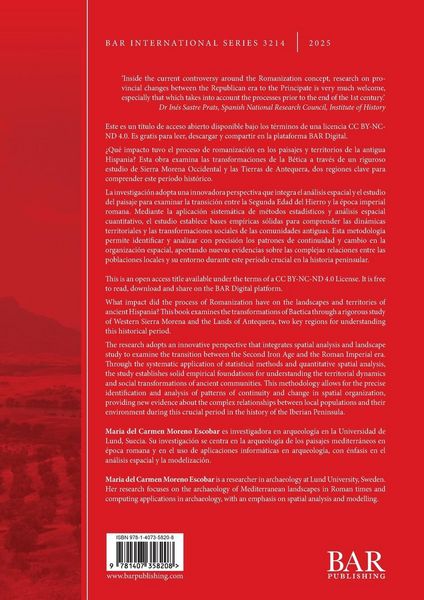
Este es un título de acceso abierto disponible bajo los términos de una licencia CC BY-NC-ND 4.0. Es gratis para leer, descargar y compartir en la plataforma BAR Digital. ¿Qué impacto tuvo el proceso de romanización en los paisajes y territorios de la antigua Hispania? Esta obra examina las transformaciones de la Bética a través de un riguroso estudio de Sierra Morena Occidental y las Tierras de Antequera, dos regiones clave para comprender este período histórico. La investigación adopta una innovadora perspectiva que integra el análisis espacial y el estudio del paisaje para examinar la transición entre la Segunda Edad del Hierro y la época imperial romana. Mediante la aplicación sistemática de métodos estadísticos y análisis espacial cuantitativo, el estudio establece bases empíricas sólidas para comprender las dinámicas territoriales y las transformaciones sociales de las comunidades antiguas. Esta metodología permite identificar y analizar con precisión los patrones de continuidad y cambio en la organización espacial, aportando nuevas evidencias sobre las complejas relaciones entre las poblaciones locales y su entorno durante este período crucial en la historia peninsular. This is an open access title available under the terms of a CC BY-NC-ND 4.0 License. It is free to read, download and share on the BAR Digital platform. What impact did the process of Romanization have on the landscapes and territories of ancient Hispania? This book examines the transformations of Baetica through a rigorous study of Western Sierra Morena and the Lands of Antequera, two key regions for understanding this historical period. The research adopts an innovative perspective that integrates spatial analysis and landscape study to examine the transition between the Second Iron Age and the Roman Imperial era. Through the systematic application of statistical methods and quantitative spatial analysis, the study establishes solid empirical foundations for understanding the territorial dynamics and social transformations of ancient communities. This methodology allows for the precise identification and analysis of patterns of continuity and change in spatial organization, providing new evidence about the complex relationships between local populations and their environment during this crucial period in the history of the Iberian Peninsula.
Noch keine Bewertungen vorhanden
Verfassen Sie die erste Bewertung zu diesem Artikel
Helfen Sie anderen Kundinnen und Kunden durch Ihre Meinung.
Kurze Frage zu unserer Seite
Vielen Dank für Ihr Feedback
Wir nutzen Ihr Feedback, um unsere Produktseiten zu verbessern. Bitte haben Sie Verständnis, dass wir Ihnen keine Rückmeldung geben können. Falls Sie Kontakt mit uns aufnehmen möchten, können Sie sich aber gerne an unseren Kund*innenservice wenden.
zum Kundenservice