KI-Beratung Beta

Gutscheinbedingungen

**Gültig bis 30.11.2026 auf Spielzeug, Schreibwaren, Filme, Geschenke & Trends, Musik, tolino eReader & Zubehör, Hörbücher und Hörbuch-Downloads, nicht preisgebundene Bücher und Kalender online auf thalia.at und in der Thalia App. Einzelne Artikel können ausgeschlossen sein. Aufgrund der Buchpreisbindung sind deutschsprachige Bücher und eBooks ausgenommen. Zusätzlich ausgenommen sind Abos & Flatrates, Games, Geschenkkarten/-boxen, Shelfies, Software, Zeitschriften sowie einzelne Artikel von tonies®. Pro Einkauf einmal einlösbar. Nur gültig mit im Onlineshop hinterlegter Bonuscard. Click & Collect nur bei Onlinevorabzahlung möglich. Keine Barauszahlung. Nicht kombinierbar mit anderen Aktionen und Gutscheinen. Gutschein wird auf max. 500€ Bestellwert angerechnet. Nicht gültig für Versandkosten und Services.

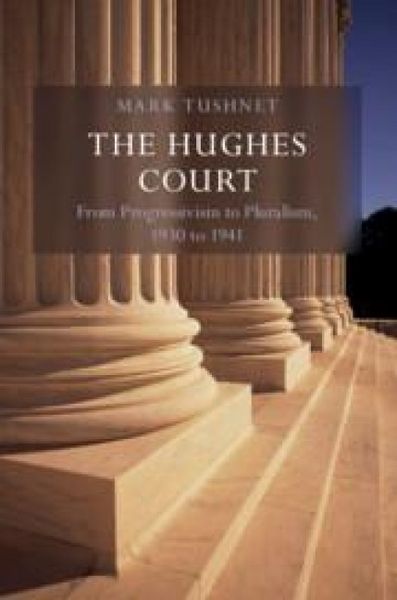
Produktbild: The Hughes Court: Volume 11

The Hughes Court: Volume 11 From Progressivism to Pluralism, 1930 to 1941

69,99 €

inkl. gesetzl. MwSt., Versandkostenfrei


Beschreibung

The Hughes Court: From Progressivism to Pluralism, 1930 to 1941 describes the closing of one era in constitutional jurisprudence and the opening of another. This comprehensive study of the Supreme Court from 1930 to 1941 - when Charles Evans Hughes was Chief Justice - shows how nearly all justices,...

Beschreibung

The Hughes Court: From Progressivism to Pluralism, 1930 to 1941 describes the closing of one era in constitutional jurisprudence and the opening of another. This comprehensive study of the Supreme Court from 1930 to 1941 - when Charles Evans Hughes was Chief Justice - shows how nearly all justices, even the most conservative, accepted the broad premises of a Progressive theory of government and the Constitution. The Progressive view gradually increased its hold throughout the decade, but at its end, interest group pluralism began to influence the law. By 1941, constitutional and public law was discernibly different from what it had been in 1930, but there was no sharp or instantaneous Constitutional Revolution in 1937 despite claims to the contrary. This study supports its conclusions by examining the Court's work in constitutional law, administrative law, the law of justiciability, civil rights and civil liberties, and statutory interpretation.

Produktdetails

Einband

Taschenbuch

Erscheinungsdatum

15.05.2025

Abbildungen

Worked examples or Exercises

Verlag Cambridge Academic

Produktdetails

Einband

Taschenbuch

Erscheinungsdatum

15.05.2025

Abbildungen

Worked examples or Exercises

Verlag Cambridge Academic
Seitenzahl

1272

Maße (L/B/H)

22,9/16/6,4 cm

Gewicht

2064 g

Sprache

Englisch

ISBN

978-1-00-956673-5

Herstelleradresse

Libri GmbH
Europaallee 1
36244 Bad Hersfeld
DE

Email: gpsr@libri.de

Noch keine Bewertungen vorhanden

Verfassen Sie die erste Bewertung zu diesem Artikel

Helfen Sie anderen Kundinnen und Kunden durch Ihre Meinung.

Kundinnen und Kunden meinen

Bewertungen (0)

  • Produktbild: The Hughes Court: Volume 11
  • Acknowledgments; Introduction; Preface; Part I. The Opening Years: Section A. Setting the Stage; 1. Personnel and Organizing Ideas; 2. Formulas and Conceptions of Basic Needs: An Overview; 3. The Complex World of Simple Formulas; 4. Formulas and Considerations of Basic Needs in Business Regulation Cases; Section B. The False Dawn; 5. Blaisdell; 6. Nebbia; 7. The Gold Clause Cases; Section C. Crisis; 8. Black Monday 1935; 9. Winter 1935-36; 10. Spring 1936; 11. The Court-Packing Plan; 12. Resolution; 13. Was There a 'Switch in Time'?; Section D. The New Constitutional Regime; 14. After the Storm: Personnel and Organization; 15. Consolidating the Scope of National Power; 16. Consolidating State Regulation of Business; 17. Consolidating Labor Law and Intergovernmental Immunity; 18. Toward a Theory of Pluralism; Part II. Continuities: Section A. Administrative Law; 19. Administrative Law Introduction; 20. Administrative Law Constitutional Limits; 21. Administrative Law Presidential Power; 22. Administrative Law Courts' Role; Section B. Civil Liberties and Civil Rights; 23. The Uncertainty of Theory; 24. Progressivism, Prohibition, and Organized Crime; 25. Race, Criminal Justice, and 'Labor Defense'; 26. Race and Strategic Litigation; 27. Radical Political Dissent; 28. Radical Religious Dissent; Section C. Justiciability; 29. Basic Concepts of Justiciability; 30. Sovereign Immunity and Political Questions; 31. Regulating Access to the National Courts; 32. Erie; 33. Erie's Legacy; 34. Form and Style in Statutory Interpretation; Part III: New Approaches Begin to Emerge: Section A. Economics; 35. New Deal Economics; 36. Regulating Strikes; 37. Regulating the NLRB; 38. The Labor Antitrust Interface; Section B. Civil Liberties After 1937; 39. The Justices and the Theories; 40. Demonstrations, Picketing, and First Amendment Theories; 41. The Jehovah's Witnesses and First Amendment Theories; 42. Conclusion; Historiographical Essay; Index.