KI-Beratung Beta

Gutscheinbedingungen

**Gültig am 27.11.2026 auf Spielzeug, Schreibwaren, Filme, Geschenke & Trends, Musik, tolino eReader & Zubehör, Hörbücher und Hörbuch-Downloads, nicht preisgebundene Bücher und Kalender online auf thalia.at und in der Thalia App. Einzelne Artikel können ausgeschlossen sein. Aufgrund der Buchpreisbindung sind deutschsprachige Bücher und eBooks ausgenommen. Zusätzlich ausgenommen sind Abos & Flatrates, Games, Geschenkkarten/-boxen, Shelfies, Software, Zeitschriften sowie einzelne Artikel von tonies®. Pro Einkauf einmal einlösbar. Click & Collect nur bei Onlinevorabzahlung möglich. Keine Barauszahlung. Nicht kombinierbar mit anderen Aktionen und Gutscheinen. Gutschein wird auf max. 500€ Bestellwert angerechnet. Nicht gültig für Versandkosten und Services.

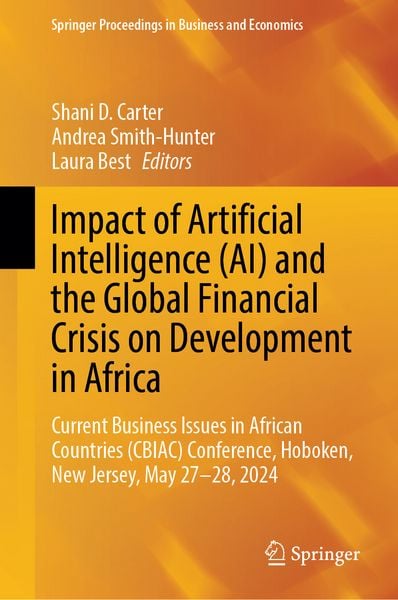
Produktbild: Impact of Artificial Intelligence (AI) and the Global Financial Crisis on Development in Africa
- 10%

Impact of Artificial Intelligence (AI) and the Global Financial Crisis on Development in Africa Current Business Issues in African Countries (CBIAC) Conference, Hoboken, New Jersey, May 27–28, 2024

10% sparen

196,99 € UVP 219,99 €

inkl. gesetzl. MwSt., Versandkostenfrei


Beschreibung

This book examines the impact of AI and the financial crisis on African nations and the issues that surround its reciprocal impact on global business, government, and society. The global financial crisis and artificial intelligence (AI) have an equal and synergistic impact on economic development in...

Beschreibung

This book examines the impact of AI and the financial crisis on African nations and the issues that surround its reciprocal impact on global business, government, and society. The global financial crisis and artificial intelligence (AI) have an equal and synergistic impact on economic development in Africa. While the global financial crisis has presented significant challenges to African businesses, AI has presented significant opportunities to alleviate these challenges. Featuring selected papers presented at the 5th Annual Current Business Issues in African Countries (CBIAC) Conference held in Hoboken, NJ, USA, in May 2024, this book focuses on the synergies between climate change, supply chain, and sustainable development featuring content from business and NGO leaders, faculty, and students.


The impetus of the CBIAC conference was the discussions held at the United Nations Conference on Trade and Development (UNCTAD) held in Nairobi, Keyna, in July 2016 and in Bridgetown, Barbados, and Geneva in 2021. The goal of the conference is to create long-term collaborative relationship between business leaders, faculty, researchers, students, and community members from different African nations.

Portrait


  •          Shani D. Carter is Associate Director of assesment at Stevens Institute of Technology (Hoboken, NJ). She also founded the Current Business Issues in African Countries Conference (CBIAC) in 2016 after attending the United Nations Conference on Trade and Development (UNCTAD) in Nairobi, Kenya. Dr. Carter taught courses in human resource management, organizational behavior, and leadership for nearly 30 years.  Dr. Carter has published more than 40 articles, book chapters, and conference proceedings on human resources and assessment of student learning.


·         Andrea E. Smith-Hunter is Professor of management at Siena College, Loudonville, NY, USA. Her research is in women’s entrepreneurship covering management issues, gender issues, ethnic issues, global issues, economic issues, and sociological issues. Her research has been published across research journals,books,  and book chapters, and conference proceedings.


·         Laura Best is Program Manager for The Global Health Network. Previously, she was at the Office of Vice-Chancellor at Nelson Mandela University in South Africa, as well as Program Coordinator across multiple governmental departments and entities. Dr. Best is active internationally in research and policy advocacy with a particular focus on incorporating sustainability into consumer protection systems. She is a Member of the United Nations Conference on Trade and Development Group of Experts in Consumer Protection and the African Dialogue Consumer Policy Network.

Produktdetails

Einband

Gebundene Ausgabe

Erscheinungsdatum

03.01.2026

Abbildungen

XII, 374 p. 35 illus., 31 illus. in color.

Herausgeber Shani D. Carter + weitere

Produktdetails

Einband

Gebundene Ausgabe

Erscheinungsdatum

03.01.2026

Abbildungen

XII, 374 p. 35 illus., 31 illus. in color.

Herausgeber
Verlag Springer
Seitenzahl

374

Maße (L/B/H)

24,1/16/2,7 cm

Gewicht

694 g

Sprache

Englisch

ISBN

978-3-031-94517-5

Herstelleradresse

Springer-Verlag GmbH
Europaplatz 3
69115 Heidelberg
DE

Email: ProductSafety@springernature.com

Noch keine Bewertungen vorhanden

Verfassen Sie die erste Bewertung zu diesem Artikel

Helfen Sie anderen Kundinnen und Kunden durch Ihre Meinung.

Kundinnen und Kunden meinen

Bewertungen (0)

  • Produktbild: Impact of Artificial Intelligence (AI) and the Global Financial Crisis on Development in Africa

  • Section 1:Artificial Intelligence.-Chapter 1.- The decision makers' perceptions toward the adoption of artificial intelligence in the context of Industry 4.0 and its effect on decision-making quality: Case of agro-industrial SME in Morocco.- Chapter 2.- The Evolution of Skills in the Era of Artificial Intelligence: Employee Attraction Strategies in a New Professional Paradigm (Case of Moroccan Companies).- Chapter 3.- Co-production of Public Services and Artificial Intelligence: Exploring the Opportunities and Challenges.- Chapter 4.- The Adoption of AI Tools in Doctoral Studies: An Extended TAM Framework.- Chapter 5.- Africa's Prosperity: Why and How Can AI Help Overcome the Effects of the Financial Crisis and Boost Development?.- Section 2: Finance.- Chapter 6.- Catalysts for financial inclusion through digital technologies in North Africa and the Middle East.- Chapter 7.- Corporate Governance and Stock Market Companies Performance in Morocco.- Chapter 8.- Adoption of Financial Innovation by Moroccan SMEs: opportunities and risks.-Chapter 9.-The Effectiveness of Internal Audit for Better Uncertainty Management: The Case of Hotels in Agadir.- Section 3: Entrepreneurship.- Chapter 10.- A Comparative Assessment of AI's Impact on Entrepreneurial Progress: Examining the Case of Western, Arab, and African Entrepreneurs.- Chapter 11.- Navigating Entrepreneurship Challenges in Nigeria: A Call for Global Attention.-The Role of Artificial Intelligence in the Social and Solidarity Economy.- Chapter 18.- Can A Digital Supply Chain Resist to Environment Disruptions?.- Chapter 19.- AI Acts in Africa: A Descriptive Exploration of Artificial Intelligence Applications in Logistics Across African Nations – Unraveling Innovations, Challenges, and Socioeconomic Impact.