KI-Beratung Beta

Produktbild: Colonialism and Enlightenment

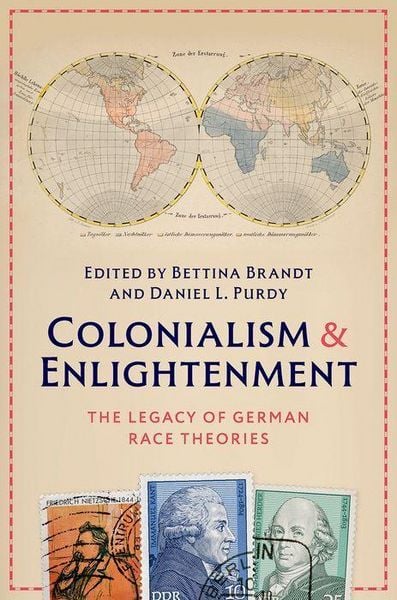
Colonialism and Enlightenment The Legacy of German Race Theories

121,99 €

inkl. gesetzl. MwSt., Versandkostenfrei


Beschreibung

For the last 30 years, scholars have treated Enlightenment race theory and nineteenth-century German colonialism as two distinct events. In Colonialism and Enlightenment, editors Bettina Brandt and Daniel L. Purdy present perspectives from scholars across the fields of philosophy, postcolonialism, literature,...

Beschreibung

For the last 30 years, scholars have treated Enlightenment race theory and nineteenth-century German colonialism as two distinct events. In Colonialism and Enlightenment, editors Bettina Brandt and Daniel L. Purdy present perspectives from scholars across the fields of philosophy, postcolonialism, literature, and German and African American studies, who challenge this view, providing a critical examination of the historical connection between "scientific" racial theory in late-Enlightenment Germany and the forces of colonialism and Nazism over a hundred years later. From its first formulations in the eighteenth century and well into the twentieth century, German race theory was implicated in colonialism. Philosophers and biologists drew their arguments about race from information that was generated by the slave trade and plantation economies in the Americas. Their reliance on colonial data was applied to so-called "internal colonization" within Eastern Europe and Central Asia, as well as to seaborn European competition in South Asia. Most strikingly, some of the sites of German race theorization, such as East Prussia and the Baltic states, were themselves long-established colonies with ethnic separations between ruling and laboring populations. Race theory depended not only on the exploration of distant islands in the Pacific, but on the long-term exploitation and breeding of forcefully transported populations across the Atlantic. Without the involuntary migration of Africans, nineteenth century racial scientists would not have been able to engage in arguments about crossbreeding, skull size, and skin color. The chapters in this volume explore how eighteenth-century German theories about race reinforced discourses on colonial settlements, both within and outside Europe. Given the multiple, often contradictory positions developed in the Enlightenment, Brandt and Purdy explore how later race thinkers responded to earlier concepts. How did Enlightenment-era debates figure into later forms of racism? How did nationalist and Nazi racisms view Enlightenment anthropology? What Enlightenment concepts and configurations persisted into the twentieth century? Taking a broad view, the scholars in this volume offer a variety of positions on these and other questions as they take stock of the debates about race and the Enlightenment held over the last 20 years.

Produktdetails

Einband

Gebundene Ausgabe

Erscheinungsdatum

07.10.2025

Abbildungen

7 b/w photographs

Herausgeber Bettina Brandt + weitere

Produktdetails

Einband

Gebundene Ausgabe

Erscheinungsdatum

07.10.2025

Abbildungen

7 b/w photographs

Herausgeber
Verlag Oxford Academic
Seitenzahl

312

Maße (L/B/H)

22,6/15/3 cm

Gewicht

590 g

Sprache

Englisch

ISBN

978-0-19-778502-7

Herstelleradresse

Libri GmbH
Europaallee 1
36244 Bad Hersfeld
DE

Email: gpsr@libri.de

Noch keine Bewertungen vorhanden

Verfassen Sie die erste Bewertung zu diesem Artikel

Helfen Sie anderen Kundinnen und Kunden durch Ihre Meinung.

Kundinnen und Kunden meinen

Bewertungen (0)

Die Leseprobe wird geladen.
  • Produktbild: Colonialism and Enlightenment
    • Introduction
    • Part One. The Long View
    • Chapter 1: Robert Bernasconi: Philosophical Histories as Sites of Racism: Race and Civilization in the Age of Chattel Slavery
    • Part 2. Enlightenment Classification
    • Chapter 2: Carl Niekerk: Race, Enlightenment Anthropology, and Radical Thought
    • 3: Huaping Lu-Adler: Know Your Place, Know Your Calling: Geography, Race, and Kant's "World-Citizen"
    • Chapter 4: Daniel Purdy: Undeutsch and Unmündig: Human Bondage Compared-An Enlightenment Discourse on Baltic Serfdom and Atlantic Slavery
    • Chapter 5: Jürgen Overhoff: Slavery and the Slave Trade in German Children's Picture Books (1714-1827)
    • Part 3. From Enlightenment Theory to Kaiserreich Colonialism and Völkisch Nationalism
    • Chapter 6: Adam A. Blackler: Popularizing the Nation Colonial Literature and the Imperial Imagination
    • Chapter 7: John K. Noyes: Is Race an Urphänomen? Chamberlain Reads Herder
    • Chapter 8: Jeannette Eileen Jones: The Anatomy of Intellectual Powers: Craniology and the Impact of the German Enlightenment on Nineteenth-Century Scientific Theories of Blackness
    • 9: Patricia Simpson: From Miracles to Miscegenation: Enlightening Skin
    • Chapter 10: Micol Bez: Facta, Ficta, and Picta: Making Race with Nietzsche and Against Kant
    • Part 4. The Postcolonial Present
    • Chapter 11: Patrice Nganang: Polemos: Reading French-German and British-German Antagonisms Through the Cameroonian Lens