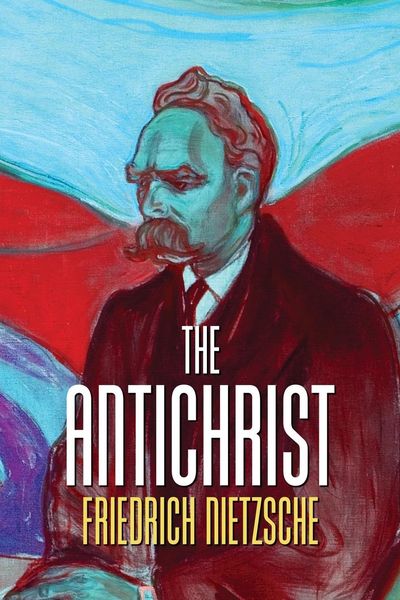
The Antichrist
-
- Hardcover
- Taschenbuch ausgewählt
- eBook
- Hörbuch
- Paperback
-
Sprache:Englisch
- Deutsch 4,90 €
- Englisch 13,99 € ausgewählt
-
Verlag:Ingram Publishers Services
- General Press 18,99 €
- Kalamos Literary Services LLP 19,99 €
- E-Kitap Projesi & Cheapest Books 20,60 €
- External catalogues UK 14,99 €
- Bibliotech Pr 18,99 €
- Classy Publishing 17,99 €
- Serenity Publishers, LLC 12,99 €
- Globe Pequot Publishing 19,99 €
- Independently Published 11,99 €
- Binker North 18,99 €
- Ingram Publishers Services 13,99 € ausgewählt
- The Big Nest 14,99 €
- Alpha Editions 19,99 €
- True Sign Publishing House 14,99 €
- Tredition 10,20 €
- Dover Publications Inc. 6,99 €
- Sanage Publishing House Llp 16,99 €
- Digital Pulse Publishing 17,99 €
- Published by Parables 15,99 €
13,99 €
inkl. gesetzl. MwSt.,
- Kostenlose Lieferung ab 30 € Einkaufswert
- Versandkostenfrei für Bonuscard-Kund*innen
Beschreibung
Produktdetails
Einband
Taschenbuch
Erscheinungsdatum
06.05.2025
Verlag
Ingram Publishers ServicesSeitenzahl
116
Maße (L/B/H)
22,9/15,2/0,6 cm
Gewicht
163 g
Sprache
Englisch
ISBN
978-1-72250-499-1
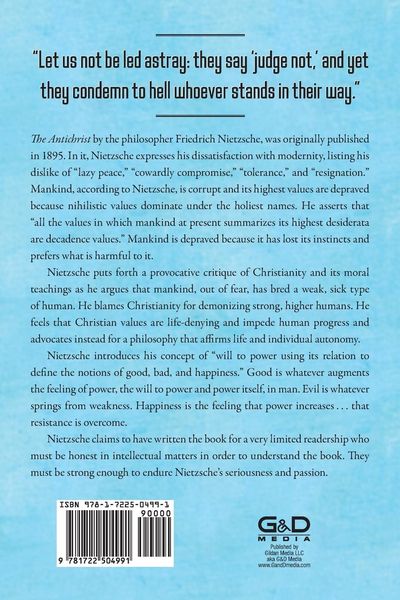
"Let us not be led astray: they say 'judge not' and yet they condemn to hell whoever stands in their way."
The Antichrist by the philosopher Friedrich Nietzsche, was originally published in 1895. In it, Nietzsche expresses his dissatisfaction with modernity, listing his dislike of "lazy peace", "cowardly compromise", "tolerance" and "resignation". Mankind, according to Nietzsche, is corrupt and its highest values are depraved because nihilistic values dominate under the holiest names. He asserts that "all the values in which mankind at present summarizes its highest desiderata are decadence values". Mankind is depraved because it has lost its instincts and prefers what is harmful to it. Nietzsche puts forth a provocative critique of Christianity and its moral teachings as he argues that mankind, out of fear, has bred a weak, sick type of human. He blames Christianity for demonizing strong, higher humans. He feels that Christian values are life-denying and impede human progress and advocates instead for a philosophy that affirms life and individual autonomy. Nietzsche introduces his concept of "will to power using its relation to define the notions of good, bad, and happiness. Good is whatever augments the feeling of power, the will to power and power itself, in man. Evil is whatever springs from weakness. Happiness is the feeling that power increases...that resistance is overcome. Nietzsche claims to have written the book for a very limited readership who must be honest in intellectual matters in order to understand the book. They must be strong enough to endure Nietzsche's seriousness and passion.Noch keine Bewertungen vorhanden
Verfassen Sie die erste Bewertung zu diesem Artikel
Helfen Sie anderen Kundinnen und Kunden durch Ihre Meinung.
Kurze Frage zu unserer Seite
Vielen Dank für Ihr Feedback
Wir nutzen Ihr Feedback, um unsere Produktseiten zu verbessern. Bitte haben Sie Verständnis, dass wir Ihnen keine Rückmeldung geben können. Falls Sie Kontakt mit uns aufnehmen möchten, können Sie sich aber gerne an unseren Kund*innenservice wenden.
zum Kundenservice