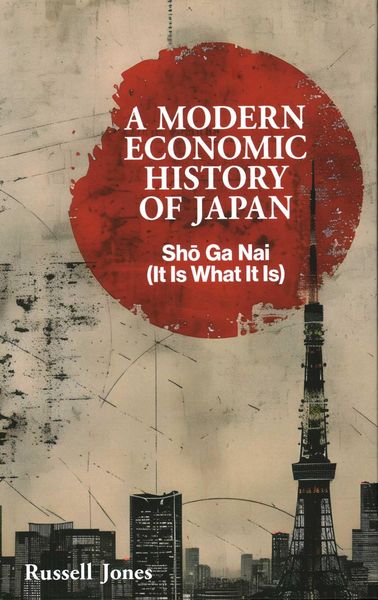
A Modern Economic History of Japan Sho Ga Nai (It Is What It Is)
41,99 €
inkl. gesetzl. MwSt.,
Beschreibung
Produktdetails
Einband
Gebundene Ausgabe
Erscheinungsdatum
05.06.2025
Verlag
London Publishing PartnershipSeitenzahl
288
Maße (L/B/H)
23,8/16,1/2,8 cm
Gewicht
584 g
Farbe
Messing / Tabak
Sprache
Englisch
ISBN
978-1-916749-39-9
The modern economic history of Japan is an extraordinary tale. The country rose over the course of just a hundred and twenty odd years from outright backwardness to the elite tier of the most advanced economies. This was a unique achievement, and one realised despite the nation succumbing to a damaging interlude of ugly totalitarianism and subsequently suffering the most demoralising of military defeats. If Japan's progress before World War II was impressive, the decades following its subjugation and occupation by the US saw it record hitherto unheard of rates of economic growth. By the 1980s, such was Japan's record of unrelenting achievement, not only did it spawn a rising tide of political resentment among its competitors, but it also encouraged them to adopt important aspects of the country's economic model. The belief at this time, both at home and abroad, was that Japan's success was set to continue. Such predictions, however, proved wide of the mark. The powerful forces that had driven its post-war boom had already been waning for some time, and its model of economic development was becoming increasingly ill-suited to the requirements of high-income country status. Its rapid rate of expansion became more and more dependent on the unsustainable combination of asset price inflation and the rapid accumulation of private, in particular corporate, debt. This was bound to end in tears, and it did, although the extent of Japan's subsequent fall from grace came as a surprise to most. By the early 2020s, Japan was again a far away country about which relatively little was known and a dwindling proportion cared less. Only a minority were aware, apart from in vague terms, of Japan's initial meteoric rise from impoverished backwater, the nature and extent of its wartime calamity, its remarkable mid-twentieth century economic miracle, and the manner in which it came to be held up as the exemplar for other nations. Instead, Japanification had emerged as a derogatory byword for stagnation. But this was to undersell a still vitally important mature and sophisticated economy and to ignore the enduring lessons that Japan's experience could offer. These extended beyond the process of successful and enduring economic development, to the management of asset price cycles and the currency markets, the complexities of combating deflation, the painful trade offs implicit in successful structural reform, and perhaps most pertinently of all, how best to deal with the inexorable forces of demographic change.
Noch keine Bewertungen vorhanden
Verfassen Sie die erste Bewertung zu diesem Artikel
Helfen Sie anderen Kundinnen und Kunden durch Ihre Meinung.
Kurze Frage zu unserer Seite
Vielen Dank für Ihr Feedback
Wir nutzen Ihr Feedback, um unsere Produktseiten zu verbessern. Bitte haben Sie Verständnis, dass wir Ihnen keine Rückmeldung geben können. Falls Sie Kontakt mit uns aufnehmen möchten, können Sie sich aber gerne an unseren Kund*innenservice wenden.
zum Kundenservice