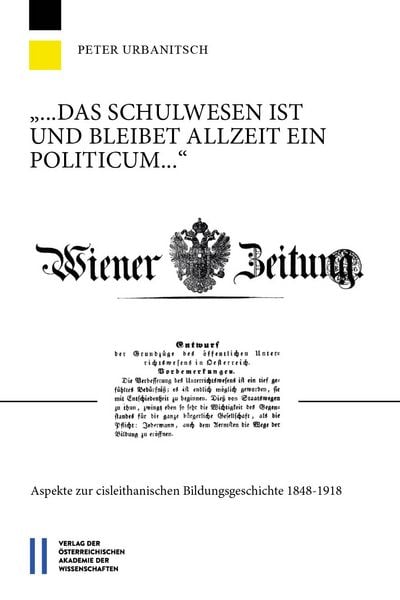
"... das Schulwesen ist und bleibet allzeit ein Politicum ..." Aspekte zur cisleithanischen Bildungsgeschichte 1848-1918
-
- Deutsch ausgewählt
90,00 €
inkl. gesetzl. MwSt.,
Beschreibung
Produktdetails
Einband
Taschenbuch
Erscheinungsdatum
26.03.2025
Verlag
Verlag D.OesterreichischeSeitenzahl
820
Maße (L/B/H)
22,7/15,2/4,9 cm
Gewicht
1286 g
Sprache
Deutsch
ISBN
978-3-7001-9417-0
In 1848 a comprehensive process of modernisation of the education system started in the Habsburg monarchy whose effects are still felt today. In keeping with the liberal, enlightened ethos, the standard of education was to be raised, the influence of the church reduced, the ability of people to make judgements improved, independent thinking encouraged, and young people were to be inoculated with a sense of patriotism centred around the emperor and the empire. The dissemination of practical knowledge was meant to facilitate economic progress. The Reichvolksschulgesetz (the imperial law on primary schools) passed in 1869 had a decisive positive effect on primary education. Immediately before the First World War, almost all primary school pupils were being taught in their mother tongue. However, the language problem was also an important factor in higher levels of education. Not all nationalities had access to education "from the cradle to the grave". Grammar schools were required to follow the neo-humanist educational ideal, while the secondary modern schools (Realschulen) and vocational schools had to take account of a new world-view shaped by the sciences and technology. The universities and other higher education establishments also followed this trend, and outstanding results were achieved in many subjects. However, only very few young men, and much later and in even smaller numbers young women, were able to attend a secondary or tertiary educational establishment, which made the wide-ranging provision of adult education organised by the civil society all the more important. While it is true that the goals that were already formulated in 1848 were not achieved across the board, the measures implemented by the state, the federal provinces, the municipalities, interest groups and civil society created a firm foundation to enable new challenges to be met, even after the fall of the Habsburg monarchy.
Kundinnen und Kunden meinen
Verfassen Sie die erste Bewertung zu diesem Artikel
Helfen Sie anderen Kund*innen durch Ihre Meinung
Kurze Frage zu unserer Seite
Vielen Dank für Ihr Feedback
Wir nutzen Ihr Feedback, um unsere Produktseiten zu verbessern. Bitte haben Sie Verständnis, dass wir Ihnen keine Rückmeldung geben können. Falls Sie Kontakt mit uns aufnehmen möchten, können Sie sich aber gerne an unseren Kund*innenservice wenden.
zum Kundenservice