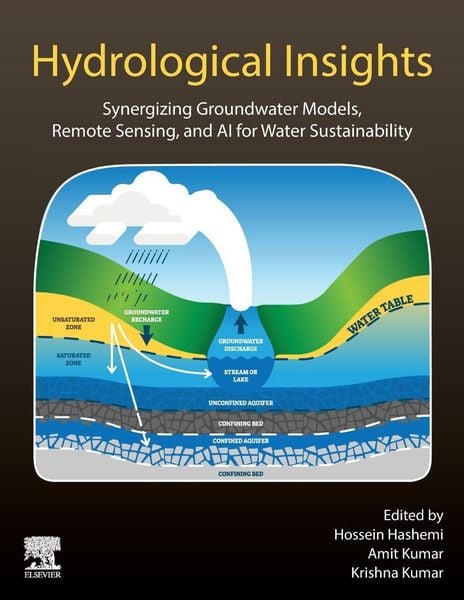
Produktbild: Hydrological Insights
- 13%

Hydrological Insights Synergizing Groundwater Models, Remote Sensing, and AI for Water Sustainability

13% sparen

145,99 € UVP 168,60 €

inkl. gesetzl. MwSt., Versandkostenfrei


Beschreibung

Produktdetails

Einband

Taschenbuch

Erscheinungsdatum

15.01.2026

Herausgeber

Amit Kumar + weitere

Verlag

Elsevier Science & Technology

Seitenzahl

296

Maße (L/B/H)

27,5/21,4/1,9 cm

Gewicht

812 g

Sprache

Englisch

ISBN

978-0-443-36394-8

Beschreibung

Portrait

Hossein Hashemi is an associate professor (universitetslektor) at the Department of Water Resources Engineering and Center for Advanced Middle Eastern Studies at Lund University. He obtained his Ph.D. in Water Resources Engineering, where he specialized in groundwater management, water harvesting techniques, and groundwater artificial recharge. These techniques are essential in ensuring the availability of water supply and reaching sustainable water resources use in arid regions. Before joining Lund University, he served as a research engineer at the Center for Agriculture and Natural Resources in Iran for several years.

After Ph.D., he worked as a postdoctoral scholar at the Center for Groundwater Evaluation and Management (GEM), Department of Geophysics at Stanford University, USA, between 2015 and 2017. During his time at Stanford, he focused on the application of remote sensing techniques in the field of hydrology and groundwater hydrology. This included studying various aspects such as precipitation, groundwater, and subsidence.

Hossein's research interests mainly revolve around remote sensing, artificial intelligence, climate change, and surface water and groundwater management.

Dr. Amit Kumar is a Professor of Hydrology and Water Resources at Nanjing University of Information Science and Technology. He obtained his M.Tech and PhD from the Indian Institute of Technology (IIT) Roorkee and conducted his postdoctoral research at Hohai University, China. Dr. Kumar's research spans the ecological health of aquatic habitats, water quality modeling, and water security practices to meet the Sustainable Development Goals. He has published five books, including Elsevier's Climate Change in the Himalayas, and is an advisory board member for the Elsevier journal Ecological Indicators.

Dr. Krishna Kumar (Member, IEEE) has more than 14 years of experience in Renewable Energy Development. He is presently a researcher at the Department of Water Resources Engineering and Center for Advanced Middle Eastern Studies at Lund University, Sweden. He holds a PhD in Renewable Energy. He worked as a postdoctoral research fellow at the School of Electrical and Electronics Engineering in the Rolls-Royce Corporate Lab, Nanyang Technological University, Singapore, from February 2023 to March 2024. Prior to that, he worked as a Senior Engineer at UJVN Ltd. (A State Government PSU of Uttarakhand (India)) from January 2013 to February 2023. His expertise includes the design, installation, commissioning, testing, and operation & maintenance of hydro, solar, and wind power plants. Dr. Kumar has also served as an Assistant Professor/Lecturer on the term appointment basis at Kumaon Engineering College, Dwarahat, Uttarakhand (India); Bharat Institute of Technology, Meerut (India); and Uttaranchal Institute of Technology, Dehradun (India), for more than three years. Dr. Kumar has published numerous highly cited SCI/SCIE research articles in reputed journals. He has also authored/edited 12 books with publishers such as Elsevier, Wiley, Taylor & Francis, Springer, and River Press. His current research interests include Renewable Energy, Multiphase Machines, Electrical Equipment Health Monitoring Systems, AI/ML, and data science.

Produktdetails

Einband

Taschenbuch

Erscheinungsdatum

15.01.2026

Herausgeber

Verlag

Elsevier Science & Technology

Seitenzahl

296

Maße (L/B/H)

27,5/21,4/1,9 cm

Gewicht

812 g

Sprache

Englisch

ISBN

978-0-443-36394-8

EU-Ansprechpartner

Zeitfracht Medien GmbH
Ferdinand-Jühlke-Straße 7
99095 Erfurt
DE
produktsicherheit@zeitfracht.de

Herstelleradresse

Elsevier Science & Technology
London Wall 125
EC2Y 5AS London
GB
tradeorders@elsevier.com

Noch keine Bewertungen vorhanden

Verfassen Sie die erste Bewertung zu diesem Artikel

Helfen Sie anderen Kundinnen und Kunden durch Ihre Meinung.

Kundinnen und Kunden meinen

Bewertungen (0)

  • Produktbild: Hydrological Insights
  • Part I: Foundations of Hydrological Modeling
    1. Introduction to Data-Driven Groundwater Modeling: Methods, Applications & Challenges
    2. InSAR-Based Estimation of Head and Storage Changes: Numerical Models and Data Driven Techniques
    3. Surfacewater Flow as a Mitigation Measure for Land Subsidence Mitigation in Rural and Urban Areas
    4. Hydro-Meteorological Droughts: Patterns, Trends, and the Role of Accumulation Periods on Groundwater Condition

    Part II: Advanced Techniques in Hydrological Studies
    5. Automated Hydrological Variable Estimation: Novel Approaches and Optimization Algorithms
    6. Spatiotemporal Variability of Hydrometeorological Parametrs: Insights from River Basin Analysis
    7. Monitoring Carbon Exchange in Wetlands and Peatlands Using InSAR-Based Methods
    8. Impact of Drinking and Sanitary Water Separation on Drinking Water Quality: Groundwater Quality Mapping

    Part III: Integration of Remote Sensing and Artificial Intelligence in Hydrology
    9. InSAR-AI-Based Approach for Groundwater Level Prediction in Arid Regions
    10. Spatiotemporal Variation of Environmental Hazards: Remote Sensing and AI Applications
    11. Detecting Changes in Global Satellite-Based Hydrological Observations using AI Techniques
    12. Satellite Monitoring of Infrastructure using Interferometric Synthetic Aperture Radar (InSAR)

    Part IV: Environmental Impact Assessment and Management Strategies
    13. Quantitative and Qualitative Assessment of Streamflow Variation: Climate vs. Human Impact
    14. Assessing Contaminated Groundwater Sites in Industrial Areas with Limited Data Availability
    15. Flood Spreading Project Suitability Mapping: Water Resources Management using Machine Learning Algorithms

    Part V: Advances in Remote Sensing and Machine Learning
    16. Advanced Machine Learning Algorithms for Assessing Groundwater Potential using Remote Sensing-Derived Data
    17. Extreme Gradient Boosting and Random Forest Algorithms for Assessing Groundwater Spring Potential using DEM-Derived Factors
    18. Remote Sensing Techniques and Machine Learning Algorithms in Groundwater Vulnerability Mapping

    Part VI: Case Studies and Future Directions
    19. Evaluation of Weather Radar Systems for Operational Use in Hydrological Studies
    20. Towards Intelligent Assessment of Groundwater Resources: Trends, Challenges, and Future Directions