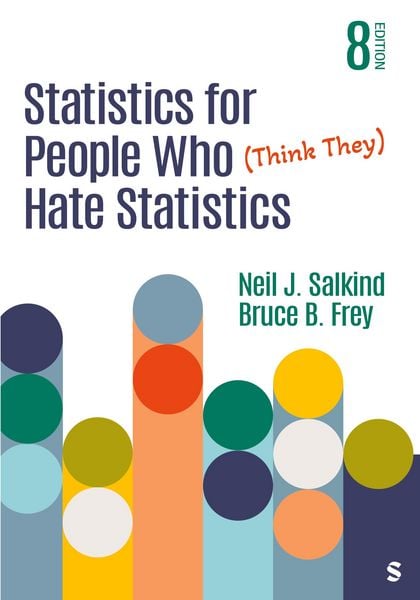
Produktbild: Statistics for People Who (Think They) Hate Statistics

Statistics for People Who (Think They) Hate Statistics

58,99 €

inkl. gesetzl. MwSt., Versandkostenfrei


Beschreibung

Produktdetails

Einband

Taschenbuch

Erscheinungsdatum

28.08.2025

Verlag

Sage Publications

Seitenzahl

374

Maße (L/B/H)

25,4/17,8/2,1 cm

Gewicht

703 g

Auflage

8. Auflage

Sprache

Englisch

ISBN

978-1-07-185550-8

Beschreibung

Produktdetails

Einband

Taschenbuch

Erscheinungsdatum

28.08.2025

Verlag

Sage Publications

Seitenzahl

374

Maße (L/B/H)

25,4/17,8/2,1 cm

Gewicht

703 g

Auflage

8. Auflage

Sprache

Englisch

ISBN

978-1-07-185550-8

Herstelleradresse


Email: info@bod.de

Noch keine Bewertungen vorhanden

Verfassen Sie die erste Bewertung zu diesem Artikel

Helfen Sie anderen Kundinnen und Kunden durch Ihre Meinung.

Kundinnen und Kunden meinen

Bewertungen (0)

  • Produktbild: Statistics for People Who (Think They) Hate Statistics
  • A Note to the Student
    Acknowledgments
    And Now, About the Eighth Edition ...
    Sage Vantage Features
    About the Authors
    Part I: Yippee! I'm in Statistics
    Chapter 1: Statistics or Sadistics? It's Up to You
    Why Statistics?
    Descriptive Statistics and Averages
    Computing the Mean
    Computing the Median
    Computing the Mode
    Summary
    Key Terms
    Activities
    Review Questions
    Critical Thinking Questions
    Chapter 2: What Do Your Data Look Like? Summarizing and Picturing Distributions
    How Much Information Is in Your Variable?
    Vive la Différence! Understanding Variability
    The Standard Deviation
    Using SPSS to Compute Descriptive Statistics
    Shaping Things Up
    Using the Computer (SPSS, That Is) to Illustrate Data
    Summary
    Key Terms
    Activities
    Review Questions
    Critical Thinking Questions
    Chapter 3: Computing Correlation Coefficients: Ice Cream and Crime
    How's Your Relationship?
    Computing a Pearson Correlation Coefficient
    What's It All Mean?
    Ice Cream Causes Crime (Association vs. Causation)
    Using SPSS to Compute a Correlation Coefficient
    Other Cool Correlations
    Parting Ways: A Bit About Partial Correlations
    Summary
    Key Terms
    Activities
    Review Questions
    Critical Thinking Questions
    Chapter 4: Reliability and Validity: Tell the Truth, Precisely the Truth
    Reliability: Getting It Right the First Time
    Different Types of Reliability
    Internal Consistency Reliability: To One's Own Self Be True
    Interrater Reliability: Agreeing Not to Disagree
    How Big Is Big? Interpreting Reliability Coefficients
    Validity: What's the Meaning of Life!?
    Validity and Reliability: Really Close Cousins
    Summary
    Key Terms
    Activities
    Review Questions
    Critical Thinking Questions
    Part II: Taking Chances for Fun and Profit
    Chapter 5: The Normal Curve: It¿s Shaped Like a Bell and It¿s Everywhere!
    Distributions and Probabilities
    Area Codes: Areas Under the Normal Curve
    The Amazing Super-Informative z Score
    Using SPSS to Compute z Scores
    Fat and Skinny Frequency Distributions
    Summary
    Key Terms
    Activities
    Review Questions
    Critical Thinking Questions
    Chapter 6: Hypotheticals and You: Making Guesses
    Samples and Populations
    The Null Hypothesis
    The Research Hypothesis
    What Makes a Good Research Hypothesis?
    Summary
    Key Terms
    Activities
    Review Questions
    Critical Thinking Questions
    Chapter 7: Significance: Not Everything That Can Be Counted Counts
    The Concept of Significance
    Significance Versus Meaningfulness
    An Introduction to Inferential Statistics
    An Introduction to Tests of Significance
    Be Even More Confident
    Summary
    Key Terms
    Activities
    Review Questions
    Critical Thinking Questions
    Part III: Significantly Different: Using Inferential Statistics
    Chapter 8: Single Samples: One Group All Alone
    Introduction to the Single-Sample z Test
    Computing the z Test Statistic
    Using SPSS to Perform a z Test t Test
    Special Effects: Do They Matter?
    Summary
    Key Terms
    Activities
    Review Questions
    Critical Thinking Questions
    Chapter 9: t(ea) for Two: Comparing Two Means
    The Classic Group Comparison: Independent t Test
    The Effect Size for a Two-Group Comparison
    Using SPSS to Perform an Independent t Test
    Using SPSS to Perform a Paired-Samples t Test
    Summary
    Key Terms
    Activities
    Review Questions
    Critical Thinking Questions
    Chapter 10: More Than Two Groups?: Analysis of Variance to the Rescue
    Different Flavors of Analysis of Variance
    Computing the F Test Statistic
    Using SPSS to Compute the F Ratio
    The Effect Size for One-Way ANOVA
    Summary
    Key Terms
    Activities
    Review Questions
    Critical Thinking Questions
    Chapter 11: Two (or More) ANOVAs in One: Factorial Analysis of Variance
    Factorial Analysis of Variance
    A New Flavor of ANOVA
    The Main Event: Main Effects in Factorial ANOVA
    Even More Interesting: Interaction Effects
    Using SPSS to Conduct a Factorial Analysis of Variance
    Computing the Effect Size for Factorial ANOVA
    Summary
    Key Terms
    Activities
    Review Questions
    Critical Thinking Questions
    Chapter 12: Correlation Coefficients and Regression: Can You Relate?
    Remember the Correlation Coefficient?
    Computing the Test Statistic
    Linear Regression
    Drawing the World's Best Line (for Your Data)
    How Good Is Your Prediction?
    Using SPSS to Compute the Regression Line
    Multiple Regression: The More Predictors the Better? Maybe
    Summary
    Key Terms
    Activities
    Review Questions
    Critical Thinking Questions
    Part IV: More Statistics! More Tools! More Fun!
    Chapter 13: Chi-Square and Some Other Nonparametric Tests: What to Do When Yoüre Not Normal
    Introduction to Nonparametric Statistics
    Introduction to the Goodness-of-Fit (One-Sample) Chi-Square
    Computing the Goodness-of-Fit Chi-Square Test Statistic
    Introduction to the Chi-Square Test of Independence
    Using SPSS to Perform Chi-Square Tests
    Other Nonparametric Tests You Should Know About
    Summary
    Key Terms
    Activities
    Review Questions
    Critical Thinking Questions
    Chapter 14: Some Other (Important) Statistical Stuff You Should Know About
    Sophisticated Group Comparisons
    Sophisticated Correlational Analyses
    It's Not about What Data is Mine, it's about What Data is Mined
    Using Chatbots for Statistical Analyses
    Summary
    Key Terms
    Appendices: Information Never Ends!
    Appendix A: SPSS Statistics in Less Than 30 Minutes
    Appendix B: Tables
    Appendix C: Data Sets
    Appendix D: Answers to Practice Questions
    Appendix E: Math: Just the Basics
    Appendix F: The 10 Commandments of Data Collection
    Appendix G: The Reward
    Glossary