Gutscheinbedingungen

**Gültig bis 06.07.2026 auf fremdsprachige Bücher online auf thalia.at, in der Thalia App ab einem Mindestbestellwert von 30€ und in allen Thalia Buchhandlungen in Österreich. In den Buchhandlungen nur gültig auf lagernde Ware. Einzelne Artikel können ausgeschlossen sein. Ausgenommen sind preisgebundene Artikel & eBooks. Pro Einkauf einmal einlösbar. Nur gültig gegen Vorlage oder im Onlineshop hinterlegter Bonuscard. Infos zur Einlösung in der Buchhandlung sind auf der Bonuscard-Vorteilspreisseite zu finden. Click & Collect nur bei Onlinevorabzahlung möglich. Keine Einlösung bei Scan & Go-Bezahlung. Keine Barauszahlung. Nicht kombinierbar mit anderen Aktionen und Gutscheinen. Gutschein wird auf max. 500€ Bestellwert angerechnet. Nicht gültig für Versandkosten und Services.

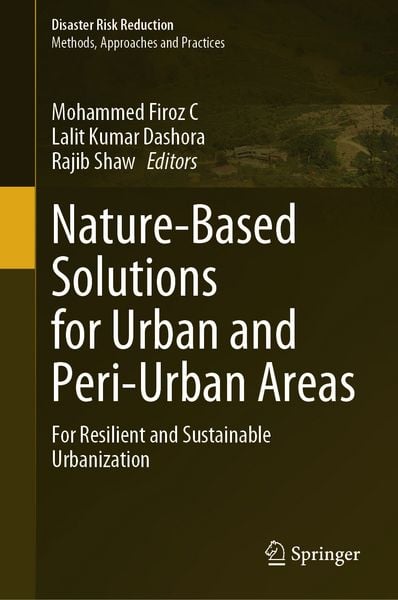
Produktbild: Nature-Based Solutions for Urban and Peri-Urban Areas
- 10%

Nature-Based Solutions for Urban and Peri-Urban Areas For Resilient and Sustainable Urbanization

Aus der Reihe Disaster Risk Reduction
10% sparen

137,99 € UVP 153,99 €

inkl. gesetzl. MwSt., Versandkostenfrei


Beschreibung

Produktdetails

Einband

Gebundene Ausgabe

Erscheinungsdatum

23.07.2025

Abbildungen

XVI, 77 illus., 69 illus. in color., farbige Illustrationen, schwarz-weiss Illustrationen

Herausgeber

Mohammed Firoz C. + weitere

Verlag

Springer Singapore

Seitenzahl

326

Maße (L/B/H)

24,1/16/2,5 cm

Gewicht

680 g

Auflage

1. Auflage

Sprache

Englisch

ISBN

978-981-9659-32-6

Beschreibung

Portrait

Dr. Mohammed Firoz currently serves as the head of the Department of Architecture and Planning as well as Chair the Centre for Climate Resilience and Disaster Management, at the National Institute of Technology (NIT) Calicut, India. Earlier, he served as a visiting faculty at the Asian Institute of Technology in Bangkok, Thailand, and the Architectural Association School of Architecture (AA), London. Dr. Firoz was awarded his Ph.D. degree from the Indian Institute of Technology (IIT) Kharagpur. He has an academic experience of 20 years and has taught undergraduate, postgraduate, and PhD students at the NIT Calicut along with his research and publication activities, consultancy and university services. He has published widely in journals and book chapters besides editing three books He is an editorial board member of 3 reputed journals including Area Development and Policy (Taylor and Francis), Social Impacts (Elsevier), and Humanities and Social Science Communications (Springer Nature). 

Lalit Kumar Dashora is an Urban Risk and Resilience Specialist, currently based at the School of Global Studies, Thammasat University, Bangkok, Thailand. Prior to joining SGS at TU, he worked with Asian Disaster Preparedness Center (ADPC) in Bangkok, Thailand, and the Asian Development Bank (ADB) in Dushanbe, Tajikistan. He holds a Master’s degree in Geo-Information Science for Earth Observation, Environmental Modelling & Management from the Faculty of Geo-Information Science and Earth Observation (formerly known as ITC), University of Twente, The Netherlands, and in Urban & Regional Planning from the School of Planning, CEPT University, India. His research interests focus on risk-informed, climate-compatible urban planning and development in developing countries, Small Island Developing States (SIDS), and other climate-fragile regions in Asia and the Pacific.  He is also Adviser for the Warning Research Center (WRC) of University College of London (UCL).

Professor Rajib Shaw is a professor in the Graduate School of Media and Governance in Keio University, Japan. He is also a senior fellow of the Institute of Global Environmental Strategies (IGES) Japan and the chairperson of the Sustainable Environment and Ecological Development Society (SEEDS) Asia and the Church World Service (CWS) Japan, two Japanese NGOs. He is a co-founder of a Delhi (India)-based social entrepreneur startup, the Resilience Innovation Knowledge Academy (RIKA). Earlier, he was the executive director of the Integrated Research on Disaster Risk (IRDR) and was a professor at Kyoto University. His expertise includes disaster governance, community-based disaster risk management, climate change adaptation, urban risk management, and disaster and environmental education. Professor Shaw was the chair of the United Nations Science Technology Advisory Group (STAG) for disaster risk reduction and currently is the co-chair of the Asia Pacific Science Technology Academic Advisory Group (APSTAAG).

Produktdetails

Einband

Gebundene Ausgabe

Erscheinungsdatum

23.07.2025

Abbildungen

XVI, 77 illus., 69 illus. in color., farbige Illustrationen, schwarz-weiss Illustrationen

Herausgeber

Verlag

Springer Singapore

Seitenzahl

326

Maße (L/B/H)

24,1/16/2,5 cm

Gewicht

680 g

Auflage

1. Auflage

Sprache

Englisch

ISBN

978-981-9659-32-6

Herstelleradresse

Springer-Verlag KG
Sachsenplatz 4-6
1201 Wien
AT

Email: GPSR Kontakt

Noch keine Bewertungen vorhanden

Verfassen Sie die erste Bewertung zu diesem Artikel

Helfen Sie anderen Kundinnen und Kunden durch Ihre Meinung.

Kundinnen und Kunden meinen

Bewertungen (0)

  • Produktbild: Nature-Based Solutions for Urban and Peri-Urban Areas
  • Chapter 1. Nature based Solutions for Urban and Peri-Urban Areas for a sustainable and resilient future: An Introduction.- Chapter 2. Nature-based Solutions (NbSs) as Spatial Planning Strategy to Mitigate Urban Heat Island (UHI) Effect: A case of Nagpur city, India.- Chapter 3. Urban Heat Island and its implication for cities.- Chapter 4. Nature-Based Solutions and Planning Strategies for Optimizing Peri-Urban Open Spaces in Varanasi.- Chapter 5. Perspectives on convergence of NbS and agile city principles in tier II industrial cities of India.- Chapter 6. Urban Climate Shelters: A nature-based solution for urban resilience.- Chapter 7. Vertical Gardens in Public Open Spaces - Nature-based Solutions for Sustainable Urbanization in Belgrade City, Serbia.- Chapter 8. Planning Nature-based-Solutions (NbS) through rainfall-runoff Simulations for Slums of Developing Countries: A Case of Nagpur, India.- Chapter 9. Quantifying the Cooling Potential of Nature-based Solutions to Mitigate the Urban Heat Island: A Case Study of the City of Bhopal.- Chapter 10. Comprehending drought mitigation probabilities through integrated techniques of using NbS and traditional disaster risk management.- Chapter 11. Urban Flood Prevention Through Community-Centered Green Stormwater Infrastructure Planning.- Chapter 12. Shifting Sands and Rising Seas: An Exploratory Study of Community-Centric Nature-Based Solutions for Coastal Hazards and Coastal Erosion in Alappad, Kerala, India.- Chapter 13. Exploring the impact of place attachment on residents’ preferences for implementing NbS in urban areas:  A Case of Using Stormwater Recycled through MAR in Taiyuan, China.- Chapter 14. Policy, frameworks and tools for risk-informed uptake of NbS.- Chapter 15. Using the Key Player Approach to Design and Manage Adaptive Urban Governance for Nature-Based Solutions Implementation: Study of Vienna and Tucson.- Chapter 16. Drivers of Successful Implementation of Nature-Based Solutions Initiatives: Challenges and Policy Recommendations.