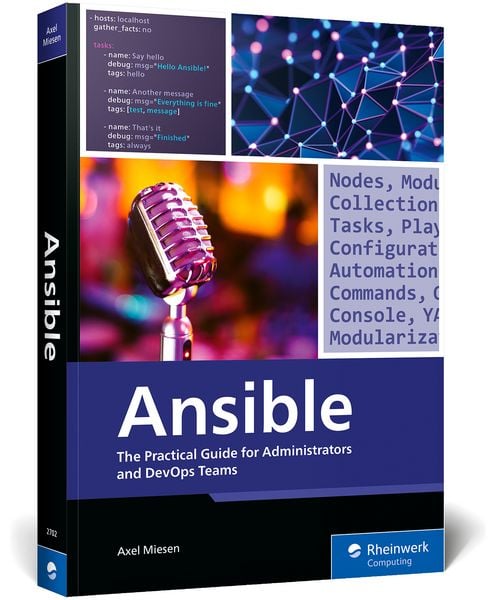
Produktbild: Ansible

Ansible The Practical Guide for Administrators and DevOps Teams

61,70 €

inkl. gesetzl. MwSt., Versandkostenfrei


Beschreibung

Produktdetails

Einband

Taschenbuch

Erscheinungsdatum

08.07.2025

Verlag

Rheinwerk Publishing

Seitenzahl

474

Maße (L/B/H)

25,3/17,9/2,6 cm

Gewicht

850 g

Auflage

1

Sprache

Englisch

ISBN

978-1-4932-2702-0

Beschreibung

Produktdetails

Einband

Taschenbuch

Erscheinungsdatum

08.07.2025

Verlag

Rheinwerk Publishing

Seitenzahl

474

Maße (L/B/H)

25,3/17,9/2,6 cm

Gewicht

850 g

Auflage

1

Sprache

Englisch

ISBN

978-1-4932-2702-0

Herstelleradresse

Rheinwerk Verlag GmbH
Rheinwerkallee 4
53227 Bonn
DE

Email: service@rheinwerk-verlag.de

Noch keine Bewertungen vorhanden

Verfassen Sie die erste Bewertung zu diesem Artikel

Helfen Sie anderen Kundinnen und Kunden durch Ihre Meinung.

Kundinnen und Kunden meinen

Bewertungen (0)

  • Produktbild: Ansible

  • ... Preface ... 21


    ... About This Book ... 23


    ... Formatting ... 23


    ... Ansible Versions ... 25


    ... Platforms and Linux Distributions ... 25


    1 ... Introduction and Installation ... 27


    1.1 ... What Is Ansible? ... 27


    1.2 ... What Is Ansible Not? ... 29


    1.3 ... History and Versions ... 30


    1.4 ... Setup/Lab Environment ... 31


    1.5 ... Ansible Installation on the Control Host ... 36


    1.6 ... Installation via PIP (plus virtualenv) ... 38


    1.7 ... Authentication and Authorization on Target Hosts ... 39


    1.8 ... Setting Up SSH Public Key Authentication ... 41


    1.9 ... An Ad Hoc Test without Any Configuration ... 42


    1.10 ... Another Note on Migrating from Older Versions ... 43


    2 ... Basic Setup and Initial Inventory Management ... 45


    2.1 ... Setting Up the Directory Structure ... 45


    2.2 ... Basic Configuration (ansible.cfg) ... 46


    2.3 ... Creating and Managing a Static Inventory ... 48


    2.4 ... Configuration Settings versus Parameters versus …? ... 50


    2.5 ... Inventory Aliases and Namespaces ... 51


    2.6 ... Beyond Ping ... 53


    2.7 ... A Somewhat More Complex Example ... 55


    2.8 ... Alternative or Multiple Inventories ... 56


    3 ... Ad Hoc Commands and Patterns ... 59


    3.1 ... Ad Hoc Commands ... 59


    3.2 ... Use Cases Beyond “command” and “shell” ... 61


    3.3 ... Idempotency ... 61


    3.4 ... Internal Workings ... 63


    3.5 ... The Ansible Console ... 66


    3.6 ... Patterns for Addressing Hosts ... 67


    4 ... YAML: The Configuration and Serialization Language ... 69


    4.1 ... Syntax and Structure ... 69


    4.2 ... Editing YAML Files ... 70


    4.3 ... Syntactic Checks ... 72


    4.4 ... Lists and Maps ... 73


    4.5 ... Nested Structures ... 73


    4.6 ... Text Passages and Block Expressions ... 75


    4.7 ... Nothingness in YAML ... 76


    4.8 ... Anchors and References ... 77


    5 ... Playbooks and Tasks: The Basics ... 79


    5.1 ... Hello Ansible: The Very First Playbook ... 79


    5.2 ... Formulation of Tasks ... 83


    5.3 ... Ending Plays ... 85


    5.4 ... The Problematic Colon ... 85


    5.5 ... Error Handling and Retrying Files ... 86


    5.6 ... Tags ... 88


    5.7 ... The “ansible-playbook” Command ... 90


    5.8 ... An Example of an Apache Installation ... 91


    5.9 ... Handler: Executing Tasks Only on Changes ... 95


    6 ... Playbooks and Tasks: Advanced Methods ... 103


    6.1 ... Variables ... 103


    6.2 ... Registered Variables ... 112


    6.3 ... Facts and Implicit Variables ... 115


    6.4 ... Conditional Execution with “when” ... 121


    6.5 ... Handling System Differences: What’s the Deal Now? ... 122


    6.6 ... Jinja and Templates ... 131


    6.7 ... Variable Tests ... 141


    6.8 ... Lookup Plug-ins ... 143


    6.9 ... Loops ... 145


    6.10 ... Error Handling with “failed_when” and “ignore_errors” ... 158


    6.11 ... Blocks ... 159


    6.12 ... Timeouts and Asynchronous Execution ... 161


    6.13 ... Local Tasks ... 163


    6.14 ... Environment Variables ... 166


    7 ... Using Modules and Collections ... 169


    7.1 ... Collections ... 169


    7.2 ... Module ... 173


    7.3 ... Modules for Command Execution ... 174


    7.4 ... Modules for Package Management ... 175


    7.5 ... Modules for Managing Files and File Contents ... 177


    7.6 ... Modules for Other Typical Administrative Tasks ... 182


    7.7 ... Modules for Interacting with Network Services ... 185


    7.8 ... Special Modules (Control Flow Management, Etc.) ... 186


    8 ... Modularization with Roles and Includes ... 191


    8.1 ... Creating and Using Roles ... 191


    8.2 ... The Online Ansible Galaxy Repository ... 198


    8.3 ... Using Imports and Includes ... 198


    8.4 ... Apache Once Again ... 202


    8.5 ... Documentation (and Conventions) ... 206


    8.6 ... Reusing Roles ... 209


    9 ... Web Interfaces: AWX and More ... 213


    9.1 ... Installation of Python Packages on Current Debian and Ubuntu Systems ... 213


    9.2 ... Ansible Configuration Management Database (“ansible-cmdb”) ... 214


    9.3 ... Preparations for Operating More Demanding Applications ... 216


    9.4 ... The Gitea Git Server ... 219


    9.5 ... AWX ... 223


    9.6 ... ARA ... 229


    9.7 ... Other Applications Not Considered in Detail Here ... 230


    9.8 ... Terminating or Deleting Applications That Are No Longer Needed ... 233


    10 ... Additional Tools and Techniques ... 235


    10.1 ... Ansible Vault ... 235


    10.2 ... Debugging and Troubleshooting ... 244


    10.3 ... Accelerating Playbooks with Pipelining ... 257


    10.4 ... The Talking Cow ... 258


    10.5 ... Ansible in Pull Mode ... 259


    11 ... Ansible and Docker ... 265


    11.1 ... Installing Docker ... 265


    11.2 ... Docker Modules ... 267


    11.3 ... An Example Application ... 274


    11.4 ... Ansible and Docker Compose ... 278


    11.5 ... The “docker” Connection Plug-in ... 282


    11.6 ... Creating Images ... 283


    12 ... Inventory Management: Advanced Methods ... 289


    12.1 ... The “ansible-inventory” Command ... 289


    12.2 ... Nested Groups ... 290


    12.3 ... Static Inventories in YAML format ... 291


    12.4 ... Creating on-the-Fly Inventories with “add_host” ... 293


    12.5 ... Dynamic Groups with “group_by” ... 295


    12.6 ... Dynamic and External Inventories ... 298


    13 ... Ansible and the Cloud ... 303


    13.1 ... Version Issues and virtualenv ... 304


    13.2 ... Where to Store Keys, Tokens, Secrets, Etc. ... 304


    13.3 ... Hetzner Cloud ... 305


    13.4 ... Amazon Web Services Elastic Compute Cloud ... 311


    13.5 ... Proxmox Virtual Environment ... 318


    14 ... Ansible as an Orchestration Tool ... 325


    14.1 ... Many Target Hosts for Testing ... 325


    14.2 ... Altering the Sequence of Execution ... 326


    14.3 ... Delegation ... 335


    15 ... Ansible and Windows ... 339


    15.1 ... A Control Host Based on Windows ... 339


    15.2 ... Windows Targets and Windows Remote Management ... 343


    15.3 ... Preparations on the Control Host ... 343


    15.4 ... Prerequisites on the Windows Side and Windows Remote Management Setup ... 344


    15.5 ... Windows Remote Management Troubleshooting ... 345


    15.6 ... Setup with an Active Directory and Kerberos ... 346


    15.7 ... Windows Modules ... 348


    16 ... Callback Plug-ins ... 351


    16.1 ... Stdout Callback Plug-ins ... 351


    16.2 ... Aggregate and Notification Callback Plug-ins ... 353


    17 ... Creating Your Own Collections and Modules ... 355


    17.1 ... Namespaces, Names, and Setting Up a Collection Project ... 355


    17.2 ... Playbooks in Collections ... 357


    17.3 ... Roles in Collections ... 358


    17.4 ... Modules in Collections ... 359


    17.5 ... Plug-ins in Collections ... 371


    17.6 ... Deploying and Installing Collections ... 373


    18 ... Developing and Testing with Molecule ... 377


    18.1 ... Preparations and Setup ... 377


    18.2 ... Getting Started ... 379


    18.3 ... Develop ... 380


    18.4 ... Testing with the Ansible Verifier ... 383


    18.5 ... Testing with the Testinfra Verifier ... 385


    18.6 ... The Complete Test Cycle ... 386


    18.7 ... Outlook and Conclusion ... 387


    19 ... Recipes, How-Tos, and Best Practices ... 389


    19.1 ... New Projects ... 389


    19.2 ... Administration ... 391


    19.3 ... Jinja Magic ... 401


    19.4 ... Tasks and Control Flow ... 408


    19.5 ... Miscellaneous ... 415


    20 ... What Could Be Better, and What Is Still Missing? ... 421


    20.1 ... Tracking Long-Running Tasks ... 421


    20.2 ... Finishing the Processing of a Role ... 422


    20.3 ... Loops over Blocks ... 424


    20.4 ... Locking with Concurrent Playbook Calls ... 425


    20.5 ... Conclusion ... 426


    ... Appendices ... 427


    A ... Project-Specific Environment Variables with “direnv” ... 429


    B ... The “pass” Password Manager ... 433


    C ... Secure Shell ... 437


    D ... Regular Expressions ... 455


    E ... “vim” and “nano” Tips and Tricks ... 463


    ... The Author ... 467


    ... Index ... 469