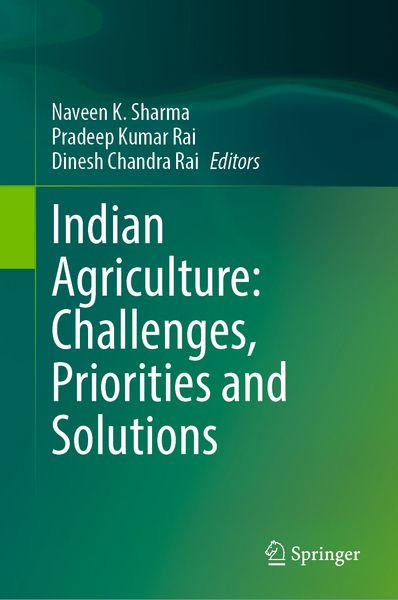
Indian Agriculture: Challenges, Priorities and Solutions
-
- Hardcover ausgewählt
- Taschenbuch
- eBook
-
Sprache:Englisch
166,99 €
UVP
186,99 €
inkl. gesetzl. MwSt.,
Beschreibung
Produktdetails
Einband
Gebundene Ausgabe
Erscheinungsdatum
14.05.2025
Abbildungen
XXVIII, 336 p. 54 illus., 43 illus. in color.
Herausgeber
Naveen K. Sharma + weitereVerlag
Springer SingaporeSeitenzahl
336
Maße (L/B/H)
24,1/16/2,6 cm
Gewicht
709 g
Auflage
1. Auflage
Sprache
Englisch
ISBN
978-981-9652-72-3
This edited volume examines the challenges and solutions in the intricate landscape of Indian agriculture and global trade. It explores the historical shifts from an industry-driven to agrarian economy, followed by rapid urbanization in the latter half of the 20th century.
Modern agri-business is a global phenomenon not only affected by local and regional factors but also by global policies directed by global agencies. This book focuses on problems commonly associated with the advancement of agriculture in India, as well as issues arising out of global agricultural trade. The book contains chapters on associated problems, some priority issues, and approaches that could be used to overcome these limitations. Focused on rural India, the book underscores the critical role of agriculture, contributing a major part to the national income. The book highlights the economic opportunities arising from agriculture, emphasizing the need for sustainable practices given ecological, cultural, and socio-economic impacts. Addressing the complexities, the book advocates for diversification, adaptive varieties, and technological integration, including biotechnology and information technologies, to ensure the sustainability of agriculture. It also stresses the urgency of coherent national policies for soil and water resource use, marketing, business management, climate impacts, and more. It outlines key interventions and frameworks designed to guide actions on food security and nutrition, making a case for India's crucial role in global food production and supply chain systems.
The book has been written and edited by leading researchers of the respective fields. It is a useful resource for students, researchers, academicians as well as farmers and policymakers.
Noch keine Bewertungen vorhanden
Verfassen Sie die erste Bewertung zu diesem Artikel
Helfen Sie anderen Kundinnen und Kunden durch Ihre Meinung.
Kurze Frage zu unserer Seite
Vielen Dank für Ihr Feedback
Wir nutzen Ihr Feedback, um unsere Produktseiten zu verbessern. Bitte haben Sie Verständnis, dass wir Ihnen keine Rückmeldung geben können. Falls Sie Kontakt mit uns aufnehmen möchten, können Sie sich aber gerne an unseren Kund*innenservice wenden.
zum Kundenservice