
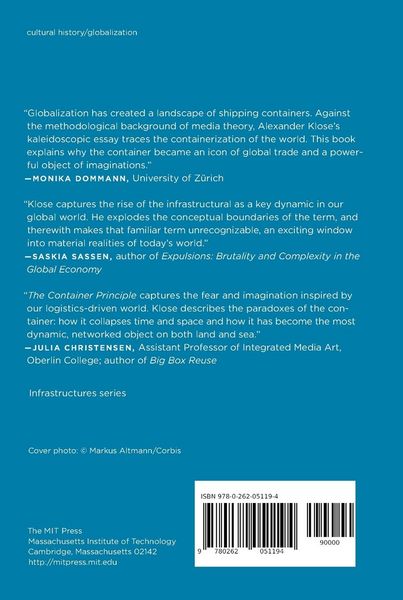
The Container Principle How a Box Changes the Way We Think
-
- Englisch ausgewählt
33,99 €
inkl. gesetzl. MwSt.,
Beschreibung
Produktdetails
Einband
Taschenbuch
Erscheinungsdatum
18.03.2025
Verlag
University PressesSeitenzahl
412
Maße (L/B/H)
20,3/13,7/2,5 cm
Gewicht
532 g
Sprache
Englisch
ISBN
978-0-262-05119-4
A cultural history of the shipping container as a crucible of globalization and a cultural paradigm.
We live in a world organized around the container. Standardized twenty- and forty-foot shipping containers carry material goods across oceans and over land; provide shelter, office space, and storage capacity; inspire films, novels, metaphors, and paradigms. Today, TEU (Twenty Foot Equivalent Unit, the official measurement for shipping containers) has become something like a global currency. A container ship, sailing under the flag of one country but owned by a corporation headquartered in another, carrying auto parts from Japan, frozen fish from Vietnam, and rubber ducks from China, offers a vivid representation of the increasing, world-is-flat globalization of the international economy. InThe Container Principle, Alexander Klose investigates the principle of the container and its effect on the way we live and think. Klose explores a series of "container situations" in their historical, political, and cultural contexts. He examines the container as a time capsule, sometimes breaking loose and washing up onshore to display an inventory of artifacts of our culture. He explains the "Matryoshka principle," explores the history of land-water transport, and charts the three phases of container history. He examines the rise of logistics, the containerization of computing in the form of modularization and standardization, the architecture of container-like housing (citing both Le Corbusier and Malvina Reynolds's "Little Boxes"), and a range of artistic projects inspired by containers. Containerization, spreading from physical storage to organizational metaphors, Klose argues, signals a change in the fundamental order of thinking and things. It has become a principle.
Noch keine Bewertungen vorhanden
Verfassen Sie die erste Bewertung zu diesem Artikel
Helfen Sie anderen Kundinnen und Kunden durch Ihre Meinung.
Kurze Frage zu unserer Seite
Vielen Dank für Ihr Feedback
Wir nutzen Ihr Feedback, um unsere Produktseiten zu verbessern. Bitte haben Sie Verständnis, dass wir Ihnen keine Rückmeldung geben können. Falls Sie Kontakt mit uns aufnehmen möchten, können Sie sich aber gerne an unseren Kund*innenservice wenden.
zum Kundenservice