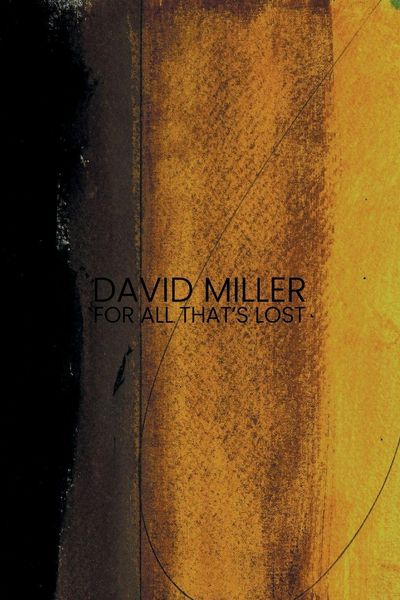
For All That's Lost
-
- Englisch ausgewählt
26,99 €
inkl. gesetzl. MwSt.,
- Kostenlose Lieferung ab 30 € Einkaufswert
- Versandkostenfrei für Bonuscard-Kund*innen
Beschreibung
Produktdetails
Einband
Taschenbuch
Erscheinungsdatum
21.03.2025
Verlag
Knives Forks and SpoonsSeitenzahl
66
Maße (L/B/H)
22,9/15,2/0,5 cm
Gewicht
157 g
Sprache
Englisch
ISBN
978-1-916590-12-0
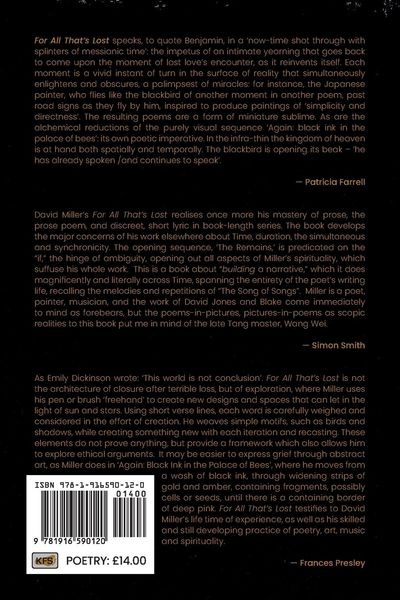
David Miller's For All That's Lost realises once more his mastery of prose, the prose poem, and discreet, short lyric in book-length series. The book develops the major concerns of his work elsewhere about Time, duration, the simultaneous and synchronicity. The opening sequence, 'The Remains,' is predicated on the "if," the hinge of ambiguity, opening out all aspects of Miller's spirituality, which suffuse his whole work. This is a book about "building a narrative," which it does magnificently and literally across Time, spanning the entirety of the poet's writing life, recalling the melodies and repetitions of "The Song of Songs". Miller is a poet, painter, musician, and the work of David Jones and Blake come immediately to mind as forebears, but the poems-in-pictures, pictures-in-poems as scopic realities to this book put me in mind of the late Tang master, Wang Wei. Simon Smith For all that's lost speaks, to quote Benjamin, in a 'now-time shot through with splinters of messianic time': the impetus of an intimate yearning that goes back to come upon the moment of lost love's encounter, as it reinvents itself. Each moment is a vivid instant of turn in the surface of reality that simultaneously enlightens and obscures, a palimpsest of miracles: for instance, the Japanese painter, who flies like the blackbird of another moment in another poem, past road signs as they fly by him, inspired to produce paintings of 'simplicity and directness'. The resulting poems are a form of miniature sublime. As are the alchemical reductions of the purely visual sequence Again: black ink in the palace of bees: its own poetic imperative. In the infra-thin the kingdom of heaven is at hand both spatially and temporally. The blackbird is opening its beak - 'he has already spoken /and continues to speak'. Patricia Farrell
Noch keine Bewertungen vorhanden
Verfassen Sie die erste Bewertung zu diesem Artikel
Helfen Sie anderen Kundinnen und Kunden durch Ihre Meinung.
Kurze Frage zu unserer Seite
Vielen Dank für Ihr Feedback
Wir nutzen Ihr Feedback, um unsere Produktseiten zu verbessern. Bitte haben Sie Verständnis, dass wir Ihnen keine Rückmeldung geben können. Falls Sie Kontakt mit uns aufnehmen möchten, können Sie sich aber gerne an unseren Kund*innenservice wenden.
zum Kundenservice