KI-Beratung Beta

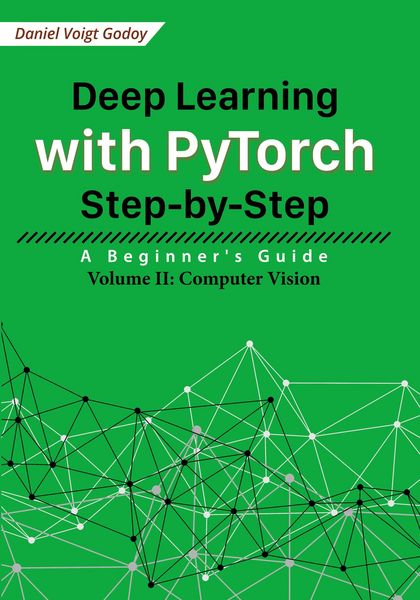
Produktbild: Deep Learning with PyTorch Step-by-Step: A Beginner's Guide - Volume II: Computer Vision

Deep Learning with PyTorch Step-by-Step: A Beginner's Guide - Volume II: Computer Vision

9,95 €

inkl. gesetzl. MwSt.

Beschreibung

Revised for PyTorch 2.x!

Why this book?

Are you looking for a book where you can learn about deep learning and PyTorch without having to spend hours deciphering cryptic text and code? A technical book that's also easy and enjoyable to read?

This is it!

How is this book different?

  • First, this book presents...

Beschreibung

Revised for PyTorch 2.x!

Why this book?

Are you looking for a book where you can learn about deep learning and PyTorch without having to spend hours deciphering cryptic text and code? A technical book that's also easy and enjoyable to read?

This is it!

How is this book different?

  • First, this book presents an easy-to-follow, structured, incremental, and from-first-principles approach to learning PyTorch.
  • Second, this is a rather informal book: It is written as if you, the reader, were having a conversation with Daniel, the author.
  • His job is to make you understand the topic well, so he avoids fancy mathematical notation as much as possible and spells everything out in plain English.

What will I learn?

In this second volume of the series, you'll be introduced to deeper models and activation functions, convolutional neural networks, initialization schemes, learning rate schedulers, transfer learning, and more.

By the time you finish this book, you'll have a thorough understanding of the concepts and tools necessary to start developing, training, and fine-tuning computer-vision models using PyTorch.

If your goal is to learn about deep learning models for computer vision, and you're already comfortable training simple models in PyTorch, the second volume is the right one for you.

What's Inside

  • Deep models, activation functions, and feature spaces
  • Torchvision, datasets, models, and transforms
  • Convolutional neural networks, dropout, and learning rate schedulers
  • Transfer learning and fine-tuning popular models (ResNet, Inception, etc.)

Produktdetails

Format

ePUB

Kopierschutz

Ja

Family Sharing

Ja

Text-to-Speech

Ja

Produktdetails

Format

ePUB

Format

eBooks im ePUB-Format erlauben eine dynamische Anpassung des Inhalts an die jeweilige Display-Größe des Lesegeräts. Das Format eignet sich daher besonders für das Lesen auf mobilen Geräten, wie z.B. Ihrem tolino, Tablets oder Smartphones.

Kopierschutz

Ja

Kopierschutz

Zum Lesen dieses eBooks auf Geräten der tolino Familie sowie auf sonstigen eReadern und am PC benötigen Sie eine Adobe ID. Weitere Hinweise zum Lesen von kopiergeschützten eBooks finden Sie unter Hilfe/Downloads.

Family Sharing

Ja

Family Sharing

Mit Family Sharing können Sie eBooks innerhalb Ihrer Familie (max. sechs Mitglieder im gleichen Haushalt) teilen. Sie entscheiden selbst, welches Buch Sie mit welchem Familienmitglied teilen möchten. Auch das parallele Lesen durch verschiedene Familienmitglieder ist durch Family Sharing möglich. Um eBooks zu teilen oder geteilt zu bekommen, muss jedes Familienmitglied ein Konto bei Thalia oder einem anderen tolino-Buchhändler haben. Weitere Informationen finden Sie unter Hilfe/Family-Sharing.

Text-to-Speech

Ja

Text-to-Speech

Bedeutet Ihnen Stimme mehr als Text? Mit der Funktion Text-to-Speech können Sie sich im tolino webReader und in der aktuellen Thalia – Lesen & Hören App das eBook vorlesen lassen. Weitere Informationen finden Sie unter Hilfe/Text-to-Speech.

Erscheinungsdatum

18.02.2025

Verlag Daniel Voigt Godoy
Seitenzahl

(Printausgabe)

Dateigröße

8939 KB

Sprache

Englisch

EAN

9798230653059

Barrierefreiheit
  • keine Information zur Barrierefreiheit bekannt

Noch keine Bewertungen vorhanden

Verfassen Sie die erste Bewertung zu diesem Artikel

Helfen Sie anderen Kundinnen und Kunden durch Ihre Meinung.

Kundinnen und Kunden meinen

Bewertungen (0)

Weitere Artikel finden Sie in

Die Leseprobe wird geladen.
  • Produktbild: Deep Learning with PyTorch Step-by-Step: A Beginner's Guide - Volume II: Computer Vision