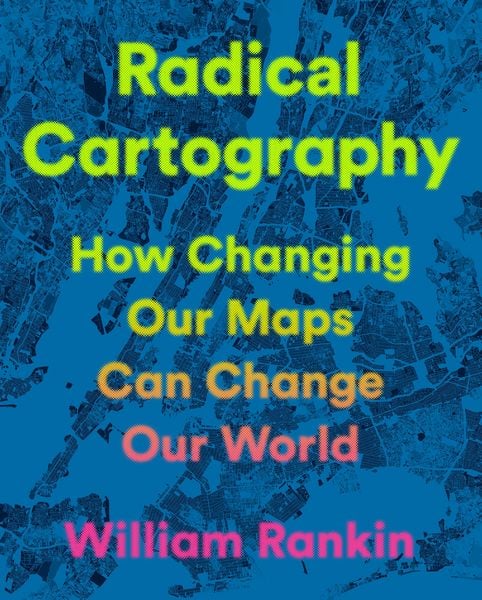
Radical Cartography How Changing Our Maps Can Change Our World
18,99 €
inkl. gesetzl. MwSt.,
- Kostenlose Lieferung ab 30 € Einkaufswert
- Versandkostenfrei für Bonuscard-Kund*innen
Beschreibung
Produktdetails
Einband
Gebundene Ausgabe
Erscheinungsdatum
11.11.2025
Abbildungen
152 IMAGES THROUGHOUT; 4C
Verlag
Penguin LLC USSeitenzahl
304
Maße (L/B/H)
23,9/20,2/2,7 cm
Gewicht
1137 g
Farbe
Ozeanblau
Sprache
Englisch
ISBN
978-0-525-55979-5
“This is it: the full download from a true genius of cartography. Radical Cartography will make you see maps, and, indeed, your place on the planet, with fresh eyes.”—Daniel Immerwahr, author of How to Hide an Empire.
A stunning, thought-provoking exploration of how maps shape our understanding of the world—featuring over 150 full-color maps in a gorgeous package
Maps are ubiquitous in contemporary life—not just for navigation, but for making sense of our society, our environment, and even ourselves. In an instant, huge datasets can be plotted on command and we can explore faraway places in exacting detail. Yet the new ease and speed of data mapping can often lead to the same results as ever: over-simplified maps are used as tools for top-down control.
Cartographer and historian William Rankin argues that it’s time to reimagine what a map can be and how it can be used. Maps are not neutral visualizations of facts. They are innately political, defining how the world is divided, what becomes visible and what stays hidden, and whose voices are heard. What matters isn’t the topics or the data, but how maps make arguments about how the world works. And the consequences are enormous. A map’s visual argument can change how cities are designed and how rivers flow, how wars are fought and how land claims are settled, how children learn about race and how colonialism becomes a habit of mind. Maps don’t just show us information—they help construct our world.
Brimming with vibrant maps, including many “radical” maps created by Rankin himself and by other cutting-edge mapmakers, Radical Cartography exposes the consequences of how maps represent boundaries, layers, people, projections, color, scale, and time. Challenging the map as a tool of the status quo, Rankin empowers readers to embrace three unexpected values for the future of cartography: uncertainty, multiplicity, and subjectivity. Changing the tools—changing the maps—can change the questions we ask, the answers we accept, and the world we build.
Noch keine Bewertungen vorhanden
Verfassen Sie die erste Bewertung zu diesem Artikel
Helfen Sie anderen Kundinnen und Kunden durch Ihre Meinung.
Kurze Frage zu unserer Seite
Vielen Dank für Ihr Feedback
Wir nutzen Ihr Feedback, um unsere Produktseiten zu verbessern. Bitte haben Sie Verständnis, dass wir Ihnen keine Rückmeldung geben können. Falls Sie Kontakt mit uns aufnehmen möchten, können Sie sich aber gerne an unseren Kund*innenservice wenden.
zum Kundenservice