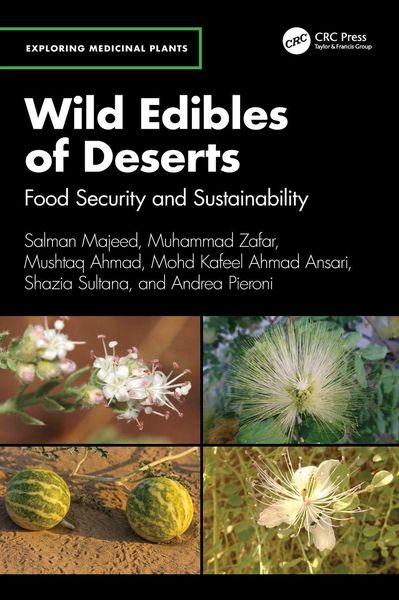
Produktbild: Wild Edibles of Deserts

Wild Edibles of Deserts Food Security and Sustainability

311,99 €

inkl. gesetzl. MwSt., Versandkostenfrei


Beschreibung

Produktdetails

Einband

Gebundene Ausgabe

Erscheinungsdatum

07.08.2025

Abbildungen

schwarz-weiss Illustrationen, Raster, schwarz-weiss, Zeichnungen, schwarz-weiss, Tabellen, schwarz-weiss

Verlag

Taylor & Francis

Seitenzahl

217

Maße (L/B/H)

26/18,3/1,8 cm

Gewicht

780 g

Sprache

Englisch

ISBN

978-1-03-286511-9

Beschreibung

Produktdetails

Einband

Gebundene Ausgabe

Erscheinungsdatum

07.08.2025

Abbildungen

schwarz-weiss Illustrationen, Raster, schwarz-weiss, Zeichnungen, schwarz-weiss, Tabellen, schwarz-weiss

Verlag

Taylor & Francis

Seitenzahl

217

Maße (L/B/H)

26/18,3/1,8 cm

Gewicht

780 g

Sprache

Englisch

ISBN

978-1-03-286511-9

Kundinnen und Kunden meinen

0 Bewertungen

Informationen zu Bewertungen

Zur Abgabe einer Bewertung ist eine Anmeldung im Konto notwendig. Die Authentizität der Bewertungen wird von uns nicht überprüft. Wir behalten uns vor, Bewertungstexte, die unseren Richtlinien widersprechen, entsprechend zu kürzen oder zu löschen.

Die Bewertungen sind nach Format, Anzahl Sterne und Datum sortiert.

Verfassen Sie die erste Bewertung zu diesem Artikel

Helfen Sie anderen Kund*innen durch Ihre Meinung

Kundinnen und Kunden meinen

0 Bewertungen filtern

Die Leseprobe wird geladen.
  • Produktbild: Wild Edibles of Deserts
  • Chapter 1: Introduction

    1.1 Why are deserts trendy?

    1.2 Extent of Climate Aridity in the Deserts

    1.3 Sustainable Land Use and Desertification

    1.3.1 Desertification: Causes and Impacts

    1.3.2 Importance of Sustainable Land Use

    1.3.3 Strategies for Combating Desertification

    1.3.4 Case Studies in Successful Desertification Mitigation

    a) The Loess Plateau, China

    b) Israel Negev Desert

    c) Great Green Wall, Africa

    d) Rewetting Peatlands in Indonesia

    e) Sustainable Land Management in Niger

    1.3.5 Policy Frameworks and International Cooperation

    1.4 Conclusion and Implications

    References

    Chapter 2: Brief Overview of Deserts of the World (Ecology, Climate, flora, Population)

    2.1 South Asian Deserts

    2.1.1 Thar Desert

    2.1.2 Cholistan Desert

    2.1.3 Kutch Desert

    2.1.4 Thal Desert

    2.1.5 Cold Deserts

    2.2 Central Asian Deserts

    2.3 Arabic Deserts

    2.4 African Deserts

    2.4.1 Sahara Desert

    2.4.2 Namib Desert

    2.5 European Deserts

    2.6 Latin American Deserts

    2.6.1 Atacama Desert

    2.6.2 Sonoran Desert

    2.6.3 Chihuahuan Desert

    References

    Chapter 3: Traditional Wild Edibles (WEs) of the Deserts: Reservoir of Ethnomedicine

    3.1 Desert legumes as a source of protein in human diets

    3.1.1 Acacia jacquemontii Benth.

    3.1.2 Acacia nilotica (L.) Willd. ex Delile

    3.1.3 Acacia modesta (Linn.) Wall.

    3.1.4 Albizia lebbeck (L.) Benth.

    3.1.5 Prosopis cineraria (Linn.) Druce

    3.1.6 Cyamopsis tetragonoloba (L.) Taub)

    3.1.7 Crotalaria burhia Buch.-Ham. ex Benth.

    3.1.8 Parkinsonia aculeata L.

    3.1.9 Prosopis juliflora (Swartz) DC

    3.1.10 Tephrosia purpurea (L.) Pers.

    3.2 Prickly pear: Low-cost forage crop for supplementing food security

    3.2.1 Opuntia dillenii (Ker Gawl.)

    3.3 Ethnopharmacological status of WEs of family Capparaceae

    3.3.1 Capparis decidua Edgew (Forssk.)

    3.3.2 Capparis spinosa L.

    3.3.3 Cleome brachycarpa Vahl ex DC.

    3.4 WEs Cucurbitaceous species: Therapeutic effect on human health

    3.4.1 Citrullus colocynthis (L.) Schrad

    3.4.2 Cucumis melo L.

    3.4.3 Cucurbita maxima Duchesne

    3.4.4 Luffa cylindrica (L.) M.Roem

    3.4.5 Momordica charantia L.

    3.4.6 Mukia maderaspatana (L.) M.Roem

    3.5 Nutritional aspects of Drought-Resistance Rhamnaceous Wes

    3.5.1 Ziziphus nummularia (Burm.f.) Wight & Arn.

    3.5.2 Ziziphus jujuba Mill.

    3.6 Biochemical therapeutic uses of Desert WEs of Zygophyllaceae

    3.6.1 Fagonia cretica Linn.

    3.6.2 Tribulus terrestris L.

    References

    Chapter 4: Economic Botany of the Deserts WEs: Source of Food and Nutrition

    4.1 WEs: Combating Food and Health Security

    4.1.1 Nutritional Benefits of WEs in Arid Regions

    4.1.2 Sustainable Harvesting Practices for Desert Foraging

    4.1.3 Cultural Significance and Traditional Knowledge of Wild Foods

    4.1.4 Wild Edibles as a Strategy for Food Security and Ecological Resilience

    4.1.5 Policy Recommendations for Promoting Wild Edibles in Desert Economies

    4.2 WEs: Nutritional value and Dietary Requirements

    4.3 Knowledge, Marketing and Finance of desert Wes

    4.4 WEs: Functional Foods and Health

    4.5 Healthy sustainable diets of desert Wes

    References

    Chapter 5: Deserts WEs, Climate Change and Ecological Transition

    5.1 Desert Wild edibles can meet the needs of future generations

    5.2 Global desert WEs nutritional initiatives for a healthier food system.

    5.3 WEs: Sustainable management by indigenous communities of Desert

    5.4 WEs Dietary development: Ecosystem conservation and Sustainability

    5.5 Unlocking desert WEs resources to promote sustainable agriculture

    5.6 Promoting WEs in the Desert: Future Implications towards sustainable value chain

    References