KI-Beratung Beta

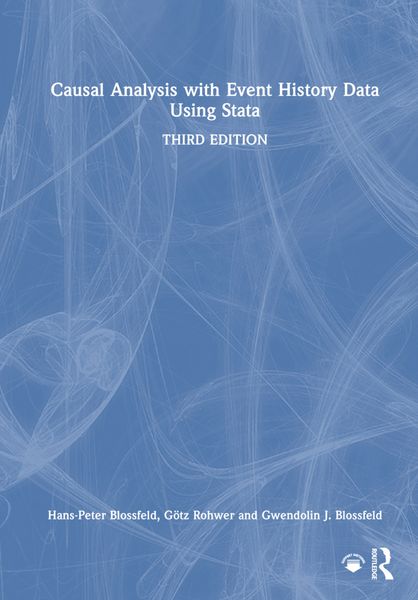
Produktbild: Rohwer, G: Causal Analysis with Event History Data Using Sta

Rohwer, G: Causal Analysis with Event History Data Using Sta

229,99 €

inkl. gesetzl. MwSt., Versandkostenfrei


Beschreibung

This third edition of Causal Analysis with Event History Data Using Stata provides an updated introduction to event history modeling along with many instructive Stata examples. Using the latest Stata software, each of these practical examples develops a research question, points to useful contextual...

Beschreibung

This third edition of Causal Analysis with Event History Data Using Stata provides an updated introduction to event history modeling along with many instructive Stata examples. Using the latest Stata software, each of these practical examples develops a research question, points to useful contextual background information, gives a brief account of the underlying statistical concepts, describes the organization of input data and the application of Stata statistical procedures, and assists the reader in interpreting the content of the results obtained.

Emphasizing the strengths and limitations of continuous-time event history analysis in different fields of social science applications, this book demonstrates that event history models provide a useful approach to uncover causal relation- ships or to map a system of causal relationships. In particular, this book demonstrates how long-term processes can be studied, how different forms of duration dependencies can be estimated using nonparametric, parametric and semiparametric models, and how parallel and interdependent dynamic systems can be analyzed from a causal-analytical point of view using the method of episode splitting. The book also shows how changing contextual information at the micro, meso and macro levels can be easily integrated into a dynamic analysis of longitudinal data. Finally, the book addresses the problem of unobserved heterogeneity of time-constant and time-dependent omitted variables and makes suggestions for dealing with these sometimes difficult methodological problems.

Causal Analysis with Event History Data Using Stata is an invaluable resource for both novice and experienced researchers from a variety of fields (e.g. sociology, economics, political science, education, psychology, demography, epidemiology, management research and organizational studies, as well as medicine and clinical applications) who need an introductory textbook on continuous-time event history analysis and who are looking for a practical handbook for their longitudinal research.

Produktdetails

Einband

Gebundene Ausgabe

Erscheinungsdatum

28.07.2025

Abbildungen

62 SW-Abb., 62 SW-Zeichn.

Verlag Taylor & Francis

Produktdetails

Einband

Gebundene Ausgabe

Erscheinungsdatum

28.07.2025

Abbildungen

62 SW-Abb., 62 SW-Zeichn.

Verlag Taylor & Francis
Seitenzahl

248

Maße (L/B/H)

29,7/21/1,6 cm

Gewicht

820 g

Auflage

3. Auflage

Sprache

Englisch

ISBN

978-1-03-270809-6

EU-Ansprechpartner

Taylor & Francis Verlag GmbH
Kaufingerstraße 24
80331 München
DE
GPSR@taylorandfrancis.com

Herstelleradresse

Taylor & Francis Group
5 Howick Place
SW1P 1WG London
UK
GPSR@taylorandfrancis.com

Noch keine Bewertungen vorhanden

Verfassen Sie die erste Bewertung zu diesem Artikel

Helfen Sie anderen Kundinnen und Kunden durch Ihre Meinung.

Kundinnen und Kunden meinen

Bewertungen (0)

Die Leseprobe wird geladen.
  • Produktbild: Rohwer, G: Causal Analysis with Event History Data Using Sta
  • 1 Introduction 1

    1.1 Causal Modeling and Observation Plans

    1.1.1 Cross-Sectional Data

    1.1.2 Panel Data

    1.1.3 Event History Data

    1.2 Event History Analysis and Causal Modeling

    1.2.1 Causal Explanations

    1.2.2 Transition Rate Models

    2 Event History Data Structures

    2.1 Basic Terminology

    2.2 Event History Data Organization

    3 Nonparametric Descriptive Methods

    3.1 Life Table Method

    3.2 Product-Limit Estimation

    3.3 Comparing Survivor Functions

    4 Exponential Transition Rate Models

    4.1 The Basic Exponential Model

    4.1.1 Maximum Likelihood Estimation

    4.1.2 Models without Covariates

    4.1.3 Time-Constant Covariates

    4.2 Models with Multiple Destinations

    4.3 Models with Multiple Episodes

    5 Piecewise Constant Exponential Models

    5.1 The Basic Model

    5.2 Models without Covariates

    5.3 Models with Proportional Covariate Effects

    5.4 Models with Period-Specific Effects

    6 Exponential Models with Time-Dependent Covariates

    6.1 Parallel and Interdependent Processes

    6.2 Interdependent Processes: The System Approach

    6.3 Interdependent Processes: The Causal Approach

    6.4 Episode Splitting with Qualitative Covariates

    6.5 Episode Splitting with Quantitative Covariates

    6.6 Application Examples

    7 Parametric Models of Time Dependence

    7.1 Interpretation of Time Dependence

    7.2 Gompertz Models

    7.3 Weibull Models

    7.4 Log-Logistic Models

    7.5 Log-Normal Models

    8 Methods for Testing Parametric Assumptions

    8.1 Simple Graphical Methods

    8.2 Pseudoresiduals

    9 Semiparametric Transition Rate Models

    9.1 Partial Likelihood Estimation

    9.2 Time-Dependent Covariates

    9.3 The Proportionality Assumption

    9.4 Stratification with Covariates and for Multiepisode Data

    9.5 Baseline Rates and Survivor Functions

    9.6 Application Example

    10 Problems of Model Specification

    10.1 Unobserved Heterogeneity

    10.2 Models with a Mixture Distribution

    10.2.1 Models with a Gamma Mixture

    10.2.2 Exponential Models with a Gamma Mixture

    10.2.3 Weibull Models with a Gamma Mixture

    10.2.4 Random Effects for Multiepisode Data

    10.3 Discussion

    11 Sequence Analysis

    Brendan Halpin

    11.1 What is Sequence Analysis?

    11.1.1 Sequence Data

    11.1.2 The Value of a Holistic View

    11.2 Defining Distances

    11.2.1 Hamming Distance

    11.2.2 Optimal Matching Distance

    11.2.3 Other Distances

    11.2.4 Determining State Distances

    11.3 Doing Sequence Analysis in Stata .

    11.3.1 Example Data

    11.3.2 A First Look at the Data

    11.4 Unary Summaries

    11.5 Intersequence Distance

    11.6 What to Do with Sequence Distances?

    11.7 Optimal Matching Distance

    11.8 Special Topics

    11.8.1 Other Distance Measures

    11.8.2 Ideal Types

    11.8.3 Multichannel Sequence Analysis

    11.8.4 Dyadic Analysis

    11.9 Conclusion

    Appendix: Exercises

    References

    About the Authors