KI-Beratung Beta

Gutscheinbedingungen

**Gültig am 25.11.2026 auf fremdsprachige Bücher online auf thalia.at und in der Thalia App. Einzelne Artikel können ausgeschlossen sein. Ausgenommen sind preisgebundene Artikel & eBooks. Pro Einkauf einmal einlösbar. Click & Collect nur bei Onlinevorabzahlung möglich. Keine Barauszahlung. Nicht kombinierbar mit anderen Aktionen und Gutscheinen. Gutschein wird auf max. 500€ Bestellwert angerechnet. Nicht gültig für Geschenkkarten, Versandkosten und Services.

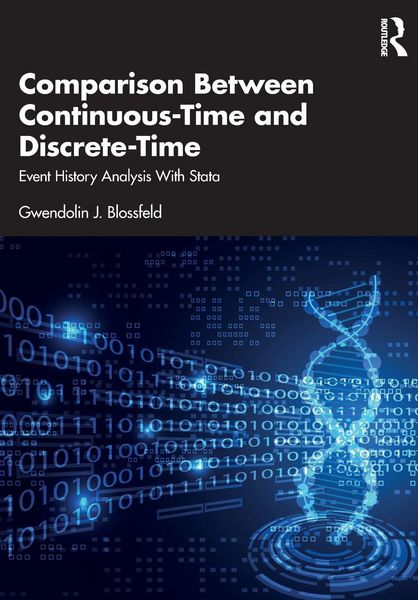
Produktbild: Comparison Between Continuous-Time and Discrete-Time

Comparison Between Continuous-Time and Discrete-Time Event History Analysis with Stata

79,99 €

inkl. gesetzl. MwSt., Versandkostenfrei


Beschreibung

Comparison Between Continuous-Time and Discrete-Time: Event History Analysis with Stata elucidates the statistical concepts and empirical applications of both continuous-time and discrete-time event history models. Empirical scientists have increasingly collected data on the timing of events, with the...

Beschreibung

Comparison Between Continuous-Time and Discrete-Time: Event History Analysis with Stata elucidates the statistical concepts and empirical applications of both continuous-time and discrete-time event history models. Empirical scientists have increasingly collected data on the timing of events, with the understanding that events can occur at any point in time and may be recorded using different observation schemes. However, time-continuous processes are not always observed with fine-grained temporal resolution; in some cases, they are captured with larger observation intervals (monthly, yearly, biennially, and quadrennially).

This book introduces the need for discrete-time event history analysis methods and adeptly discusses the limitations of the discrete-time approach when compared to continuous-time models. It offers an in-depth comparison of both methods and sheds light on how they differ and align. By utilizing the statistical software Stata and using a campus example data set, the book provides practical examples that showcase the implications of larger observation intervals in discrete-time applications.

This book serves as an essential resource for researchers, students, and practitioners seeking to comprehend the nuances of event history analysis in both continuous and discrete-time frameworks. Its comprehensive exploration of statistical techniques and real-world applications will equip readers with a deeper understanding of the strengths and limitations of each method, thus enabling more informed and robust decision-making in empirical research.

Produktdetails

Einband

Taschenbuch

Erscheinungsdatum

30.09.2025

Abbildungen

58 SW-Abb., 58 SW-Zeichn., 31 Tabellen

Verlag Taylor & Francis

Produktdetails

Einband

Taschenbuch

Erscheinungsdatum

30.09.2025

Abbildungen

58 SW-Abb., 58 SW-Zeichn., 31 Tabellen

Verlag Taylor & Francis
Seitenzahl

160

Maße (L/B/H)

24,4/17/0,9 cm

Gewicht

289 g

Sprache

Englisch

ISBN

978-1-03-267831-3

EU-Ansprechpartner

Taylor & Francis Verlag GmbH
Kaufingerstraße 24
80331 München
DE
GPSR@taylorandfrancis.com

Herstelleradresse

Taylor & Francis Group
5 Howick Place
SW1P 1WG London
UK
GPSR@taylorandfrancis.com

Noch keine Bewertungen vorhanden

Verfassen Sie die erste Bewertung zu diesem Artikel

Helfen Sie anderen Kundinnen und Kunden durch Ihre Meinung.

Kundinnen und Kunden meinen

Bewertungen (0)

  • Produktbild: Comparison Between Continuous-Time and Discrete-Time
  • 1. Introduction. 2. Basic terminology, concepts, and data structures. 3. Statistical models. 4. Comparison of continuous-time and discrete-time exponential transition rate models. 5. Comparison of continuous-time and discrete-time transition rate models with duration dependence. 6. Models with unobserved heterogeneity. 7. Discussion and conclusion. 8. Appendix A: Stata do-files.