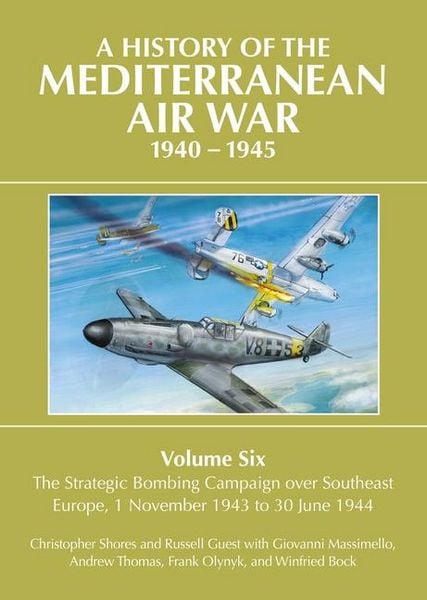
A History of the Mediterranean Air War 1940-1945 Volume Six: The Strategic Bombing Campaign over South-East Europe 1 November 1943 to 30 June 1944
-
Sprache:Englisch
-
Verlag:Grub Street Publishing
65,99 €
inkl. gesetzl. MwSt.,
Beschreibung
Produktdetails
Einband
Gebundene Ausgabe
Erscheinungsdatum
23.06.2025
Verlag
Grub Street PublishingSeitenzahl
576
Maße (L/B/H)
24,3/18,1/4,2 cm
Gewicht
1851 g
Sprache
Englisch
ISBN
978-1-911714-23-1
"From its inception, this series has been a monumental undertaking, and Volume 6 reinforces that sense of scope. The research is prodigious; the documentation exhaustive; and the attention to operational details of aircraft, units, missions, losses, and personalities remains unmatched in the literature of the Mediterranean air war." - The Journal of the Air Force Historical Foundation
Following the inter-Allied Casablanca Conference in January 1943 the outline for the Combined Bomber Offensive was agreed and resulted in early February with the 'Casablanca Directive'. This required the "progressive destruction and dislocation of the German military, industrial and economic systems and the undermining of the morale of the German people to a point where their capacity for armed resistance is fatally weakened". This directive was clarified in June when the Combined Chiefs of Staff issued the 'Pointblank Directive' that stated that the highest priority targets were the fighter aircraft factories to ensure that in the coming invasion of France the enemy would not have air superiority.
When these directives were issued it was envisaged that as well as attacks by RAF Bomber Command and the US 8th Air Force based in England, the strategic bomber forces in Italy would begin operations once suitable bases were available. After the Allied landings in Italy and resulting collapse of the Italian fascist regime a network of bomber bases was hastily developed. Thus, on 1 November 1943 the US 15th Air Force was formed to conduct the daylight bombing offensive against strategic targets in southern Germany and across southeastern Europe. Key among these were the Rumanian oilfields and traffic along the River Danube. This new formation was joined by the smaller, but highly effective 205 Group, RAF that was trained and equipped for night bombing so mirroring their equivalent British-based formations.
The damaging attacks on the Reich's oil supplies and the highly effective Danube mining campaign conducted at night by 205 Group delivered huge strategic effect. The latter reduced vital oil and goods traffic into the Reich to a trickle but also dislocated the supply and logistics train into the southern part of the Eastern Front so giving manifest support to the Soviets.
In this volume the early months of this hugely significant air campaign are described in minute and original detail, and are accompanied by hundreds of hitherto unpublished photographs. In combating these attacks, Germany's Axis allies such as Hungary, Rumania, Bulgaria and Slovakia were encountered for the first time by the Western Allies.
Noch keine Bewertungen vorhanden
Verfassen Sie die erste Bewertung zu diesem Artikel
Helfen Sie anderen Kundinnen und Kunden durch Ihre Meinung.
Kurze Frage zu unserer Seite
Vielen Dank für Ihr Feedback
Wir nutzen Ihr Feedback, um unsere Produktseiten zu verbessern. Bitte haben Sie Verständnis, dass wir Ihnen keine Rückmeldung geben können. Falls Sie Kontakt mit uns aufnehmen möchten, können Sie sich aber gerne an unseren Kund*innenservice wenden.
zum Kundenservice