• Produktbild: Proceedings of the 1st Electrical Artificial Intelligence Conference, Volume 2
  • Produktbild: Proceedings of the 1st Electrical Artificial Intelligence Conference, Volume 2
Band 1395 - 17%

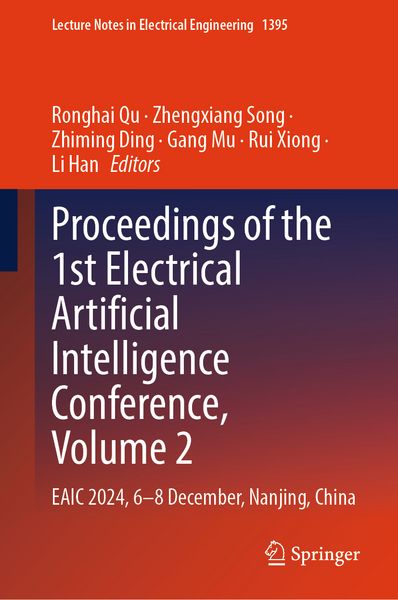
Proceedings of the 1st Electrical Artificial Intelligence Conference, Volume 2 EAIC 2024, 6-8 December, Nanjing, China

17% sparen

342,99 € UVP 417,99 €

inkl. gesetzl. MwSt., Versandkostenfrei


Beschreibung

Produktdetails

Einband

Gebundene Ausgabe

Erscheinungsdatum

12.04.2025

Herausgeber

Ronghai Qu + weitere

Verlag

Springer Singapore

Seitenzahl

578

Maße (L/B/H)

24,1/16/3,7 cm

Gewicht

1037 g

Auflage

1. Auflage

Originaltitel

Proceedings of the 2024 Electrical Engineering and Artificial Intelligence Conference, Volume 2

Sprache

Englisch

ISBN

978-981-9640-62-1

Beschreibung

Portrait

Ronghai Qu is Professor, the College of Electrical and Electronic Engineering, Huazhong University of Science and Technology, China, and Fellow of IEEE. He received his bachelor’s and master’s degree from Tsinghua University, China, in 1993 and 1995, respectively. He received his doctoral degree from the University of Wisconsin, Madison, the USA, in 2002. He received the honorary titles of Distinguished Lecturer of IEEE Industry Application Society for 2019~2020 and the Outstanding Member Awards in 2019. His research focuses on motor design and drive and control.

Zhengxiang Song is Professor, the College of Electrical and Electronic Engineering, Xi'an Jiaotong University, China. He obtained his bachelor’s, master’s, and doctoral degrees from Xi'an Jiaotong University, China, in 1992, 1995, and 1999, respectively. He has served as Executive Deputy Director of the State Key Laboratory of Energy, China, since 2013, and Executive Deputy Director of the Engineering Research Center, the Ministry of Education of China, since 2018. His research interests include the theory and engineering of intelligent electrical appliances, the theory and technology of electric energy storage, electromagnetic protection, and equipment detection and fault diagnosis.

Zhiming Ding is Professor, the Institute of Software, Chinese Academy of Sciences. He obtained his bachelor’s degree from Wuhan University, China, in 1989, his master’s degree from Beijing University of Technology, China, in 1996, and his doctoral degree from the Institute of Computing, Chinese Academy of Sciences in 2002. He serves as Director of the Center of Space-Time Data Management and Date Science. He is also Chair of the society transportation sector of the IEEE Intelligent Transportation System Society. His research interests include database and knowledge base systems, real-time processing and intelligent analysis of the big data in spatiotemporal awareness, Internet of Things and mobile data management, disaster emergency big data management, etc.

Gang Mu is Professor, Northeast Electric Power University, China. He received his bachelor’s and master’s degrees from Northeast Electric Power University, China, in 1982 and 1984, respectively. He received his doctoral degree from Tsinghua University, China, in 1991. He serves as Fellow of the Chinese Society of Electrical Engineering. He was granted two second prizes of the National Science and Technology Progress Awards of China. His research interests focus on safe operation and control of the new generation power system and large-scale renewable energy development and networking technology.

Rui Xiong is Professor, Beijing Institute of Technology, China. He also serves as Guest Professor at the Massachusetts Institute of Technology, the USA, Adjunct Professor at Swinburne University of Technology, and IET Fellow. He has hosted an Outstanding Youth Fund Project by the National Natural Science Foundation of China. He has engaged in fundamental theoretical and engineering application research on power systems, power battery systems, energy storage systems, big data, and artificial intelligence for electric transport vehicles.

Li Han is Professor, Institute of Electrical Engineering (IEE), Chinese Academy of Sciences. He received his bachelor’s and master’s degrees from Lanzhou University, China, in 1992 and 1995, respectively. He received his doctoral degree from Tsinghua University, China, in 2000. He serves as Director of the research sector of micro-nano processing technology of IEE.

Produktdetails

Einband

Gebundene Ausgabe

Erscheinungsdatum

12.04.2025

Herausgeber

Verlag

Springer Singapore

Seitenzahl

578

Maße (L/B/H)

24,1/16/3,7 cm

Gewicht

1037 g

Auflage

1. Auflage

Originaltitel

Proceedings of the 2024 Electrical Engineering and Artificial Intelligence Conference, Volume 2

Sprache

Englisch

ISBN

978-981-9640-62-1

Herstelleradresse

Springer-Verlag GmbH
Tiergartenstr. 17
69121 Heidelberg
DE

Email: ProductSafety@springernature.com

Kundinnen und Kunden meinen

0 Bewertungen

Informationen zu Bewertungen

Zur Abgabe einer Bewertung ist eine Anmeldung im Konto notwendig. Die Authentizität der Bewertungen wird von uns nicht überprüft. Wir behalten uns vor, Bewertungstexte, die unseren Richtlinien widersprechen, entsprechend zu kürzen oder zu löschen.

Die Bewertungen sind nach Format, Anzahl Sterne und Datum sortiert.

Verfassen Sie die erste Bewertung zu diesem Artikel

Helfen Sie anderen Kund*innen durch Ihre Meinung

Kundinnen und Kunden meinen

0 Bewertungen filtern

  • Produktbild: Proceedings of the 1st Electrical Artificial Intelligence Conference, Volume 2
  • Produktbild: Proceedings of the 1st Electrical Artificial Intelligence Conference, Volume 2
  • Chapter 1. Global Efficiency Optimization of High-Gain IPOP System Based on Genetic Algorithm.- Chapter 2. IGBT Open-Circuit Fault Diagnosis of MMC Submodules Based on Tensor Data-Driven Approach.- Chapter 3. Study on the diagnosis of industrial robot abnormalities based on SVDD.- Chapter 4. Small defect detection of power electronic devices based on YOLO-DHGC.- Chapter 5. Research on Parallel Multimodal Current Sharing Based on Merged Coupled Inductance.- Chapter 6. Study on Fault Diagnosis of Power Electronic Devices in Power Conversion System Based on Machine Learning.- Chapter 7. Power Electronics Topology Derivation: A Technical Review and Cutting-edge Exploration.