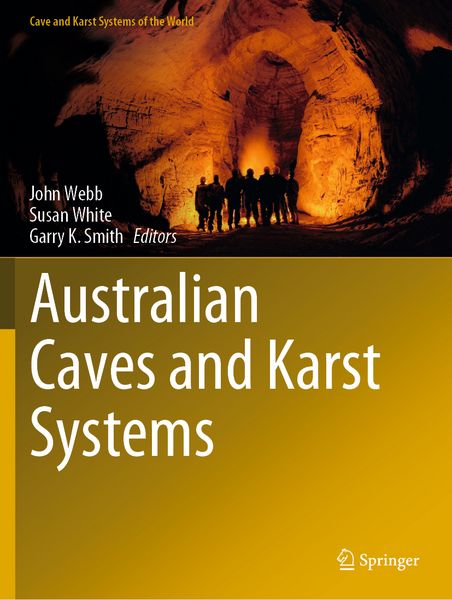
Produktbild: Australian Caves and Karst Systems
- 15%

Australian Caves and Karst Systems

15% sparen

166,99 € UVP 197,99 €

inkl. gesetzl. MwSt., Versandkostenfrei


Beschreibung

Produktdetails

Einband

Taschenbuch

Erscheinungsdatum

15.05.2025

Herausgeber

John Webb + weitere

Verlag

Springer

Seitenzahl

398

Maße (L/B/H)

27,9/21/2,1 cm

Gewicht

1120 g

Sprache

Englisch

ISBN

978-3-031-24269-4

Beschreibung

Portrait

John A. Webb is Emeritus Professor of Environmental Geoscience at La Trobe University, Melbourne. He has published extensively on Australian karst, particularly the Nullarbor and southeastern Australia, and has caved throughout Australia and overseas (although not so much recently). In 2013 the Australian Speleological Federation awarded him the Edie Smith Award for outstanding service to Australian speleology, and he gave an invited plenary speech on Australian karst at the 2017 International Congress of Speleology. His interests extend to geoarchaeology, including artefact and ochre sourcing, as well as the landscape evolution of archaeological sites. He also works on groundwater and contaminated site management, with an on-going research project on improving treatment procedures for acid mine drainage. He has supervised over 30 PhD and 100 honours students in a variety of geomorphological, ^5000 citations in total.

Susan Q. White is akarst geomorphologist at La Trobe University Melbourne. She has published on Australian karst developed on Cenozoic limestones (including the Nullarbor) and Proterozoic dolomites (Bullita/Judburra). She has caved extensively in Australia and overseas. In 2015 she was awarded the Order of Australia Medal (OAM) for service to science (especially speleology) and youth (Girl Guides). She chaired the ASF Publications commission from 2005 to 2019, has been involved in the Speleo2017 Congress, Conservation and Library Commissions, and was an Editor of Helictite (1998-2016). She was made a Fellow of the Australian Speleological Federation in 2015 for her service to ASF and is an Honorary Life Member of the Victorian Speleological Association. She has worked at several tertiary institutions in Melbourne where she has co-supervised Honours and post-graduate students. Her interests also include Geological Heritage and Significance, and she chaired the Geological Society of Australia’s Standing Committee on Geological Heritage (1994-2010) and GSA (Victoria)’s Geological Heritage subcommittee (1993 - present).

Garry K. Smith is an active speleologist, with more than 50 years’ experience in Australia and overseas. He has held various qualifications as a Scouts caving instructor and examiner as well as 36 years membership of the Newcastle & Hunter Valley Speleological Society, serving in various executive positions including the current president. He has published numerous articles and chapters in magazines and books, covering subjects about cave atmospheres, caving techniques, histoplasmosis, mineralogy, geomorphology and photography. Garry enjoys underground photography and has received numerous photographic awards.

Produktdetails

Einband

Taschenbuch

Erscheinungsdatum

15.05.2025

Herausgeber

Verlag

Springer

Seitenzahl

398

Maße (L/B/H)

27,9/21/2,1 cm

Gewicht

1120 g

Sprache

Englisch

ISBN

978-3-031-24269-4

Herstelleradresse

Springer-Verlag GmbH
Tiergartenstr. 17
69121 Heidelberg
DE

Email: ProductSafety@springernature.com

Kundinnen und Kunden meinen

0 Bewertungen

Informationen zu Bewertungen

Zur Abgabe einer Bewertung ist eine Anmeldung im Konto notwendig. Die Authentizität der Bewertungen wird von uns nicht überprüft. Wir behalten uns vor, Bewertungstexte, die unseren Richtlinien widersprechen, entsprechend zu kürzen oder zu löschen.

Die Bewertungen sind nach Format, Anzahl Sterne und Datum sortiert.

Verfassen Sie die erste Bewertung zu diesem Artikel

Helfen Sie anderen Kund*innen durch Ihre Meinung

Kundinnen und Kunden meinen

0 Bewertungen filtern

  • Produktbild: Australian Caves and Karst Systems
  • Introduction.- Part 1- People and Caves in Australia.- Part 2 - ‘Hard’ rock karst developed in Neoproterozoic and Palaeozoic carbonates.- Part 3 - ‘Soft’ rock karst developed in Tertiary and Quaternary limestones.- Part 4 – Pseudokarst.- Part 5 – Cave contents.