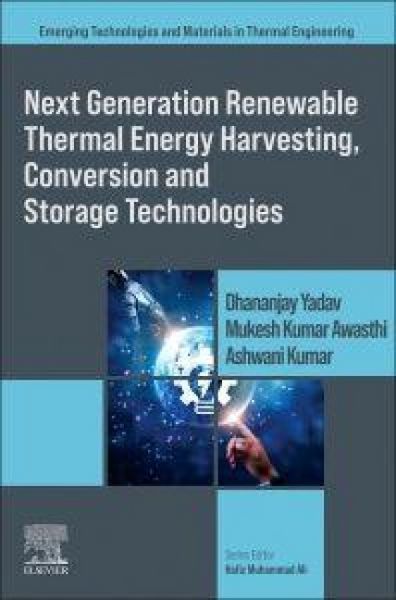
Produktbild: Next Generation Renewable Thermal Energy Harvesting, Conversion and Storage Technologies
- 13%

Next Generation Renewable Thermal Energy Harvesting, Conversion and Storage Technologies

13% sparen

166,99 € UVP 192,30 €

inkl. gesetzl. MwSt., Versandkostenfrei


Beschreibung

Produktdetails

Einband

Taschenbuch

Erscheinungsdatum

29.09.2025

Herausgeber

Dhananjay Yadav + weitere

Verlag

Elsevier Science & Technology

Seitenzahl

780

Maße (L/B/H)

22,8/15,2/3,8 cm

Gewicht

1197 g

Sprache

Englisch

ISBN

978-0-443-33184-8

Beschreibung

Portrait

Dr. Dhananjay Yadav received his Ph.D. degree from Department of Mathematics, Indian Institute of Technology (IIT) Roorkee, India in 2013 and post-graduation (M.Sc.) in Mathematics from DDU University Gorakhpur, India in 2007. Currently, he is working as an Associate Professor in Department of Mathematics at University of Nizwa, Oman. Prior to his appointment to University of Nizwa, Oman, he had worked as Principal Research Scientist at Athabasca University, Canada, Yonsei University, South Korea and Jeju National University, South Korea. He is a leading expert in CO 2 capture, storage and oil recovery, Computational sustainability and environmental analytics, Fluid mechanics, Numerical analysis, Hydrodynamic and Hydromagnetic stability, Nanofluids and Fluid flow in porous media. He has published more than 100 research articles (high impact factor) in various reputed international journals. He is also listed in the top 2% influential researchers in the World prepared by Stanford University based on Scopus data.

Dr. Mukesh Kumar Awasthi has done his Ph.D. on the topic "Viscous Correction for the Potential Flow Analysis of Capillary and Kelvin-Helmholtz instability”. He is working as an Assistant Professor in the Department of Mathematics at Babasaheb Bhimrao Ambedkar University, Lucknow. Dr. Awasthi is specialized in the mathematical modeling of flow problems. He has taught courses of Fluid Mechanics, Discrete Mathematics, Partial differential equations, Abstract Algebra, Mathematical Methods, and Measure theory to postgraduate students. He has acquired excellent knowledge in the mathematical modeling of flow problems and he can solve these problems analytically as well as numerically. He has a good grasp of the subjects like viscous potential flow, electro-hydrodynamics, magneto-hydrodynamics, heat, and mass transfer. He has excellent communication skills and leadership qualities. He is self-motivated and responds to suggestions in a more convincing manner. Dr. Awasthi has qualified National Eligibility Test (NET) conducted on all India level in the year 2008 by the Council of Scientific and Industrial Research (CSIR) and got Junior Research Fellowship (JRF) and Senior Research Fellowship (SRF) for doing research. He has published 125 plus research publications (journal articles/books/book chapters/conference articles) in Elsevier, Taylor & Francis, Springer, Emerald, World Scientific, and many other national and international journals and conferences. Also, he has published 14 books. He has attended many symposia, workshops, and conferences in mathematics as well as fluid mechanics. He has got the "Research Awards” consecutively four times from 2013-2016 by the University of Petroleum and Energy Studies, Dehradun, India. He has also received the start-up research fund for his project "Nonlinear study of the interface in multilayer fluid system” from UGC, New Delhi. He is also listed in the top 2% influential researchers in the World prepared by Stanford University based on Scopus data in the years 2022 and 2023.

Dr. Ashwani Kumar is currently Professor and Head of the Department of Mechanical Engineering (Gazetted Officer Group A) at the Technical Education Department Uttar Pradesh Kanpur (under Government of Uttar Pradesh), in India. He holds a Ph.D. in Mechanical Engineering. His research areas include Artificial Intelligence and machine learning in mechanical engineering, thermal energy storage, renewable energy harvesting, sustainability, and renewable energy integration. Dr. Kumar's has authored or co-authored over 275 articles in prestigious journals, book chapters, and conference proceedings. Additionally, he has co-authored or co-edited over 50 books in mechanical engineering, materials science, and renewable energy engineering. With extensive leadership and administrative experience, he has held numerous key positions within the education sector and has served on the editorial board of several international journals.

Produktdetails

Einband

Taschenbuch

Erscheinungsdatum

29.09.2025

Herausgeber

Verlag

Elsevier Science & Technology

Seitenzahl

780

Maße (L/B/H)

22,8/15,2/3,8 cm

Gewicht

1197 g

Sprache

Englisch

ISBN

978-0-443-33184-8

EU-Ansprechpartner

Zeitfracht Medien GmbH
Ferdinand-Jühlke-Straße 7
99095 Erfurt
DE
produktsicherheit@zeitfracht.de

Herstelleradresse

Elsevier Science & Technology
London Wall 125
EC2Y 5AS London
GB
tradeorders@elsevier.com

Noch keine Bewertungen vorhanden

Verfassen Sie die erste Bewertung zu diesem Artikel

Helfen Sie anderen Kundinnen und Kunden durch Ihre Meinung.

Kundinnen und Kunden meinen

Bewertungen (0)

Die Leseprobe wird geladen.
  • Produktbild: Next Generation Renewable Thermal Energy Harvesting, Conversion and Storage Technologies
  • Section I Solar thermal energy

    1. Recent technological developments in solar thermal energy harvesting technologies
    2. Advances in solar collectors and concentrators
    3. High-temperature heat transfer fluids for next-generation solar thermal energy systems
    4. Harnessing solar thermal energy: Applications in process heating and power generation
    5. Hybrid systems: Integrating solar thermal with other renewable sources
    6. Design of high-performance nanomaterials for sustainable solar thermal energy absorption
    7. Next-generation passive cooling: Leveraging phase change materials in thermal energy storage systems
    8. Limitations, technological challenges, and recycling of thermal renewable energy systems 233
    9. Phase change materials for next generation renewable thermal energy systems in existence of thermoelectric generator
    10. Thermoelectric materials and devices for renewable thermal energy harvesting
    11. Applications of solar thermal energy systems
    12. Solar thermal drying systems for diverse applications: A sustainable approach
    13. Innovative roughness techniques for enhanced heat transfer in double-pass solar air heaters for sustainable drying and buildings application
    14. Enhancing hydrogen production: A study on steam reforming using advanced nanocomposites
    15. Thermal management of Li-Ion batteries for enhanced performance in renewable energy integration
    16. Impact of environmental factors on next-generation micro hydropower: An experimental investigation of silt erosion on pico pelton turbine performance

    Section II Geothermal energy

    17. Geothermal energy harvesting: An experimental investigation of horizontal ground heat exchanger using centrifugal pump
    18. Enhanced geothermal systems (EGSs) for electricity generation
    19. Geothermal direct use in heating and cooling applications

    Section III Biomass energy

    20. Advancements in hydrogen storage materials: Synthesis and applications
    21. Biomass technologies
    22. Dark-fermentation technology: A sustainable approach for biohydrogen production from waste biomass
    23. Photofermentation: Harnessing solar energy for biohydrogen production
    24. Metabolic engineering for biohydrogen production
    25. Predictive modeling solar panel performance using artificial intelligence for evaluation
    26. Green hydrogen production from renewable energy resources: Current status and future perspective
    27. Microwave-driven biodiesel production from waste cooking oil: A parametric optimization approach for next-generation biofuel upcycling
    Index