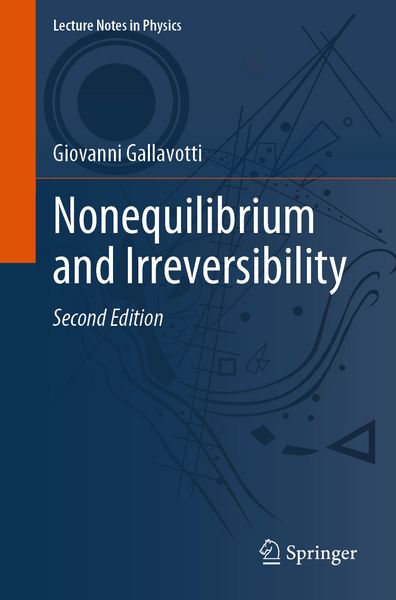
Nonequilibrium and Irreversibility
-
- Taschenbuch ausgewählt
- eBook
-
Sprache:Englisch
117,99 €
UVP
142,99 €
inkl. gesetzl. MwSt.,
Beschreibung
Produktdetails
Einband
Taschenbuch
Erscheinungsdatum
01.06.2025
Abbildungen
XVII, 266 p. 26 illus., 6 illus. in color.
Verlag
SpringerSeitenzahl
266
Maße (L/B/H)
23,5/15,5/1,6 cm
Gewicht
435 g
Auflage
Second Edition 2025
Sprache
Englisch
ISBN
978-3-031-85496-5
This 2nd edition of the book focuses on the properties of stationary states in chaotic systems of particles or fluids, setting aside the theory of how these states are achieved. The second edition has been thoroughly revised and includes numerous corrections. It incorporates recent findings, with particular emphasis on the equivalence between irreversible and reversible equations. The ongoing debate over reversibility and irreversible behavior is frequently discussed. The book seeks to unify the study of stationary nonequilibrium states with that of equilibrium states, using the paradigm offered by the simplest chaotic systems, specifically Anosov systems.
The book begins by exploring the time-invariant distributions relevant to physics. A distinctive feature of this work is its historical approach. To clarify foundational issues, the author analyzes the works of pioneering figures like Boltzmann, Clausius, and Maxwell, including translated excerpts of key historical documents. Additionally, the author establishes a close connection between the treatment of irreversible phenomena in statistical mechanics and the theory of chaotic systems, particularly at and beyond the onset of turbulence, as developed by Sinai, Ruelle, and Bowen (SRB) and others. Arguments are presented to strongly support the perspective that stationary states, whether in equilibrium or not, can be described in a unified framework.
The book offers extensive coverage of contemporary research, presented in sufficient detail to give advanced students a sense of the ongoing research directions in this dynamic field. Proofs of theorems are generally limited to heuristic outlines, favoring the presentation of concepts and providing references for further study, thereby avoiding an overload of technical detail in the main text.
Noch keine Bewertungen vorhanden
Verfassen Sie die erste Bewertung zu diesem Artikel
Helfen Sie anderen Kundinnen und Kunden durch Ihre Meinung.
Kurze Frage zu unserer Seite
Vielen Dank für Ihr Feedback
Wir nutzen Ihr Feedback, um unsere Produktseiten zu verbessern. Bitte haben Sie Verständnis, dass wir Ihnen keine Rückmeldung geben können. Falls Sie Kontakt mit uns aufnehmen möchten, können Sie sich aber gerne an unseren Kund*innenservice wenden.
zum Kundenservice