KI-Beratung Beta

Gutscheinbedingungen

**Gültig am 20.11.2026 ab einem Mindestbestellwert von 30€ auf Spielzeug, Schreibwaren, Filme, Geschenke & Trends, Musik, tolino eReader & Zubehör, Hörbücher und Hörbuch-Downloads, nicht preisgebundene Bücher und Kalender online auf thalia.at und in der Thalia App. Einzelne Artikel können ausgeschlossen sein. Aufgrund der Buchpreisbindung sind deutschsprachige Bücher und eBooks ausgenommen. Zusätzlich ausgenommen sind Abos & Flatrates, Games, Geschenkkarten/-boxen, Shelfies, Software, Zeitschriften sowie einzelne Artikel von tonies®. Pro Einkauf einmal einlösbar. Click & Collect nur bei Onlinevorabzahlung möglich. Keine Barauszahlung. Nicht kombinierbar mit anderen Aktionen und Gutscheinen. Gutschein wird auf max. 500€ Bestellwert angerechnet. Nicht gültig für Versandkosten und Services. Preisgebundene Artikel sind vom Mindestbestellwert ausgeschlossen.

Produktbild: Decisions

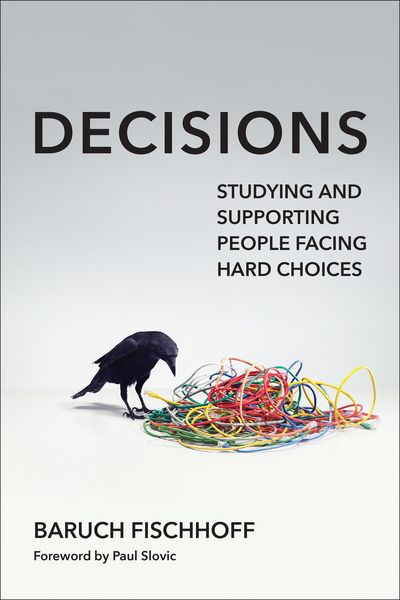
Decisions Studying and Supporting People Facing Hard Choices

52,99 €

inkl. gesetzl. MwSt., Versandkostenfrei


Beschreibung

A lively, authoritative insider’s account of how we make decisions and how decision-making research has developed over the last half century. Decisions describes the evolution of decision science (also called behavioral decision research and related to behavioral economics) through its application to...

Beschreibung

A lively, authoritative insider’s account of how we make decisions and how decision-making research has developed over the last half century.
Decisions describes the evolution of decision science (also called behavioral decision research and related to behavioral economics) through its application to challenging personal and public policy decisions, since the inception of the field.
Baruch Fischhoff covers all major topics in basic research, including how people create options, determine what matters to them, evaluate their chances of achieving those goals, and engage their emotions. He shows how those processes play out in an exceptionally wide variety of decisions regarding health, safety, the environment, disasters, and national security, among other topics. He also examines how decision-making abilities vary across individuals and across the lifespan, as well as the ethics and politics of how research is conducted and its results are shared and applied.

Produktdetails

Einband

Taschenbuch

Erscheinungsdatum

14.10.2025

Abbildungen

2 BLACK AND WHITE ILLUS.

Verlag MIT Press

Produktdetails

Einband

Taschenbuch

Erscheinungsdatum

14.10.2025

Abbildungen

2 BLACK AND WHITE ILLUS.

Verlag MIT Press
Seitenzahl

214

Maße (L/B/H)

22,6/15,3/1,8 cm

Gewicht

278 g

Sprache

Englisch

ISBN

978-0-262-55316-2

Herstelleradresse

Libri GmbH
Europaallee 1
36244 Bad Hersfeld
DE

Email: gpsr@libri.de

Noch keine Bewertungen vorhanden

Verfassen Sie die erste Bewertung zu diesem Artikel

Helfen Sie anderen Kundinnen und Kunden durch Ihre Meinung.

Kundinnen und Kunden meinen

Bewertungen (0)

Die Leseprobe wird geladen.
  • Produktbild: Decisions
  • Preface
    Acknowledgements
    Foreword by Paul Slovic
    What Decisions Do People Face?
    Chapter 1. Analyzing Decisions: Not as hard as it seems
    Chapter 2. The Ethics of Analysis: Once the terms are set, the calculations hardly matter
    Chapter 3. What Does Anyone Know? Uncertainty about the present and future
    How Do People Interpret Their Decisions?
    Chapter 4. What Did Anyone Know: Hindsight bias and vanishing uncertainty about the past
    Chapter 5. How Much Do We Need to Know: Getting the facts that matter
    Chapter 6. Knowing What You Can Get: Judging risks and benefits
    Chapter 7. Knowing What You Want: Facing hard tradeoffs
    Chapter 8. Decision Making Competence: Are some people better decision makers?
    How Can Science Support Their Decision Making?
    Chapter 9. Giving Advice: A case study of its perils
    Chapter 10. Making Research Useful: Nuclear power, energy conservation, climate change, drug regulation, national security
    Chapter 11. Better Decisions: Empowerment and manipulation
    Chapter 12. Conclusion: Science at the boundaries
    Coda: The Pandemic of 2020+