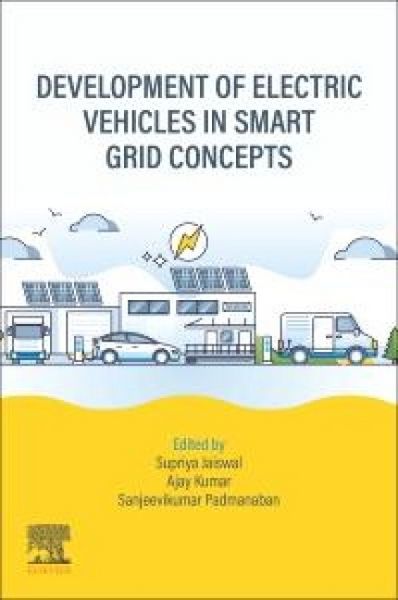
Development of Electric Vehicles in Smart Grid Concepts
-
- Taschenbuch ausgewählt
- eBook
-
Sprache:Englisch
196,99 €
inkl. gesetzl. MwSt.,
Beschreibung
Produktdetails
Einband
Taschenbuch
Erscheinungsdatum
12.09.2025
Herausgeber
Supriya Jaiswal + weitereVerlag
ElsevierSeitenzahl
268
Maße (L/B/H)
22,5/14,8/1,4 cm
Gewicht
450 g
Sprache
Englisch
ISBN
978-0-443-30140-7
Development of Electric Vehicles in Smart Grid Concepts presents a guide to the design, development, and deployment of electric vehicles in smart grids. The book examines the current technological progression of power electronic converters for smart grid operation and EV technology as well as providing the international standards, policies, and market needs to ensure readers understand the nuanced requirements of the grid. The book begins by introducing EVs, encompassing their historical evolution, current status, and potential advancements. It delves into the architecture, components, working modes, and technological challenges within EVs.
There is a dedicated chapter on international standards, governmental policies, and codes for implementation, followed by the integration of EVs into smart grids, discussing infrastructure requirements, impacts, and integration modes (V2G, G2V, V2B, and V2H). Technical aspects, modeling, and optimization methods for EV scheduling are explored alongside battery modeling, degradation, charging standards, SOC estimation, and battery management systems. Additionally, the book examines EV interaction with smart grids, renewable energy sources, energy storage systems, global market surveys, and future trends.
Noch keine Bewertungen vorhanden
Verfassen Sie die erste Bewertung zu diesem Artikel
Helfen Sie anderen Kundinnen und Kunden durch Ihre Meinung.
Kurze Frage zu unserer Seite
Vielen Dank für Ihr Feedback
Wir nutzen Ihr Feedback, um unsere Produktseiten zu verbessern. Bitte haben Sie Verständnis, dass wir Ihnen keine Rückmeldung geben können. Falls Sie Kontakt mit uns aufnehmen möchten, können Sie sich aber gerne an unseren Kund*innenservice wenden.
zum Kundenservice