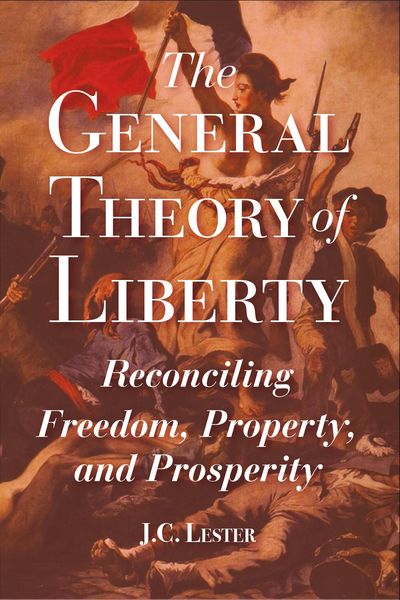
The General Theory of Liberty Reconciling Freedom, Property, and Prosperity
-
- Taschenbuch ausgewählt
- eBook
-
Sprache:Englisch
29,99 €
inkl. gesetzl. MwSt.,
- Kostenlose Lieferung ab 30 € Einkaufswert
- Versandkostenfrei für Bonuscard-Kund*innen
Beschreibung
Produktdetails
Einband
Taschenbuch
Erscheinungsdatum
17.12.2026
Verlag
Carus BooksSeitenzahl
380
Maße (L/B/H)
22,8/15,2/2 cm
Gewicht
509 g
Sprache
Englisch
ISBN
978-1-63770-071-6
Liberty, or freedom, is the absence of some sort of constraint on something. Most people think their own liberty is important. Classical liberals and libertarians love interpersonal or political liberty and almost worship it, but most of them, sadly, can’t explain what it is. Other people, even socialists, often declare that they like liberty a lot, but usually they too can’t tell us what it is.
Interpersonal liberty is not about the freedom to jump over buildings or levitate. That people are constrained by natural laws is not the issue. At first glance, interpersonal liberty looks to be about the absence of interpersonal or social constraints: people not interfering with (or constraining) each other in certain ways.
Sometimes people, including classical liberals, explicitly adapt the notion of liberty that Thomas Hobbes appealed to. They say that someone is free when other people don’t or can’t stop him from doing or having what he wants. The big problem with this is that it’s zero-sum. If I have the liberty to murder or rob you, then you don’t have the liberty not to be murdered or robbed (and vice versa). We can only choose which liberties we prefer by using some other, apparently higher, principle than liberty; such as utility, happiness, or prudential choice.
Hobbes’s liberty is a common-sense intuition, but John Locke had a better one. Roughly, we have liberty when people don’t interfere with or constrain us in our person or property. In this sense, not being murdered or robbed is part of liberty but murdering or robbing is not: murder and robbery are impositions or licenses. Such liberty can be decreased or increased. This is what most people, including classical liberals, intend to advocate. We see how it promotes human welfare as the satisfaction of wants or preferences: people don’t want to be imposed on and do want the products of free markets.
But we still have a big problem. Liberty, property, and welfare (well-being) have been conflated. What is the abstract theory of liberty that is being presupposed, independently of property and human well-being? How does that theory relate to property and well-being or prosperity? Can want-satisfaction be an adequate theory of welfare?
J.C. Lester’s new book starts by explaining and defending the abstract theory of liberty and then applying it until libertarian property is eventually derived. The bulk of the book defends many aspects of the overall theory from criticisms. It concludes with some important and controversial applications.
Noch keine Bewertungen vorhanden
Verfassen Sie die erste Bewertung zu diesem Artikel
Helfen Sie anderen Kundinnen und Kunden durch Ihre Meinung.
Kurze Frage zu unserer Seite
Vielen Dank für Ihr Feedback
Wir nutzen Ihr Feedback, um unsere Produktseiten zu verbessern. Bitte haben Sie Verständnis, dass wir Ihnen keine Rückmeldung geben können. Falls Sie Kontakt mit uns aufnehmen möchten, können Sie sich aber gerne an unseren Kund*innenservice wenden.
zum Kundenservice