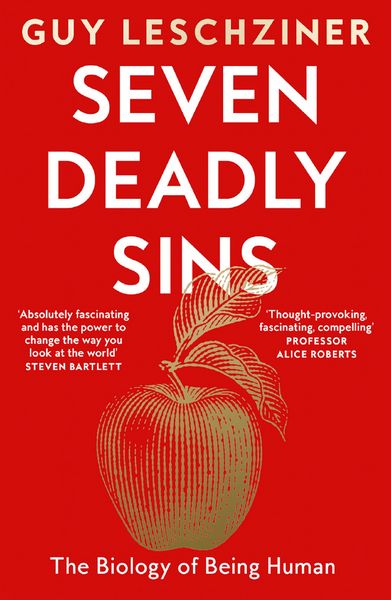
Seven Deadly Sins The Biology of Being Human
-
- Hardcover
- Taschenbuch ausgewählt
- eBook
-
Sprache:Englisch
-
Verlag:HarperCollins
- HarperCollins 8,99 € ausgewählt
- HarperCollins 16,99 €
8,99 €
inkl. gesetzl. MwSt.,
- Kostenlose Lieferung ab 30 € Einkaufswert
- Versandkostenfrei für Bonuscard-Kund*innen
Beschreibung
Produktdetails
Einband
Taschenbuch
Erscheinungsdatum
01.02.2026
Verlag
HarperCollinsSeitenzahl
384
Maße (L/B/H)
19,5/12,8/2,7 cm
Gewicht
266 g
Sprache
Englisch
ISBN
978-0-00-861573-4
'Has the power to change the way you look at the world' Steven Bartlett
'The heir to Oliver Sacks' David Baddiel
A FINANCIAL TIMESBEST BOOK OF 2024
AN INDEPENDENTBOOK OF THE MONTH
Gluttony. Greed. Sloth. Pride. Envy. Lust. Anger.
These are the seven deadly sins, the vices of humankind that define immorality, the roots of all evil in the world. Or so some believe.
But do these sins really represent moral failings, or are they simply human functions that aid us? Are they just the result of how our bodies, psyches, and brains in particular, are wired?
This new book by Dr Guy Leschziner, a professor of neurology and sleep medicine, explores the underlying nature of the seven deadly sins, their neuroscientific and psychological basis, their origin in our genes and crucially how certain medical disorders give rise to them.
Drawing on his clinical practice, we meet individuals whose physical and psychological conditions have given rise to these sins, where brain injury or other experiences have sparked 'immoral' actions. He explores how illness can simply expose what lies within us and investigates how the origins of these traits lie in evolutionary imperatives to preserve the wellbeing of the tribe. Perhaps, he suggests, these character traits are less of a moral question and more biological, which raises fundamental issues of responsibility and blame in the face of 'sin'.
Combining cutting-edge science placed in the context of real-life experience with patients, the book reexamines where the boundaries between normal human nature, pathology and sin are drawn. And, most importantly, whether these hard-wired traits truly represent sin, or simply the intensity of our intrinsic desire to survive and thrive.
Kundinnen und Kunden meinen
Verfassen Sie die erste Bewertung zu diesem Artikel
Helfen Sie anderen Kund*innen durch Ihre Meinung
Kurze Frage zu unserer Seite
Vielen Dank für Ihr Feedback
Wir nutzen Ihr Feedback, um unsere Produktseiten zu verbessern. Bitte haben Sie Verständnis, dass wir Ihnen keine Rückmeldung geben können. Falls Sie Kontakt mit uns aufnehmen möchten, können Sie sich aber gerne an unseren Kund*innenservice wenden.
zum Kundenservice