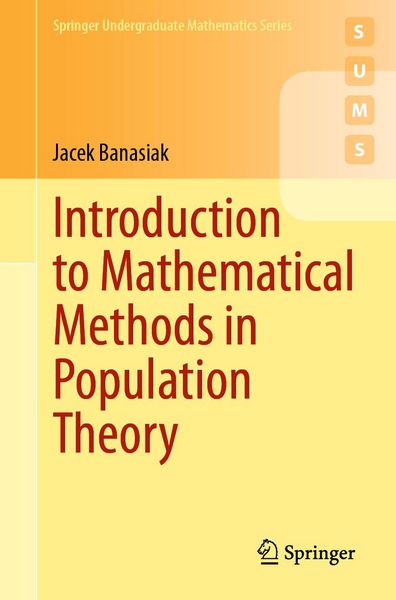
Introduction to Mathematical Methods in Population Theory
-
- Taschenbuch
- eBook ausgewählt
-
Form:Einzelkauf Download
-
Sprache:Englisch
65,99 €
inkl. gesetzl. MwSt.Beschreibung
Produktdetails
Format
Kopierschutz
Nein
Family Sharing
Nein
Text-to-Speech
Nein
Erscheinungsdatum
20.12.2024
Verlag
SpringerSeitenzahl
615 (Printausgabe)
Dateigröße
21723 KB
Sprache
Englisch
EAN
9783031654916
This textbook provides an introduction to the mathematical methods used to analyse deterministic models in life sciences, including population dynamics, epidemiology and ecology. The book covers both discrete and continuous models.
The presentation emphasises the solvability of the equations appearing in the mathematical modelling of natural phenomena and, in the absence of solutions, the analysis of their relevant properties. Of particular interest are methods that allow for determining the long-term behaviour of solutions. Thus, the book covers a range of techniques, from the classical Lyapunov theorems and positivity methods based on the Perron-Frobenius theorem, to the more modern monotone dynamical system approach. The book offers a comprehensive presentation of the Lyapunov theory, including the inverse Lyapunov theorems with applications to perturbed equations and Vidyasagar theorem. Furthermore, it provides a coherent presentation of the foundations of the theory of monotone dynamical systems with its applications to epidemiological models. Another feature of the book is the derivation of the McKendrick-von Foerster equation from the discrete Leslie model and the analysis of the long-term behaviour of its solutions.
Designed for upper undergraduate courses and beyond, this textbook is written for students and researchers looking to master the mathematics of the tools commonly used to analyse life science models. It therefore goes somewhat deeper into mathematics than typical books at this level but should be accessible to anyone with a good command of calculus with elements of real and complex analysis and linear algebra; the necessary concepts are collected in the appendices.
Noch keine Bewertungen vorhanden
Verfassen Sie die erste Bewertung zu diesem Artikel
Helfen Sie anderen Kundinnen und Kunden durch Ihre Meinung.
Kurze Frage zu unserer Seite
Vielen Dank für Ihr Feedback
Wir nutzen Ihr Feedback, um unsere Produktseiten zu verbessern. Bitte haben Sie Verständnis, dass wir Ihnen keine Rückmeldung geben können. Falls Sie Kontakt mit uns aufnehmen möchten, können Sie sich aber gerne an unseren Kund*innenservice wenden.
zum Kundenservice