Implantable Pressure Sensor Encapsulation for Ventricular Assist Device Control
-
- Englisch ausgewählt
64,00 €
inkl. gesetzl. MwSt.,
Beschreibung
Produktdetails
Einband
Taschenbuch
Erscheinungsdatum
19.12.2024
Herausgeber
Christofer HieroldVerlag
Hartung-GorreSeitenzahl
192
Maße (L/B/H)
24/17/1,3 cm
Gewicht
376 g
Auflage
2025
Sprache
Englisch
ISBN
978-3-86628-834-8
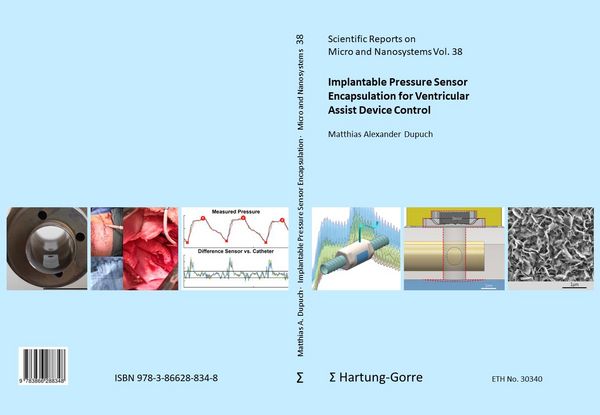
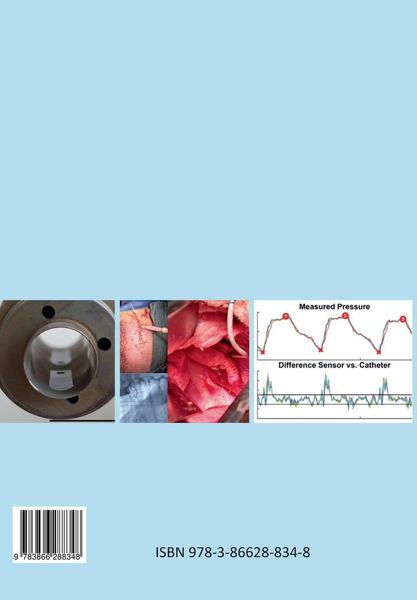
In this thesis, a pressure sensor encapsulation was developed and integrated in an inflow cannula for a VAD and in an implantable testing platform for animal trials. The encapsulation uses a media separating diaphragm embedded in a Parylene C coating. The approach is expanded to enable optimized diaphragm shapes, which allow significantly better control over the final device characteristics, especially the temperature cross sensitivity.
Furthermore, a production processes was developed to minimize assembly induced internal overpressure.
The produced capsules showed excellent pressure transmission of more than 99.7 % and a temperature cross sensitivity of less than 266 Pa from 35 °C to 42 °C for most capsules. However, a large temperature cross sensitivity was observed from room to body temperature in some capsules, adding relevant drift of 750 Pa (75 % quartile) after 42 days to the measurement.
The observed drift is related to the viscoelastic nature of the Parylene C diaphragm and the capsule-to-capsule variation is attributed to production process variations, which can be further optimized.
Systematic errors in the pressure transmission, temperature cross sensitivity (TCS), and drift were extracted and correction approaches for each were developed. This enabled the reduction of the pressure transmission error by 50 % by linear correction. A differential measurement approach reduced the temperature cross sensitivity to less than 70 Pa from 35 °C to 42 °C and
drastically reduced the temperature induced drift to 300 Pa (75 % quartile) after a jump from room to body temperature. Half of all sensors even remained within a +- 100 Pa window in the same time period.An alternative drift correction solution was developed based on the Burgers
model for viscoelastic materials. This approach performed almost as well as
the differential correction, but with the added benefit of being applicable to
single sensor systems.
One of the implantable testing platforms was used in three acute animal
trials. It matched the systolic and diastolic pressures recorded by a catheter
tip sensor within a +- 133 Pa window for most measurements.
The developed solutions and gained understanding with the proof of concept
device build a solid foundation for future pressure sensor integrations for
VAD applications.
Noch keine Bewertungen vorhanden
Verfassen Sie die erste Bewertung zu diesem Artikel
Helfen Sie anderen Kundinnen und Kunden durch Ihre Meinung.
Kurze Frage zu unserer Seite
Vielen Dank für Ihr Feedback
Wir nutzen Ihr Feedback, um unsere Produktseiten zu verbessern. Bitte haben Sie Verständnis, dass wir Ihnen keine Rückmeldung geben können. Falls Sie Kontakt mit uns aufnehmen möchten, können Sie sich aber gerne an unseren Kund*innenservice wenden.
zum Kundenservice