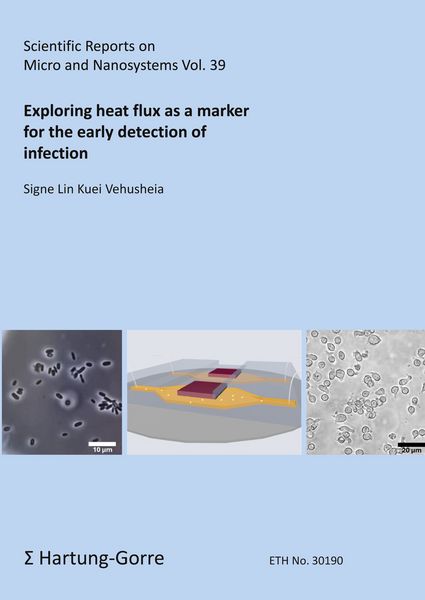
Exploring heat flux as a marker for the early detection of infection
-
- Englisch ausgewählt
64,00 €
inkl. gesetzl. MwSt.,
Beschreibung
Produktdetails
Einband
Taschenbuch
Erscheinungsdatum
19.12.2024
Herausgeber
Christofer HieroldVerlag
Hartung-GorreSeitenzahl
254
Maße (L/B/H)
24/17/1,6 cm
Gewicht
440 g
Auflage
2025
Sprache
Englisch
ISBN
978-3-86628-835-5
One major technological hurdle is the high-volume fabrication of CNT devices, in particular that of suspended CNT devices, which demonstrate several advantages as sensors. This thesis presents an approach to address this challenge, focusing on the scalable batch growth of suspended CNTs and their automated assembly into functional devices. Through systematic multi-parameter optimization and the development of large-scale growth substrates, the optimal growth conditions for CNTs were identified, leading to a significant increase in the number of individual CNTs available for device integration. An automated nanoassembly machine was employed to transfer pre-selected CNTs from growth substrates to device substrates.
The process flow designed around automated robotic assembly demonstrates a production rate – mechanical transfer rate for carbon nanotubes – of approximately 46 CNTs per hour, with a 70 % yield of electrically active devices. The assembled devices were characterized electrically to understand the performance of devices fabricated by this method.
Contact resistance at the CNT-electrode interface is another critical factor influencing device performance. This thesis demonstrates that electrode etching with argon ion immediately prior to nanotube transfer effectively removes all adsorbates from palladium or gold electrode surface and, as a result, consistently enables clean CNT-electrode contact. When combined with post-transfer thermal annealing, this pre-transfer treatment reduces the median ON-resistance (Ron) of CNT devices by an order of magnitude and the interquartile range by more than two orders of magnitude. This is crucial for the self-heating functionality of suspended CNT gas sensors.
Lastly, the thesis demonstrates the application of suspended CNTs in fast and ultra-low-power NO2 sensors. By leveraging self-heating for rapid gas desorption and employing a nonlinear transient analysis method, the sensors achieved a signal recovery time of 1 minute and readout time of 1-5 minutes at a peak power of approximately 5.6 μW. With a readout time of 5 minutes, the limit of detection of the sensor was 9 ppb NO2 in synthetic air with 40 % relative humidity. These performance improvements were reproduced with additional devices, which were assembled both manually and automatically.
Noch keine Bewertungen vorhanden
Verfassen Sie die erste Bewertung zu diesem Artikel
Helfen Sie anderen Kundinnen und Kunden durch Ihre Meinung.
Kurze Frage zu unserer Seite
Vielen Dank für Ihr Feedback
Wir nutzen Ihr Feedback, um unsere Produktseiten zu verbessern. Bitte haben Sie Verständnis, dass wir Ihnen keine Rückmeldung geben können. Falls Sie Kontakt mit uns aufnehmen möchten, können Sie sich aber gerne an unseren Kund*innenservice wenden.
zum Kundenservice