KI-Beratung Beta

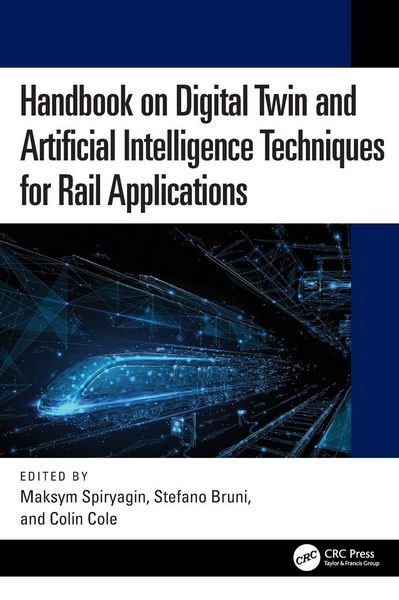
Produktbild: Handbook on Digital Twin and Artificial Intelligence Techniques for Rail Applications

Handbook on Digital Twin and Artificial Intelligence Techniques for Rail Applications

356,99 €

inkl. gesetzl. MwSt., Versandkostenfrei


Beschreibung

The handbook showcases the modern methods, methodologies and frameworks for the development of DT and AI architectures and apparatus in the area of the existing railway systems and transport engineering tasks.

Beschreibung

The handbook showcases the modern methods, methodologies and frameworks for the development of DT and AI architectures and apparatus in the area of the existing railway systems and transport engineering tasks.

Produktdetails

Einband

Gebundene Ausgabe

Erscheinungsdatum

17.06.2025

Abbildungen

schwarz-weiss Illustrationen, farbige Illustrationen, Raster,schwarz-weiss, Raster, farbig, Zeichnungen, schwarz-weiss, Zeichnungen, farbig, Tabellen, schwarz-weiss

Herausgeber Maksym Spiryagin + weitere

Produktdetails

Einband

Gebundene Ausgabe

Erscheinungsdatum

17.06.2025

Abbildungen

schwarz-weiss Illustrationen, farbige Illustrationen, Raster,schwarz-weiss, Raster, farbig, Zeichnungen, schwarz-weiss, Zeichnungen, farbig, Tabellen, schwarz-weiss

Herausgeber
Verlag Taylor and Francis
Seitenzahl

334

Maße (L/B/H)

26/18,3/2,3 cm

Gewicht

763 g

Sprache

Englisch

ISBN

978-1-03-277602-6

Herstelleradresse

Libri GmbH
Europaallee 1
36244 Bad Hersfeld
DE

Email: gpsr@libri.de

Noch keine Bewertungen vorhanden

Verfassen Sie die erste Bewertung zu diesem Artikel

Helfen Sie anderen Kundinnen und Kunden durch Ihre Meinung.

Kundinnen und Kunden meinen

Bewertungen (0)

Die Leseprobe wird geladen.
  • Produktbild: Handbook on Digital Twin and Artificial Intelligence Techniques for Rail Applications
  • Chapter 1 Introduction to Digital Twins and Artificial Intelligence

    Maksym Spiryagin, Stefano Bruni, and Colin Cole

    Chapter 2 Architecture Concepts of Digital Twins

    Florian Klinger and Johannes Edelmann

    Chapter 3 Data Collection and Management for Digital Twins

    Giovanni Lugaresi, Lulai Zhu, and Andrea Matta

    Chapter 4 Digital Twin Modeling and Simulation

    Maksym Spiryagin, Yan Quan Sun, Thomas Mond, Chris Bosomworth, and Leron Postelnik

    Chapter 5 Development of DatäDriven Digital Twins

    Jacek Mocki, George Stojkovski, and Jake Pisano

    Chapter 6 Development of Physics¿Based Digital Twin

    Sanjar Ahmad and Farzaneh Tahmoorian

    Chapter 7 Development of Human-Digital Twin Interaction

    Anjum Naweed

    Chapter 8 Digital Twins for Rail Vehicle Designs

    Nicola Bosso, Matteo Magelli, and Nicolò Zampieri

    Chapter 9 Digital Twins for Railway Infrastructure Asset Management and Maintenance

    Marco Macchi, Adalberto Polenghi, and Irene Roda

    Chapter 10 Digital Twins for Train Operation Optimizations

    Colin Cole

    Chapter 11 Digital Twins for Train Operational Safety and Reliability

    Qing Wu, Xiaohua Ge, Shengyang Zhu, and Shuai Su

    Chapter 12 Digital Twins for Rail Network Infrastructure

    Farzaneh Tahmoorian, Travis March, and Maksym Spiryagin

    Chapter 13 AI in Digital Twins for Rail Operations

    Francesco Flammini, Elena Napoletano, and Stefano Ricci

    Chapter 14 AI for Rolling Stock

    Sebastian Stichel, Wolfgang Birk, Carlos Casanueva, and Jonathan Leung

    Chapter 15 AI for Rail Infrastructure and Maintenance

    Stefano Bruni, Marco Carnevale, Gabriele Cazzulani,

    Egidio Di Gialleonardo, and Ivano La Paglia

    Chapter 16 Digital Twin and Artificial Intelligence for Railway Hubs Design and Management

    Pierluigi Coppola, Luigi Castagna, and Fulvio Silvestri

    Chapter 17 Ethical Considerations for the Development and Deployment of AI in Rail

    Yit Hong Choo, Douglas Creighton, Fariza Sabrina, Hong Shen, and MD Mamunur Rashid

    Chapter 18 Integration of AI in Digital Twin Technologies

    Esteban Bernal Arango

    Chapter 19 Future of Digital Twins in the Rail Industry

    Maksym Spiryagin, Stefano Bruni, and Colin Cole

    Chapter 20 Conclusion

    Maksym Spiryagin, Stefano Bruni, and Colin Cole