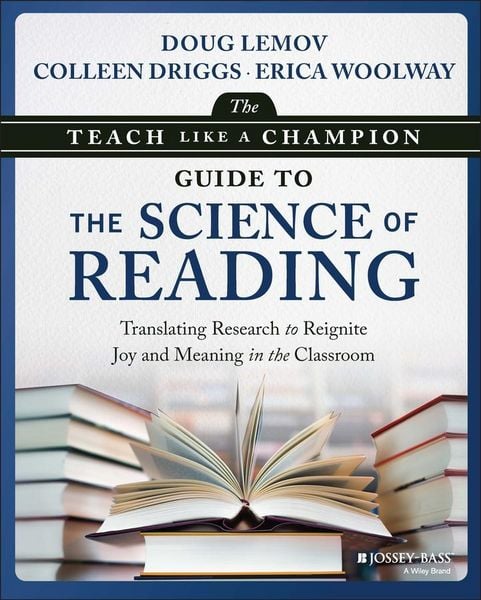
The Teach Like a Champion Guide to the Science of Reading Translating Research to Reignite Joy and Meaning in the Classroom
-
- Englisch ausgewählt
25,99 €
inkl. gesetzl. MwSt.,
- Kostenlose Lieferung ab 30 € Einkaufswert
- Versandkostenfrei für Bonuscard-Kund*innen
Beschreibung
Produktdetails
Einband
Taschenbuch
Erscheinungsdatum
21.07.2025
Verlag
John Wiley & SonsSeitenzahl
438
Maße (L/B/H)
23,3/18,8/2,8 cm
Gewicht
890 g
Sprache
Englisch
ISBN
978-1-394-30599-5
"I love this book. Every teacher who asks their students to read will find it becomes the most worn on their shelf; it's a wellspring of clear explanation of the science of reading, and practical strategies for helping students become successful readers."
-DANIEL T. WILLINGHAM, Professor of Psychology at the University of Virginia and author of Why Don't Students Like School?, Outsmart Your Brain, and Raising Kids Who Read
Learn to use the latest reading science to improve your literacy instruction
In The Teach Like a Champion Guide to the Science of Reading, experienced literacy experts, educators, and authors, Doug Lemov, Colleen Driggs, and Erica Woolway deliver actionable guidance-grounded in seven evidence-based principles-that helps teachers use established science and research to ensure greater reading success once students have learned to decode.
The book shares proven classroom instruction techniques that equip teachers, especially those in grades 3-12, to translate the latest reading science into teaching and curriculum design. It includes links to more than 50 video clips from the classroom that demonstrate the principles of the science of reading in action.
The Teach Like a Champion Guide to the Science of Reading explains the central role of background knowledge in understanding text, the often-overlooked role of fluency in reading comprehension as well as the profound importance of managing and socializing attention in an age of technology.
Perfect for teachers, literacy coaches, curriculum designers, and administrators aiming to foster rigorous literacy instruction in their classes and schools, this book is a powerful guide to helping students discover the joy of reading, helping them to become better, wiser, more engaged, and more motivated readers.
Noch keine Bewertungen vorhanden
Verfassen Sie die erste Bewertung zu diesem Artikel
Helfen Sie anderen Kundinnen und Kunden durch Ihre Meinung.
Kurze Frage zu unserer Seite
Vielen Dank für Ihr Feedback
Wir nutzen Ihr Feedback, um unsere Produktseiten zu verbessern. Bitte haben Sie Verständnis, dass wir Ihnen keine Rückmeldung geben können. Falls Sie Kontakt mit uns aufnehmen möchten, können Sie sich aber gerne an unseren Kund*innenservice wenden.
zum Kundenservice