Gutscheinbedingungen

**Gültig von 22.06.2026 ab 19 Uhr bis 23.06.2026 24 Uhr auf Spielzeug, Schreibwaren, Filme, Geschenke & Trends, Musik, tolino eReader & Zubehör, Hörbücher und Hörbuch-Downloads (außer Abo), nicht preisgebundene Bücher und Kalender online auf thalia.at und in der Thalia App. Einzelne Artikel können ausgeschlossen sein. Aufgrund der Buchpreisbindung sind deutschsprachige Bücher und eBooks ausgenommen. Zusätzlich ausgenommen sind preisgebundene Artikel, Abos & Flatrates, eBooks, Games, Geschenkkarten/-boxen, Shelfies, Software, Zeitschriften sowie einzelne Artikel von tonies®. Pro Einkauf einmal einlösbar. Click & Collect nur bei Onlinevorabzahlung möglich. Keine Barauszahlung. Nicht kombinierbar mit anderen Aktionen und Gutscheinen. Gutschein wird auf max. 500€ Bestellwert angerechnet. Nicht gültig für Versandkosten und Services.

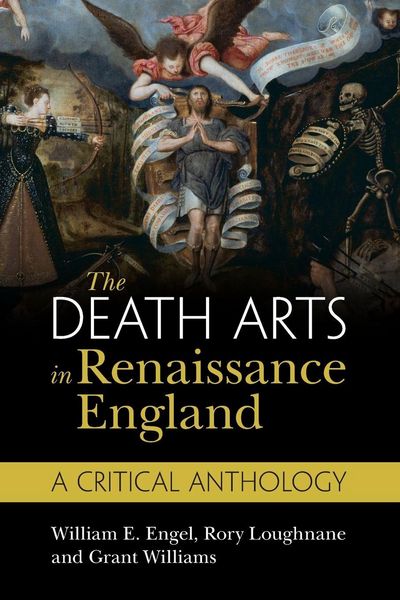
  • Produktbild: The Death Arts in Renaissance England
  • Produktbild: The Death Arts in Renaissance England

The Death Arts in Renaissance England A Critical Anthology

44,99 €

inkl. gesetzl. MwSt., Versandkostenfrei


Beschreibung

Produktdetails

Einband

Taschenbuch

Erscheinungsdatum

13.03.2025

Herausgeber

William E. Engel + weitere

Verlag

Bloomsbury USA

Seitenzahl

406

Maße (L/B/H)

22,9/15,2/2,2 cm

Gewicht

586 g

Sprache

Englisch

ISBN

978-1-108-74956-5

Beschreibung

Portrait

William E. Engel is the Nick B. Williams Professor of Literature at the University of the South, Sewanee. He is the author of five books on literary history, memory studies and applied emblematics, including Mapping Mortality (1995), Death and Drama in Renaissance England (2002), and co-editor of The Memory Arts in Renaissance England (Cambridge, 2016). He is on the editorial board of Renaissance Quarterly and is the Renaissance Society of America's Discipline Representative for Emblems.

Rory Loughnane is Reader in Early Modern Studies and Co-Director of the Centre for Medieval and Early Modern Studies at University of Kent. He is the author or editor of eight books, including, most recently, Early Shakespeare, 1588–1594 (Cambridge UP, 2020) and The Death Arts in Renaissance England (Cambridge UP, 2022). He is a General Editor of The Oxford Marlowe, a General Editor of The Revels Plays series for Manchester UP, an Associate Editor of the New Oxford Shakespeare, and a Series Editor of Routledge's Studies in Early Modern Authorship and Cambridge's Shakespeare and Text. He was awarded the 2019 Charles and Rose G. Hoffman Prize for distinguished work in Marlowe studies.

Grant Williams is an Associate Professor of English at Carleton University. He has co-edited four collections: Forgetting in Early Modern English Literature and Culture: Lethe's Legacies (2004), Ars reminiscendi: Memory and Culture in the Renaissance (2009), Taking Exception to the Law: Materializing Injustice in Early Modern English Literature (2015), and The Memory Arts in Renaissance England: A Critical Anthology (Cambridge, 2016). He is currently working on an introduction to an edition of Henry Chettle's Kindheart's Dream and Piers Plainness and a SSHRC funded project to study 16th and 17th century emblematic title pages.

Produktdetails

Einband

Taschenbuch

Erscheinungsdatum

13.03.2025

Herausgeber

Verlag

Bloomsbury USA

Seitenzahl

406

Maße (L/B/H)

22,9/15,2/2,2 cm

Gewicht

586 g

Sprache

Englisch

ISBN

978-1-108-74956-5

Herstelleradresse

Libri GmbH
Europaallee 1
36244 Bad Hersfeld
DE

Email: gpsr@libri.de

Kundinnen und Kunden meinen

0 Bewertungen

Informationen zu Bewertungen

Zur Abgabe einer Bewertung ist eine Anmeldung im Konto notwendig. Die Authentizität der Bewertungen wird von uns nicht überprüft. Wir behalten uns vor, Bewertungstexte, die unseren Richtlinien widersprechen, entsprechend zu kürzen oder zu löschen.

Die Bewertungen sind nach Format, Anzahl Sterne und Datum sortiert.

Verfassen Sie die erste Bewertung zu diesem Artikel

Helfen Sie anderen Kund*innen durch Ihre Meinung

Kundinnen und Kunden meinen

0 Bewertungen filtern

  • Produktbild: The Death Arts in Renaissance England
  • Produktbild: The Death Arts in Renaissance England
  • Part I. Preparatory and dying Arts: I.1. To know well to die (1490); I.2. The Calendar of Shepherds (1518); I.3. The way of dying well (1534); I.4. The Lamentation of a Sinner (1547); I.5. 'A Meditation of a penitent Sinner' (1560); I.6. A Fruitful treatise...against the fear of Death (1564); I.7. A Spiritual Consolation (1578); I.8. The repentance of Robert Greene (1592); I.9. A Salve for a Sick Man (1595); I.10. The Mother's Blessing (1616); I.11. Selected Works (1628, 1635); I.12. 'The unnatural Wife' (1628); I.13. An antidote against purgatory (1634); I.14. Holy dying (1651); I.15. The virgin's pattern (1661); I.16. A Token for Children (1676); I.17. 'A True account of...last dying speeches' (1690); Part II. Funereal and Commemorative Arts: II.1.Chronicles (1548); II.2. 'The Order for the burial of the dead' (1549); II.3. The Primer set forth at large (1559); II.4. Acts and Monuments (1576); II.5. The Glorious Martyrdom of twelve Priests (1582); II.6. The life and death of Sir Philip Sidney (1587); II.7. The French History (1589); II.8. 'Doleful Lay of Clorinda' (1595); II.9. Selected Works (1603, 1604); II.10. 'A Mirror of Modesty' (1621); II.11. 'A Sermon...the 5th of November, 1606' (1629); II.12. The Phoenix of these late times (1637); II.13. Eikon Basilike (1649); II.14. 'An Elegy on the Lady Markham' (1653); II.15. A String of Pearls (1657); II.16. Poems (1669); II.17. 'An Essay upon Death' (1696); Part III. Knowing and Understanding Death: III.1. The despising of the World (1532); III.2. A Preservative against Death (1545); III.3. A Godly Meditation (1548); III.4. A Mirror for Magistrates (1587); III.5. The Haven of Health (1588); III.6. Protection for Woman (1589); III.7. Montaigne's Essays (1603); III.8. The Works of Seneca (1614); III.9. Navmachia (1622); III.10. 'Of Death' (1625); III.11. Mikrokosmographia (1631); III.12. 'A View of the present State of Ireland' (1633); III.13. A View of all Religions in the World (1653); III.14. Natural and Political Observations (1662); III.15. Philosophical Letters (1664); III.16. Lucretius's Six Books (1683); III.17. Principles of the most Ancient and Modern Philosophy (1692); Part IV. Death Arts in Literature: IV.1. The Ship of Fools (1509); IV.2. The Summoning of Everyman (1528); IV.3. The Dance of Death (1554); IV.4. 'Complaint of a Dying Lover' (1557); IV.5. 'A Strange Punishment' (1566); IV.6. 'Gascoigne's Goodnight' (1573); IV.7. 'The Manner of her Will' (1573); IV.8. The Mirror of Princely deeds and Knighthood (1578); IV.9. Selected Works (1594, 1604); IV.10. Selected Works (1606, 1614); IV.11. Salve Deus Rex Judaeorum (1611); IV.12. Selected Works (1611, 1613); IV.13. The Tragedy of Mariam (1613); IV.14. Urania (1621); IV.15. 'The last Will and Testament of Philip Herbert' (1650); IV.16. 'The Nymph complaining for the death of her Fawn' (1681); IV.17. Oroonoko (1688).