
Gutscheinbedingungen

**Gültig bis 06.07.2026 auf fremdsprachige Bücher online auf thalia.at, in der Thalia App ab einem Mindestbestellwert von 30€ und in allen Thalia Buchhandlungen in Österreich. In den Buchhandlungen nur gültig auf lagernde Ware. Einzelne Artikel können ausgeschlossen sein. Ausgenommen sind preisgebundene Artikel & eBooks. Pro Einkauf einmal einlösbar. Nur gültig gegen Vorlage oder im Onlineshop hinterlegter Bonuscard. Infos zur Einlösung in der Buchhandlung sind auf der Bonuscard-Vorteilspreisseite zu finden. Click & Collect nur bei Onlinevorabzahlung möglich. Keine Einlösung bei Scan & Go-Bezahlung. Keine Barauszahlung. Nicht kombinierbar mit anderen Aktionen und Gutscheinen. Gutschein wird auf max. 500€ Bestellwert angerechnet. Nicht gültig für Versandkosten und Services.

  • Produktbild: Dynamics of Physiological Control
  • Produktbild: Dynamics of Physiological Control

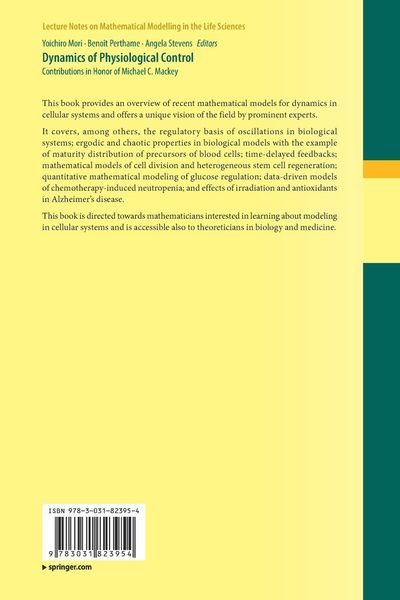
Dynamics of Physiological Control Contributions in Honor of Michael C. Mackey

49,99 €

inkl. gesetzl. MwSt., Versandkostenfrei


Beschreibung

Produktdetails

Einband

Taschenbuch

Erscheinungsdatum

04.04.2025

Abbildungen

VII, 27 illus., 18 illus. in color., schwarz-weiss Illustrationen, farbige Illustrationen

Herausgeber

Yoichiro Mori + weitere

Verlag

Springer

Seitenzahl

161

Maße (L/B/H)

23,5/15,5/1 cm

Gewicht

271 g

Sprache

Englisch

ISBN

978-3-031-82395-4

Beschreibung

Portrait

Yoichiro Mori is the Calabi-Simons Professor of Mathematics and Biology at the University of Pennsylvania. He has worked on problems in physiology and biophysics, with a focus on electrophysiology and biofluid mechanics. His mathematical interests include numerical and applied analysis of partial differential equations and dynamical systems.

Benoît Perthame is an Emeritus Professor at Sorbonne Université in Paris. He has been successively the head of an Inria team he organized on mathematical biology, and head of the Laboratoire Jacques-Louis Lions. He is a member of the Académie des Sciences. Since the end of 1990s he turned his research area to partial differential equations in biology and medicine, including cell motion, modeling evolution, neuroscience, and more generally structured equations.

Angela Stevens is Full Professor at the University of Münster and Honorary Professor at Leipzig University. Together with Michael C. Mackey she is founding editor of Springer's Lecture Notes on Mathematical Modelling in the Life Sciences (LMML).  She is working on mathematical models in biology and medicine, including cell motility and chemotaxis, the cellular cytoskeleton, epidemiology, pattern formation in microbial colonies, and tissue regeneration. Mathematically her focus is on partial- and integro-differential equations with further interests in stochastic interacting many-particle systems.

Produktdetails

Einband

Taschenbuch

Erscheinungsdatum

04.04.2025

Abbildungen

VII, 27 illus., 18 illus. in color., schwarz-weiss Illustrationen, farbige Illustrationen

Herausgeber

Verlag

Springer

Seitenzahl

161

Maße (L/B/H)

23,5/15,5/1 cm

Gewicht

271 g

Sprache

Englisch

ISBN

978-3-031-82395-4

Herstelleradresse

Springer-Verlag GmbH
Tiergartenstr. 17
69121 Heidelberg
DE

Email: GPSR Kontakt

Noch keine Bewertungen vorhanden

Verfassen Sie die erste Bewertung zu diesem Artikel

Helfen Sie anderen Kundinnen und Kunden durch Ihre Meinung.

Kundinnen und Kunden meinen

Bewertungen (0)

  • Produktbild: Dynamics of Physiological Control
  • Produktbild: Dynamics of Physiological Control
  • - 1. Mike and Me Since 1973: A Review of a Long Friendship and Research Relationship.- 2. Michael Mackey and Data-Driven Models of Chemotherapy-Induced Neutropenia.- 3. Biological rhythms: Mechanisms, functions, and associated disorders.- 4. Mathematical Modeling of Heterogeneous Stem Cell Regeneration: From Cell Division to Waddington’s Epigenetic Landscape.- 5. A Mathematical Model to Describe the Formation of Perinuclear ATM Crown and the Effect of Irradiation and Antioxidants in Cells Affected by Alzheimer’s Disease.- 6. Ergodic and Chaotic Properties of Some Biological Models.- 7. Quantitative Insights into Glucose Regulation: A Review of Mathematical Modeling Efforts.- 8. Why does a Stick Balanced on the Fingertip fall?.