KI-Beratung Beta

Gutscheinbedingungen

**Gültig bis 05.10.2026 ab einem Mindestbestellwert von 30€ auf Spielzeug, Schreibwaren, Filme, Geschenke & Trends, Musik, tolino eReader & Zubehör, Hörbücher und Hörbuch-Downloads, nicht preisgebundene Bücher und Kalender online auf thalia.at und in der Thalia App. Einzelne Artikel können ausgeschlossen sein. Aufgrund der Buchpreisbindung sind deutschsprachige Bücher und eBooks ausgenommen. Zusätzlich ausgenommen sind Abos & Flatrates, Games, Geschenkkarten/-boxen, Shelfies, Software, Zeitschriften sowie einzelne Artikel von tonies®. Pro Einkauf einmal einlösbar. Nur gültig mit im Onlineshop hinterlegter Bonuscard. Click & Collect nur bei Onlinevorabzahlung möglich. Keine Barauszahlung. Nicht kombinierbar mit anderen Aktionen und Gutscheinen. Gutschein wird auf max. 500€ Bestellwert angerechnet. Nicht gültig für Versandkosten und Services. Preisgebundene Artikel sind vom Mindestbestellwert ausgeschlossen.

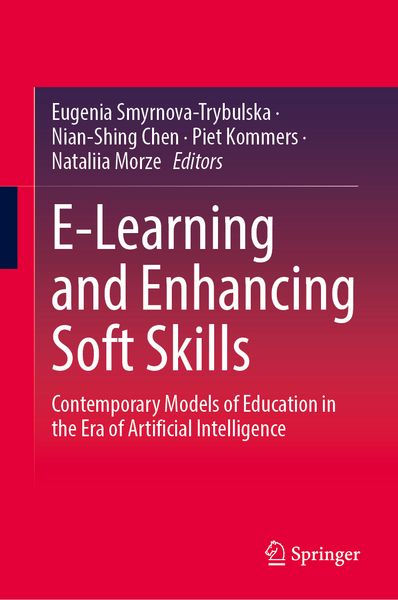
  • Produktbild: E-Learning and Enhancing Soft Skills
  • Produktbild: E-Learning and Enhancing Soft Skills
- 15%

E-Learning and Enhancing Soft Skills Contemporary Models of Education in the Era of Artificial Intelligence

15% sparen

166,99 € UVP 197,99 €

inkl. gesetzl. MwSt., Versandkostenfrei


Beschreibung

Produktdetails

Einband

Gebundene Ausgabe

Erscheinungsdatum

11.03.2025

Abbildungen

VII, 358 p. 127 illus., 106 illus. in color.

Herausgeber

Eugenia Smyrnova-Trybulska + weitere

Verlag

Springer

Seitenzahl

358

Maße (L/B/H)

24,1/16/2,6 cm

Gewicht

715 g

Sprache

Englisch

ISBN

978-3-031-82242-1

Beschreibung

Portrait

Dr. hab. Eugenia Smyrnova-Trybulska
is an Associate Professor at the University of Silesia, Poland, with over 30 years of experience. She coordinates the European IRNet project and has led numerous national and international educational and research initiatives. Her research focuses on e-learning methodology, ICT, multimedia, robotics in education, SMART universities, STEAM education, teacher training in ICT and e-learning, and MOOCs. She holds a PhD (1997) and a D.Litt. (2008) in Pedagogical Sciences, specializing in the theory and methodology of teaching computer science. She became a Full Professor in Ukraine in 2021. Eugenia Smyrnova-Trybulska has authored over 380 scientific publications, including 26 books and monographs. She has coordinated and participated in various projects funded by the European Union (7FP IRSES Marie Curie), Erasmus+, CEEPUS, and national projects. She has also developed 160 e-learning courses and two MOOCs. Currently, she is a Professor at the University of Silesia and coordinates the Silesian scientific laboratory on ICT, robotics, SMART, and Well-Being in education.


Professor Dr. Nian-Shing
Chen is a Chair Professor in the Institute for Research Excellence in Learning Sciences and Program of Learning Sciences at the National Taiwan Normal University, Taiwan. Professor Chen received the National Outstanding Research award three times in 2008, 2011, and 2015. He is ranked in second place on the Top Authors list by article count in Computers & Education. He is ranked number 4 on the top scholar list in the educational technology field based on an article published in the British Journal of Educational Technology. One of his papers published in Innovations in Education and Teaching International was awarded as the top-cited article in 2010. Professor Chen is ranked third in the list of Social Sciences and Humanities Scientists in Taiwan. Based on AD Scientific Index 2023, Prof. Chen is ranked number 8 in Asia and is ranked number 103 in the world in Education Research. He is listed as World’s top 2% scientists in 2021, 2022, 2023 and in the list of "Lifelong Science Influence Rankings (1960-2022) by Stanford University. Professor Chen was served as the Editor-in-Chief for Educational Technology & Society (ET&S) journal. He is also a golden core member of IEEE, a lifelong member of ACM, and the former Chair of the IEEE Technical Committee on Learning Technology.

Prof. Dr. Piet Kommers
is advisor and consultant for the European Commission, UNESCO and National Ministries of Education. He received the title of honorary professor in Learning Technologies by the UNESCO International Research and Training Centre for his Developmental Projects in Europe, the ASEAN countries. His workshop templates and experiences have been implemented into the UNESCO IITE reports, policy briefings and Master Course. After initiating and chairing the NATO conferences on Cognitive Support Tools, he was invited to undertake the accreditation processes of new EU research projects. His books and journal article citations exceed the level of 10.000 and the h-index of 37. He successfully supervised more than 22 awarded PhD projects. His recent book is "Sources for a better Education"

Nataliia Morze,
Professor in the Department of Computer Science, Ph.D. hab., professor, is corresponding member of the National Academy of Sciences of Ukraine. Her research is in the field of ICT education, digital and online learning. She is a member of the Digital Technologies in Education Committee at the Ministry of Education & Science in Ukraine. She provides expertise and consultancy for the Ministry of Education & Science in Ukraine in the field of ICT, policy making, concept papers development, digital programs/processes/skill framework development, online learning resources analysis, expert ETF “Digital Skills and Competence (DSC) and Digital and Online Learning (DOL) in VET in ETF partner countries." She has authored textbooks and methodological manuals on ICT for secondary schools and HEd and vocational education, Leadership in several international research project teams in the field of innovative technologies. Dr. Morze has authored more than 400 scientific works including on computer science, e-government, ICT and Elearning, methodology of E-learning, use of ICT in learning and teaching of mathematic and other subjects, STEAM- education, using multimedia in education, etc.

Produktdetails

Einband

Gebundene Ausgabe

Erscheinungsdatum

11.03.2025

Abbildungen

VII, 358 p. 127 illus., 106 illus. in color.

Herausgeber

Verlag

Springer

Seitenzahl

358

Maße (L/B/H)

24,1/16/2,6 cm

Gewicht

715 g

Sprache

Englisch

ISBN

978-3-031-82242-1

Herstelleradresse

Springer-Verlag GmbH
Tiergartenstr. 17
69121 Heidelberg
DE

Email: ProductSafety@springernature.com

Noch keine Bewertungen vorhanden

Verfassen Sie die erste Bewertung zu diesem Artikel

Helfen Sie anderen Kundinnen und Kunden durch Ihre Meinung.

Kundinnen und Kunden meinen

Bewertungen (0)

Weitere Artikel finden Sie in

  • Produktbild: E-Learning and Enhancing Soft Skills
  • Produktbild: E-Learning and Enhancing Soft Skills

  • Chapter1: 
    Introduction. Third Decade of 21st Century Education.- Chapter2: Revolutionizing Education with Pedagogical AI Agents
    .- Chapter3: 
    The concept of teaching high school students programming using artificial intelligence.- Chapter4: Comparison of Methods for Identifying Rapid Guessing Behavior in Microlearning Courses.- Chapter5: Development of Youth Information Hygiene Skills: The Gap Between  Self-Assessment and the Actual Situation
    .- Chapter6: 
    The use of educational applications in primary and lower secondary school teaching and their impact on the development of learners' key competences
    .- Chapter7: 
    Programming in technical focused education
    .- Chapter8: 
    Examining M-learning trends among university students - mobile devices in students study and life.- Chapter9: E-learning in developing interaction with the environment as Soft skills in 6-year-old children (on the example of preschool educational institutions in Ukraine and France).- Chapter10: The Use of Artificial Intelligence in the Professional Activity of University Teachers of Ukraine
    .- Chapter11: 
    EXAMPLE OF GOOD PRACTICE FOR TEACHING ABOUT CYBER SECURITY IN SECONDARY SCHOOL.- Chapter12: Solution Time And Confidence In Assessment Of Algorithmic And Logical Thinking Of First-Year Computer Science Students.- Chapter13: Approach for Automatic Test Generation from ontology in virtual educational platform.- Chapter14: CAN bus workplace with remote access employing LabVIEW  Web Service.- Chapter15: Virtual laboratory as a tool to empower IT students
    .- Chapter16: 
    Examination of Teachers' Competencies for Online Teaching.- Chapter17: Digitalization of social services for vulnerable groups in territorial communities of Ukraine.- Chapter18: Tools for teaching the R programming language to bachelors of computer science in the period of distance learning.- Chapter19: Digital And Pedagogical Skills Of Future Teachers - Doctors Of Philosophy Of Economic Specialties.