Gutscheinbedingungen

**Gültig bis 06.07.2026 auf fremdsprachige Bücher online auf thalia.at, in der Thalia App ab einem Mindestbestellwert von 30€ und in allen Thalia Buchhandlungen in Österreich. In den Buchhandlungen nur gültig auf lagernde Ware. Einzelne Artikel können ausgeschlossen sein. Ausgenommen sind preisgebundene Artikel & eBooks. Pro Einkauf einmal einlösbar. Nur gültig gegen Vorlage oder im Onlineshop hinterlegter Bonuscard. Infos zur Einlösung in der Buchhandlung sind auf der Bonuscard-Vorteilspreisseite zu finden. Click & Collect nur bei Onlinevorabzahlung möglich. Keine Einlösung bei Scan & Go-Bezahlung. Keine Barauszahlung. Nicht kombinierbar mit anderen Aktionen und Gutscheinen. Gutschein wird auf max. 500€ Bestellwert angerechnet. Nicht gültig für Versandkosten und Services.

Produktbild: Aquatic Macrophytes: Ecology, Functions and Services

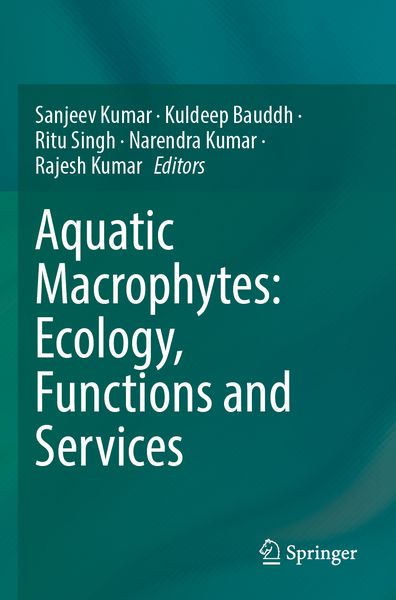
Aquatic Macrophytes: Ecology, Functions and Services

218,99 €

inkl. gesetzl. MwSt., Versandkostenfrei


Beschreibung

Produktdetails

Einband

Taschenbuch

Erscheinungsdatum

23.11.2024

Herausgeber

Sanjeev Kumar + weitere

Verlag

Springer Singapore

Seitenzahl

311

Maße (L/B/H)

23,5/15,5/1,8 cm

Gewicht

493 g

Auflage

1. Auflage

Sprache

Englisch

ISBN

978-981-9938-24-7

Beschreibung

Portrait

Dr. Sanjeev Kumar has obtained his M.Sc. and Ph.D. in Environmental Science from Babasaheb Bhimrao Ambedkar University, Lucknow, India. Currently, he is working as an Assistant Professor in the Department of Geology at the same university. Dr. Kumar has made significant contributions in the field of sustainable agriculture, focusing on various aspects such as soil quality management, agriculture gaseous emissions, slow-release fertilizers, and phytoremediation. His research endeavors aim to develop innovative approaches for enhancing agricultural practices while minimizing environmental impacts.


Dr. Kuldeep Bauddh is currently an Assistant Professor at the Department of Environmental Sciences, Central University of Jharkhand, Ranchi, India. He received his MSc and Ph.D. in Environmental Science from Babasaheb Bhimrao Ambedkar University, Lucknow, India. Dr. Bauddh is currently teaching thrust areas of environmental sciences like environmentalpollution and management, environmental impact assessment, environmental toxicology, etc. His major research areas include environmental pollution and management, phytoremediation, and restoration of abandoned mining sites.


Dr. Ritu Singh is an Assistant Professor in the Department of Environmental Science, School of Earth Sciences at the Central University of Rajasthan, Ajmer, India. She received her Ph.D. in Environmental Science from the Indian Institute of Toxicology Research (CSIR-IITR), Lucknow, and Babasaheb Bhimrao Ambedkar University, Lucknow, Uttar Pradesh, India. She is actively involved in teaching and research in the field of environmental chemistry, environmental toxicology, and wastewater treatment. Her research primarily focuses on the potential of metal nanoparticles and nanocomposites for various environmental applications, including remediation of emerging contaminants and wastewater treatment. She has a keen interest in the study ofnano-agro particles, exploring their applications in agriculture and environmental remediation.


Dr. Narendra Kumar is a Professor in the Department of Environmental Science and is currently the Head of the Department of Geology, Babasaheb Bhimrao Ambedkar University, Lucknow, India. Dr. Kumar has made significant contributions to various areas of environmental science, including phytoremediation, air and water pollutants, and wastewater treatment. His work involves exploring the capabilities of different plant species in removing or degrading pollutants from contaminated soil, water, and air.  In addition to his expertise in phytoremediation, he has also contributed to the field of river ecology. He studies the ecological health and dynamics of rivers, including their biodiversity, water quality, and the impact of anthropogenic activities on river ecosystems.


Dr. Rajesh Kumar is a Professor at the Department of Environmental Science and presently Dean, School of Earth Sciences, Central University of Rajasthan, Ajmer, India. He earned his MSc (Tech.) and Ph.D. in Geophysics specialization in Meteorology, from Banaras Hindu University (BHU), Varanasi, India. With 23 years of experience in teaching and research, Dr. Kumar has made significant contributions to various fields within environmental science. His expertise lies in the study of air pollution and its impact on human health, climate change, arid and desert environments, as well as the application of remote sensing and Geographic Information System (GIS). His current research focuses on the fields of air pollution, climate change, and the Himalayan cryosphere.

Produktdetails

Einband

Taschenbuch

Erscheinungsdatum

23.11.2024

Herausgeber

Verlag

Springer Singapore

Seitenzahl

311

Maße (L/B/H)

23,5/15,5/1,8 cm

Gewicht

493 g

Auflage

1. Auflage

Sprache

Englisch

ISBN

978-981-9938-24-7

Herstelleradresse

Springer-Verlag KG
Sachsenplatz 4-6
1201 Wien
AT

Email: GPSR Kontakt

Noch keine Bewertungen vorhanden

Verfassen Sie die erste Bewertung zu diesem Artikel

Helfen Sie anderen Kundinnen und Kunden durch Ihre Meinung.

Kundinnen und Kunden meinen

Bewertungen (0)

Weitere Artikel finden Sie in

  • Produktbild: Aquatic Macrophytes: Ecology, Functions and Services
  • Chapter 1_ An Introduction to the Functions and Ecosystems Services associated with aquatic macrophytes.- Chapter 2_ Factors structuring Aquatic Macrophytes.- Chapter 3_ Aquatic Macrophytes: Ecology, Function and Services in Niger Delta, Nigeria.- Chapter 4_ Environmental and Ecological Importance of Indian Aquatic Macrophytes.- Chapter 5_ Macrophytes used as complementary medicines for curing human ailments to facilitate livelihood opportunities.- Chapter 6_ Macrophytes and their role in wetland ecosystems.- Chapter 7_ Ecotoxicology of REEs in aquatic macrophytes and prospect for bioremediation of REEs.- Chapter 8_ Efficiency of Aquatic Plants for Remediation of Wastewater.- Chapter 9_ Phytoremediation of organic contaminants: An ecofriendly approach based application of aquatic macrophytes.- Chapter 10_ Remediation of heavy metals by different aquatic macrophytes.- Chapter 11_ Translocations of heavy metals in aquatic macrophytes naturally grown in the riverine ecosystem.- Chapter 12_ Enhanced Effluent Treatment and Bioelectricity Generation Using Coupled Constructed Wetland-Microbial Fuel Cell (CW-MFC) Technology: Challenges and Opportunities.- Chapter 13_ Role of microbial communities and aquatic macrophytes in constructed wetlands for tannery wastewater treatment: Challenges and opportunities.- Chapter 14_ Role of plant-bacteria association in constructed wetlands for the removal of iron (Fe) from contaminated water.