Gutscheinbedingungen

**Gültig bis 06.07.2026 auf fremdsprachige Bücher online auf thalia.at, in der Thalia App ab einem Mindestbestellwert von 30€ und in allen Thalia Buchhandlungen in Österreich. In den Buchhandlungen nur gültig auf lagernde Ware. Einzelne Artikel können ausgeschlossen sein. Ausgenommen sind preisgebundene Artikel & eBooks. Pro Einkauf einmal einlösbar. Nur gültig gegen Vorlage oder im Onlineshop hinterlegter Bonuscard. Infos zur Einlösung in der Buchhandlung sind auf der Bonuscard-Vorteilspreisseite zu finden. Click & Collect nur bei Onlinevorabzahlung möglich. Keine Einlösung bei Scan & Go-Bezahlung. Keine Barauszahlung. Nicht kombinierbar mit anderen Aktionen und Gutscheinen. Gutschein wird auf max. 500€ Bestellwert angerechnet. Nicht gültig für Versandkosten und Services.

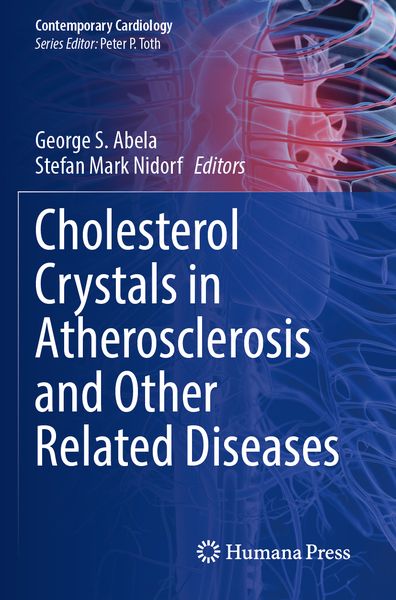
Produktbild: Cholesterol Crystals in Atherosclerosis and Other Related Diseases
- 11%

Cholesterol Crystals in Atherosclerosis and Other Related Diseases

Aus der Reihe Contemporary Cardiology
11% sparen

96,99 € UVP 109,99 €

inkl. gesetzl. MwSt., Versandkostenfrei


Beschreibung

Produktdetails

Einband

Taschenbuch

Erscheinungsdatum

23.11.2024

Herausgeber

George S. Abela + weitere

Verlag

Springer

Seitenzahl

504

Maße (L/B/H)

23,5/15,5/2,7 cm

Gewicht

874 g

Sprache

Englisch

ISBN

978-3-031-41194-6

Beschreibung

Portrait

George S. Abela, M.D., M.Sc., M.B.A. Michigan State University

Department of Medicine, CardiologyB208 Clinical Center, East Lansing, MI 48824Phone: 517-353-1754; Fax: 517-353-4978; email: abela@msu.edu

Stefan Mark Nidorf, M.B.B.S., F.R.A.C.P., M.D. Cardiologist Sir Charles Gairdner Hospital

The Heart and Vascular Research Institute 3/140 Mount Bay RdPerth, Western Australia 6000 (61+) 4803000 smnidorf@gmaiol.com

George S. Abela is a physician scientist and chief of cardiology at Michigan State University. He has conducted and authored the seminal research describing for the first time the critical role of cholesterol crystals in tissue injury. This was accomplished by demonstrating that cholesterol expands in volume when transformed from a liquid to solid state generating the hypothesis that this expansion in the confined environment of an atherosclerotic plaque can lead to rupture and erosion. Support data comes from demonstration of extensive crystals perforating ruptured plaques only in patients who died with myocardial infarction. Moreover, by modifying the tissue preparation process that avoids ethanol for scanning electron microscopy, he and lab co-workers were able to preserve the crystals from being dissolved by ethanol dehydration, a protocol that had been established centuries earlier. This unraveled the extent and severity of mechanical injury to the arterial wall by sharp tipped cholesterol crystals. He demonstrated that this process is not only present in coronary artery atherosclerotic plaques but also in cardiac valves, various solid cancers, brains from Alzheimer patients and most recently was found by other investigators in diabetic retinopathy. This universal process is a source of inflammation triggered by the transformation of cholesterol as a metastable molecule into a flat crystal. In a collaboration between Dr. Abela and immunologists, they demonstrated the role of cholesterol crystals in triggering inflammation via the NLRP3 inflammasome similar to the mechanism described for uric acid crystals. Overall, atherosclerosis as a crystalloid disease was recognized based on the discoveries made in Dr. Abela’s laboratory at Michigan State University.

Stefan Mark Nidorf   is a clinical cardiologist practicing in Perth Western Australia affiliated the Heart and Vascular Research Institute at the Perkins Research Institute. His clinical research interest in atherosclerosis led him to initiate the LoDoCo trials of low dose colchicine for the secondary prevention of chronic coronary disease, the rationale of which has been strengthened by an improved understanding of how cholesterol transitions from an essential molecule into a crystalline form that can act toinitiate and perpetuate the chronic and acute manifestations of atherosclerosis.


Produktdetails

Einband

Taschenbuch

Erscheinungsdatum

23.11.2024

Herausgeber

Verlag

Springer

Seitenzahl

504

Maße (L/B/H)

23,5/15,5/2,7 cm

Gewicht

874 g

Sprache

Englisch

ISBN

978-3-031-41194-6

Herstelleradresse

Springer-Verlag GmbH
Tiergartenstr. 17
69121 Heidelberg
DE

Email: ProductSafety@springernature.com

Noch keine Bewertungen vorhanden

Verfassen Sie die erste Bewertung zu diesem Artikel

Helfen Sie anderen Kundinnen und Kunden durch Ihre Meinung.

Kundinnen und Kunden meinen

Bewertungen (0)

  • Produktbild: Cholesterol Crystals in Atherosclerosis and Other Related Diseases
  • Section 1. Detection of Cholesterol Crystals-Why Was it Missing ,- Chapter 1. Historical perspective.- Chapter 2. New techniques.- Section 2: Crystallography-A Molecular Perspective .- Chapter 3. Overview.- Chapter 4. Cholesterol Crystal Formation.- Section 3. Cholesterol Crystals in Atherosclerosis- Atheroma to Atherosclerosis & Beyond .- Chapter 5. Lipidology and Atherosclerosis.- Chapter 6. Studies of CCs in Cell Culture.- Chapter 7. Mechanisms of CC induced Inflammation and atherosclerosis.- Chapter 8. Rheumatology/Vascular biology – intersection of gout and atherosclerosis.- Chapter 9. Potential of Cholesterol Crystals to cause trauma.- Section 4. Cholesterol Crystal Induced Vascular Embolism & End-organ Injury .- Chapter 10. Myocardial Injury.- Chapter 11. Cerebral, Hollenhorst plaques & Amaurosis fugax, Stroke and TIA.- Chapter 12. Muscular.- Chapter 13. Cutaneous.- Chapter 14. Renal injury.- Section 5. Other Cardiac Sites of Cholesterol Crystal injury .- Chapter 15. Cardiac Valve Injury by Cholesterol Crystals.- Chapter 16. Interaction of Cholesterol Crystals and Bacteria Causing Endocarditis.- Chapter 17. Pericardial deposition.- Section 6. Interaction of Cholesterol Crystals with Other Crystalloids .- Chapter 18. Cholesterol Crystals as a nidus for calcification.- Chapter 19. Calcium phosphate crystals as inducers of inflammation.- Chapter 20. Monosodium urate crystals as triggers of inflammation.- Section 7. A Universal Role of Cholesterol Crystals Beyond Cardiac Disease .- Chapter 21. Solid Tumors with crystal induced VEGF.- Chapter 22. Alzheimer’s with evidence of cholesterol crystals.- Chapter 23. Apical periodontitis.- Chapter 24. Biliary disease by cholesterol gall stones.- Chapter 25. Ocular retinal injury in diabetic retinopathy.- Section 8. Therapeutic Implications - Targeting Cholesterol Crystal Induced Disease.- Chapter 26. Lipid lowering with Statins.- Chapter 27. Anti-inflammatory Colchicine, canakinumab, Aspirin.- Chapter 28. Future Directions and Developments Cyclodextrin.