KI-Beratung Beta

Gutscheinbedingungen

**Gültig bis 31.10.2026 ab einem Mindestbestellwert von 30€ auf Spielzeug, Schreibwaren, Filme, Geschenke & Trends, Musik, tolino eReader & Zubehör, Hörbücher und Hörbuch-Downloads, nicht preisgebundene Bücher und Kalender online auf thalia.at und in der Thalia App. Einzelne Artikel können ausgeschlossen sein. Aufgrund der Buchpreisbindung sind deutschsprachige Bücher und eBooks ausgenommen. Zusätzlich ausgenommen sind Abos & Flatrates, Games, Geschenkkarten/-boxen, Shelfies, Software, Zeitschriften sowie einzelne Artikel von tonies®. Pro Einkauf einmal einlösbar. Click & Collect nur bei Onlinevorabzahlung möglich. Keine Barauszahlung. Nicht kombinierbar mit anderen Aktionen und Gutscheinen. Gutschein wird auf max. 500€ Bestellwert angerechnet. Nicht gültig für Versandkosten und Services. Preisgebundene Artikel sind vom Mindestbestellwert ausgeschlossen.

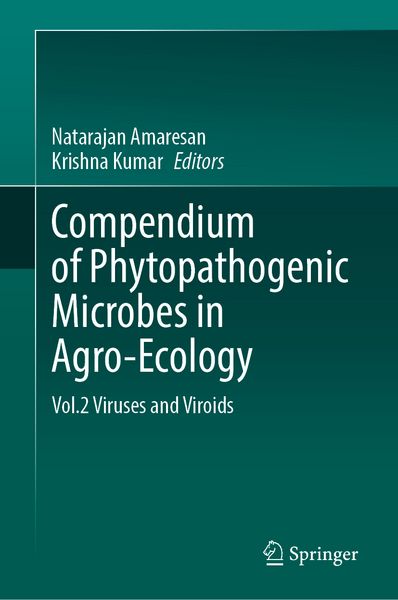
  • Produktbild: Compendium of Phytopathogenic Microbes in Agro-Ecology 
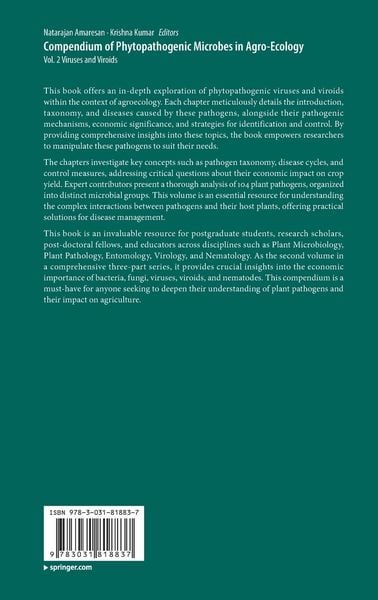
  • Produktbild: Compendium of Phytopathogenic Microbes in Agro-Ecology 
- 19%

Compendium of Phytopathogenic Microbes in Agro-Ecology  Vol. 2 Viruses and Viroids

19% sparen

195,99 € UVP 241,99 €

inkl. gesetzl. MwSt., Versandkostenfrei


Beschreibung

Produktdetails

Einband

Gebundene Ausgabe

Erscheinungsdatum

23.04.2025

Abbildungen

XII, 484 p. 50 illus., 43 illus. in color.

Herausgeber

Natarajan Amaresan + weitere

Verlag

Springer

Seitenzahl

484

Maße (L/B/H)

24,1/16/3,3 cm

Gewicht

853 g

Sprache

Englisch

ISBN

978-3-031-81883-7

Beschreibung

Portrait


Dr. N. Amaresan
is an Associate Professor at C.G. Bhakta Institute of Biotechnology, Uka Tarsadia University, Gujarat. He has over sixteen years of experience in teaching & research in various allied fields of microbiology mainly plant-microbe interactions, bioremediation, plant pathology and others. He has been awarded young scientist awards by Association of Microbiologists of India and National Academy of Biological Sciences. He also been awarded visiting scientist fellowship from National Academy of India to learn advanced techniques. He has published more than 180 research articles, book chapters and books of national and international reputes. He also deposited over 550 16S rDNA, 28S rDNA and ITS rDNA sequences in the Genbank (NCBI, EMBL & DDBJ) and also preserved over 150 microbial germplasm in various culture collection centres of India. He has successfully completed research projects from national funding agencies such as DBT, SERB-DST, GUJCOST, UTU, & GEMI and guided students for their doctoral and master degrees.


Dr. Krishna Kumar
 
obtained Ph. D. degree in Plant Pathology from NDUAT, Faizabad, India. He worked as a Research Associate at IARI, New Delhi, Assistant Professor at SKUAST, Jammu, Senior Scientist and Principal Scientist at Central Agricultural Research Institute, Port Blair, Principal Scientist at IARI, New Delhi, Head, Division of Crop Protection at Indian Institute of Pulses Research (IIPR), Kanpur, and Dean of Pandit Deendayal Upadhyay College of Horticulture & Forestry, Bihar. Presently he is a Principal Scientist, Division of Crop Protection at Indian Institute of Pulses Research (IIPR), Kanpur. He has over 27 years of research, teaching and extension experience in the field of Plant Pathology, bio-control, microbial diversity, integrated disease management, and diagnosis of unknown plant diseases. He has handled several projects on crop protection funded by various funding agencies. He is a recipient of Fakhruddin Ali Ahmed Award for Outstanding Research in Tribal Farming Systems-2010 by Indian Council of Agricultural Research, New Delhi, India, SPPS Meritorious Scientist Award-2011 by Society of Plant Protection Sciences, New Delhi, India and Distinguished Service Award-2010 for his contribution in Plant Pathology by BIOVED Research Society, Allahabad, Uttar Pradesh, India. He is a fellow of three prestigious professional societies and life member of 12 scientific societies. He has published over 135 research papers includes books, chapters, popular articles, extension bulletins, and various training manuals in National and International level. He also deposited 42 microorganisms at National Bureau of Agriculturally Important Microorganisms (NCBI) and submitted 400 sequences of them to NCBI. He delivered several radio talks and TV shows on different topics for the benefit of farming community.

Produktdetails

Einband

Gebundene Ausgabe

Erscheinungsdatum

23.04.2025

Abbildungen

XII, 484 p. 50 illus., 43 illus. in color.

Herausgeber

Verlag

Springer

Seitenzahl

484

Maße (L/B/H)

24,1/16/3,3 cm

Gewicht

853 g

Sprache

Englisch

ISBN

978-3-031-81883-7

Herstelleradresse

Springer-Verlag GmbH
Europaplatz 3
69115 Heidelberg
DE

Email: ProductSafety@springernature.com

Noch keine Bewertungen vorhanden

Verfassen Sie die erste Bewertung zu diesem Artikel

Helfen Sie anderen Kundinnen und Kunden durch Ihre Meinung.

Kundinnen und Kunden meinen

Bewertungen (0)

  • Produktbild: Compendium of Phytopathogenic Microbes in Agro-Ecology 
  • Produktbild: Compendium of Phytopathogenic Microbes in Agro-Ecology 

  • Chapter 1.
    Abaca bunchy top virus.-
    Chapter 2.
    African cassava mosaic virus .-
    Chapter 3.


    Alfamovirus (Alfalfa mosaic virus).-
    Chapter 4.
     Banana bract mosaic virus.-
    Chapter 5.
    Barley yellow dwarf virus.-
    Chapter 6.
     Beet pseudoyellows virus.-
    Chapter 7.
     Brome mosaic virus.-
    Chapter 8.
     Capsicum chlorosis virus.-
    Chapter 9.
     Cauliflower mosaic virus.-
    Chapter 10.
     Celery mosaic virus.-
    Chapter 11.
     Cucumber mosaic virus.-
    Chapter 12. 
    Iris yellow spot orthotospovirus.-
    Chapter 13. 
    Johnson grass mosaic virus.-
    Chapter 14.
     Lettuce necrotic yellow virus.-
    Chapter 15.
     Pea enation mosaic virus.-
    Chapter 16.
     Pepper mild mottle virus.-
    Chapter 17. 
    Potato leafroll virus.-
    Chapter 18. 
    Rice dwarf virus.-
    Chapter 19.
     Rice tungro virus.-
    Chapter 20.
     Tobacco mosaic virus.-
    Chapter 21.
     Tomato mosaic virus.-
    Chapter 22.
     Tomato spotted wilt virus.-
    Chapter 23
    . Turnip mosaic virus.-
    Chapter 24.
     Watermelon mosaic virus.-
    Chapter 25. 
    Zucchini yellow mosaic virus.-
    Chapter 26
    . Chrysanthemum stunt viroid.-
    Chapter 27. 
    Citrus exocortis viroid.-
    Chapter 28. 
    Hop latent viroid.-
    Chapter 29.
     Potato spindle tuber viroid.