KI-Beratung Beta

Gutscheinbedingungen

**Gültig am 20.11.2026 ab einem Mindestbestellwert von 30€ auf Spielzeug, Schreibwaren, Filme, Geschenke & Trends, Musik, tolino eReader & Zubehör, Hörbücher und Hörbuch-Downloads, nicht preisgebundene Bücher und Kalender online auf thalia.at und in der Thalia App. Einzelne Artikel können ausgeschlossen sein. Aufgrund der Buchpreisbindung sind deutschsprachige Bücher und eBooks ausgenommen. Zusätzlich ausgenommen sind Abos & Flatrates, Games, Geschenkkarten/-boxen, Shelfies, Software, Zeitschriften sowie einzelne Artikel von tonies®. Pro Einkauf einmal einlösbar. Click & Collect nur bei Onlinevorabzahlung möglich. Keine Barauszahlung. Nicht kombinierbar mit anderen Aktionen und Gutscheinen. Gutschein wird auf max. 500€ Bestellwert angerechnet. Nicht gültig für Versandkosten und Services. Preisgebundene Artikel sind vom Mindestbestellwert ausgeschlossen.

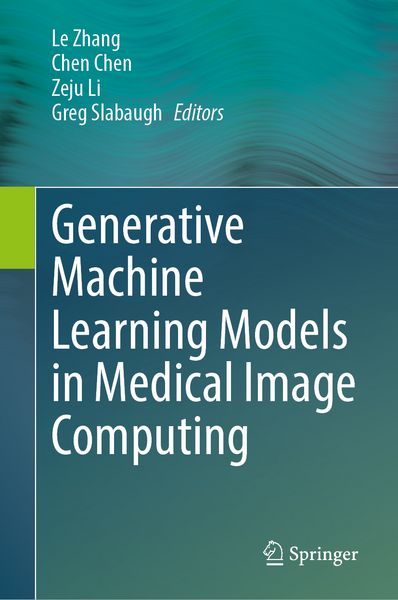
  • Produktbild: Generative Machine Learning Models in Medical Image Computing
  • Produktbild: Generative Machine Learning Models in Medical Image Computing
- 16%

Generative Machine Learning Models in Medical Image Computing

16% sparen

146,99 € UVP 175,99 €

inkl. gesetzl. MwSt., Versandkostenfrei


Beschreibung

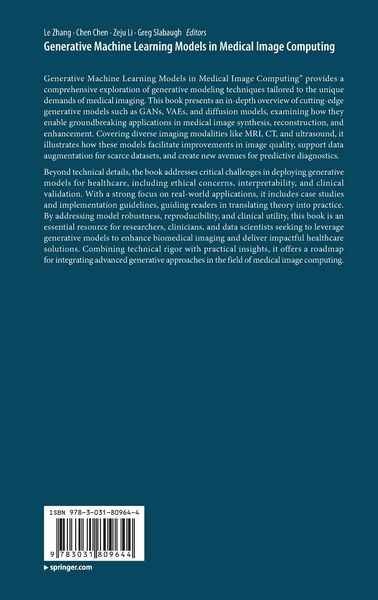
Generative Machine Learning Models in Medical Image Computing" provides a comprehensive exploration of generative modeling techniques tailored to the unique demands of medical imaging. This book presents an in-depth overview of cutting-edge generative models such as GANs, VAEs, and diffusion models,...

Beschreibung

Generative Machine Learning Models in Medical Image Computing" provides a comprehensive exploration of generative modeling techniques tailored to the unique demands of medical imaging. This book presents an in-depth overview of cutting-edge generative models such as GANs, VAEs, and diffusion models, examining how they enable groundbreaking applications in medical image synthesis, reconstruction, and enhancement. Covering diverse imaging modalities like MRI, CT, and ultrasound, it illustrates how these models facilitate improvements in image quality, support data augmentation for scarce datasets, and create new avenues for predictive diagnostics.


Beyond technical details, the book addresses critical challenges in deploying generative models for healthcare, including ethical concerns, interpretability, and clinical validation. With a strong focus on real-world applications, it includes case studies and implementation guidelines, guiding readers in translating theory into practice. By addressing model robustness, reproducibility, and clinical utility, this book is an essential resource for researchers, clinicians, and data scientists seeking to leverage generative models to enhance biomedical imaging and deliver impactful healthcare solutions. Combining technical rigor with practical insights, it offers a roadmap for integrating advanced generative approaches in the field of medical image computing.

Portrait


Dr. Le Zhang
is an Assistant Professor at the School of Engineering, College of Engineering and Physical Sciences in the University of Birmingham. He was a Postdoc Researcher at the University of Oxford since 2022. Before that, he was a Research Fellow at University College London since 2019 working with Prof. Daniel Alexander. Under the supervision of Prof. Alejandro F Frangi, he obtained his Ph.D. in Medical Image Computing from the University of Sheffield in 2019.


Dr. Chen Chen
is a Lecturer in Computer Vision, at the Department of Computer Science, University of Sheffield, a core member of Insigeno Institute and Shef.AI community. Previously, she was a post-doc at Oxford BioMedIA group, University of Oxford, and the Computing Department at Imperial College London (ICL). She was also a research scientist at HeartFlow. In 2022, she obtained her Ph.D. from the Department of Computing at Imperial College London, working closely with Prof. Daniel Rueckert and Dr. Wenjia Bai.


Dr. Zeju Li
is currently a Post-Doctoral Researcher in FMRIB Analysis Group, University of Oxford, working with Prof. Saad Jbabdi. Previously, he obtained his PhD in Computing from BioMedIA Group with Prof. Ben Glocker, Imperial College London. During his PhD, he spent time in MIRACLE Group (Institute of Computing Technology) and Huawei Noah's Ark Lab (London). He got both his MSc and BSc from the Department of Electronic Engineering, Fudan University.


Greg Slabaugh
is Professor of Computer Vision and AI and Director of the Digital Environment Research Institute (DERI) at Queen Mary University of London. He is also Turing Liaison (Academic) for Queen Mary at The Alan Turing Institute. He earned a PhD in Electrical Engineering from Georgia Institute of Technology in Atlanta, USA. Previously, he was Chief Scientist in Computer Vision (EU) for Huawei Technologies R&D, and other prior appointments include City, University of London, Medicsight, and Siemens. He holds 38 granted patents and has approximately 200 per-reviewed publications. He regularly serves on the technical program committe for computer vision and machine learning conferences (CVPR, NeurIPS, AAAI) and related journals.

Produktdetails

Einband

Gebundene Ausgabe

Erscheinungsdatum

13.03.2025

Abbildungen

VIII, 382 p. 107 illus., 97 illus. in color.

Herausgeber Le Zhang + weitere

Produktdetails

Einband

Gebundene Ausgabe

Erscheinungsdatum

13.03.2025

Abbildungen

VIII, 382 p. 107 illus., 97 illus. in color.

Herausgeber
Verlag Springer
Seitenzahl

382

Maße (L/B/H)

24,1/16/2,7 cm

Gewicht

700 g

Sprache

Englisch

ISBN

978-3-031-80964-4

Herstelleradresse

Springer-Verlag GmbH
Europaplatz 3
69115 Heidelberg
DE

Email: ProductSafety@springernature.com

Noch keine Bewertungen vorhanden

Verfassen Sie die erste Bewertung zu diesem Artikel

Helfen Sie anderen Kundinnen und Kunden durch Ihre Meinung.

Kundinnen und Kunden meinen

Bewertungen (0)

  • Produktbild: Generative Machine Learning Models in Medical Image Computing
  • Produktbild: Generative Machine Learning Models in Medical Image Computing

  • Part I Segmentation.- Synthesis of annotated data for medical image segmentation.- Diffusion Models For Histopathological Image Generation.- Generative AI Techniques for Ultrasound Image Reconstruction.- Part II Detection and Classification.- Vision Language Pre training from Synthetic Data.- Diffusion models for inverse problems in medical imaging.- Virtual Elastography Ultrasound via Generative Adversarial Network and its Application to Breast Cancer Diagnosis.- Generative Adversarial Networks for Brain MR Image Synthesis and Its Clinical Validation on Multiple Sclerosis.- Histopathological Synthetic Augmentation with Generative Models.- Part III Image Super resolution and Reconstruction.- Enhancing PET with Image Generation Techniques Generating Standard dose PET from Low dose PET.- EyesGAN Synthesize human face from human eyes.- Deep Generative Models for 3D Medical Image Synthesis.- Part IV Various Applications.- Cross Modal Attention Fusion based Generative Adversarial Network for text to image synthesis.- CHeart A Conditional Spatio Temporal Generative Model for Cardiac Anatomy.- Generative Models for Synthesizing Anatomical Plausible 3D Medical Images.- Diffusion Probabilistic Models for Image Formation in MRI.- Embedding 3D CT Prior into X ray Imaging Using Generative Adversarial Networks.