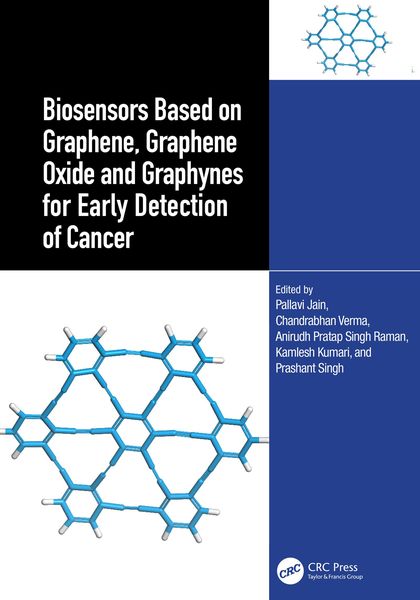
Biosensors Based on Graphene, Graphene Oxide and Graphynes for Early Detection of Cancer
-
- Hardcover
- Taschenbuch
- eBook ausgewählt
-
Form:Einzelkauf Download
-
Sprache:Englisch
-
eBook Format:PDF
- PDF 80,70 € ausgewählt
- ePUB 80,70 €
80,70 €
inkl. gesetzl. MwSt.Beschreibung
Produktdetails
Format
Kopierschutz
Ja
Family Sharing
Nein
Text-to-Speech
Nein
Erscheinungsdatum
03.12.2024
Herausgeber
Pallavi Jain + weitereVerlag
Taylor & Francis eBooksSeitenzahl
302 (Printausgabe)
Auflage
1. Auflage
Sprache
Englisch
EAN
9781040261149
The detection of cancer at its earliest stages is paramount for successful treatment and improved patient outcomes. In recent years, the field of nanotechnology has witnessed significant advancements, and one material that has emerged as a potential game-changer in cancer detection is graphene. Graphene's high surface area, excellent electrical conductivity, and ability to interact with biological molecules have paved the way for innovative approaches to diagnosing cancer. Moreover, graphene oxide, a derivative of graphene, has gained significant attention in the field of cancer detection. Its unique properties, including biocompatibility and high photothermal conversion efficiency, enable its use in various imaging techniques. Graphene oxide can selectively accumulate in tumor tissues, enhancing the contrast signals in imaging modalities like optical imaging, magnetic resonance imaging (MRI), and photoacoustic imaging. This allows for precise visualization and localization of cancerous cells or tissues, aiding in early detection and accurate diagnosis.
Features:
- Provides a comprehensive exploration of carbon, its allotropes, and its significance in emerging applications.
- Discusses the synthesis and functionalization of graphene on diverse substrates, and modeling approaches employed in graphene research.
- Details the application of graphene, graphene oxide, and graphyne-based materials on cancer detection.
- Explores the overview of the wider biological applications of carbon-based materials.
This book will serve as a valuable reference source for researchers, academics, and biologists working in R&D and interested in biosensing for the early detection of cancer.
Noch keine Bewertungen vorhanden
Verfassen Sie die erste Bewertung zu diesem Artikel
Helfen Sie anderen Kundinnen und Kunden durch Ihre Meinung.
Kurze Frage zu unserer Seite
Vielen Dank für Ihr Feedback
Wir nutzen Ihr Feedback, um unsere Produktseiten zu verbessern. Bitte haben Sie Verständnis, dass wir Ihnen keine Rückmeldung geben können. Falls Sie Kontakt mit uns aufnehmen möchten, können Sie sich aber gerne an unseren Kund*innenservice wenden.
zum Kundenservice