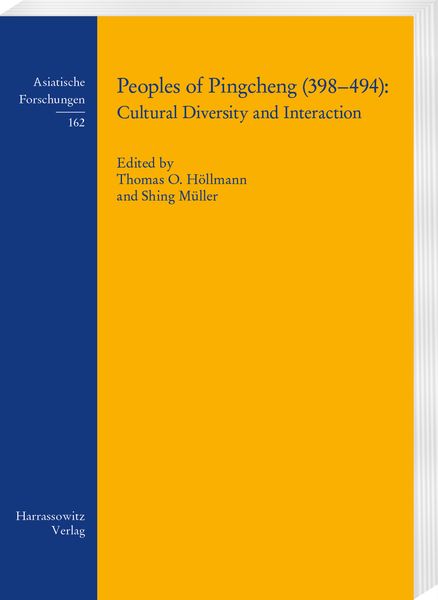
Peoples of Pingcheng (398–494): Cultural Diversity and Interaction
-
- Taschenbuch ausgewählt
- eBook
-
Sprache:Englisch
44,99 €
inkl. gesetzl. MwSt.,
Beschreibung
Produktdetails
Einband
Taschenbuch
Erscheinungsdatum
11.12.2024
Abbildungen
147 ill., 15 tables, 3 diagrams, 2 maps
Herausgeber
Thomas O. Höllmann + weitereVerlag
HarrassowitzSeitenzahl
190
Maße (L/B/H)
24,2/17,4/1,2 cm
Gewicht
480 g
Sprache
Englisch
ISBN
978-3-447-12308-2
Compared to the later capital of the Northern Wei Dynasty, Luoyang (494–534), Pingcheng on the northern border of the Chinese world has received less scholarly attention despite its far longer capital status (398–494). The main reason is the lack of written sources. In addition, there is the derogatory idea that Pingcheng was a
latifundium
inhabited by “barbarians,” since the rulers of the Northern Wei were the Tuoba Xianbei from the eastern steppe, who established the first long-term foreign control over northern China. Traditionally, Luoyang is the epitome of the sinicized Tuoba Xianbei, while Pingcheng represents the state of the Tuoba Xianbei who were on the way to “becoming Chinese.” Excavations show that Pingcheng, which was built on the ruins of a garrison from the Han-Dynasty, arose from nothing and the inhabitants came from outside. Burial finds indicate a steadily growing population, which is said to have reached one million in its prime. At first, tombs were erected to indicate their steppe origins. New rites and artifacts emerged in spurts. This corresponds to written records, according to which the city was mainly populated by steppe warriors, followed by forcibly relocated peoples from all conquered northern Chinese regions.
The authors focus on the people(s) in Pingcheng. Zhang’s epigraphic study is devoted to a Xianbei family that arose during the Pingcheng period and remained closely intertwined with the imperial court in the following centuries. Using burial finds, Müller explores the diversity and foreignness of funerary customs and artifacts, the ways in which different ethnic groups communicated and interacted, and the emergence of a new collective identity that was anything but Chinese.
Noch keine Bewertungen vorhanden
Verfassen Sie die erste Bewertung zu diesem Artikel
Helfen Sie anderen Kundinnen und Kunden durch Ihre Meinung.
Kurze Frage zu unserer Seite
Vielen Dank für Ihr Feedback
Wir nutzen Ihr Feedback, um unsere Produktseiten zu verbessern. Bitte haben Sie Verständnis, dass wir Ihnen keine Rückmeldung geben können. Falls Sie Kontakt mit uns aufnehmen möchten, können Sie sich aber gerne an unseren Kund*innenservice wenden.
zum Kundenservice