Beschreibung
Produktdetails
Format
ePUB
Kopierschutz
Ja
Family Sharing
Nein
Text-to-Speech
Ja
Erscheinungsdatum
05.02.2025
Herausgeber
G. David Schieffler + weitereVerlag
Princeton University PressSeitenzahl
274 (Printausgabe)
Dateigröße
2040 KB
Sprache
Englisch
EAN
9780807183885
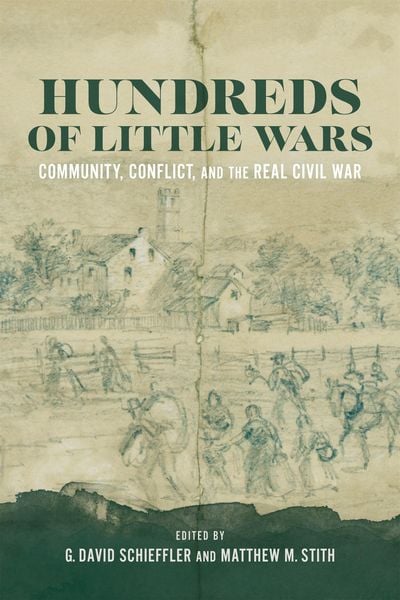
From Texas to Virginia, towns, regions, counties, regiments, prisons, and even refugee camps played a significant role in shaping the contours of the Civil War. According to historian Daniel E. Sutherland, whose many books and essays helped establish the field of community studies, these varied assemblages of individuals experienced and fought the real war. Following his lead, the contributors to Hundreds of Little Wars reveal how viewing the war from the vantage point of singular communities allows us to better understand the larger conflict.
The volume includes contributions from a wide array of Civil War scholars. Lesley J. Gordon and Eric P. Totten examine military outfits, namely the 126th New York Regiment and the 4th New Hampshire Volunteer Infantry. Madeleine C. Forrest provides an analysis of Fauquier County, Virginia, in 1862, and Matthew M. Stith evaluates a Confederate prisoner-of-war camp in East Texas. Christopher Phillips and Scott A. Tarnowieckyi investigate the middle border region spanning the Ohio, Mississippi, and Missouri rivers. Lorien Foote and G. David Schieffler assess the demographically diverse Sea Islands of South Carolina and Georgia, as well as Helena, Arkansas. Barton A. Myers and Terry L. Beckenbaugh employ Sutherland's framing while considering irregular war, first with an examination of partisan officers and then with a survey of the White River Valley in Arkansas. Finally, Niels Eichhorn and Michael Shane Powers assume a transnational viewpoint, comparing Richmond with Vienna, Austria, and analyzing a community of Confederate veterans in Central America.
The essays in Hundreds of Little Wars show that no one single conflict defined the Civil War. Instead, hundreds of wars existed, variously categorized by geography, race, gender, environment, and myriad other factors. Only by concentrating on these communities can we grasp the scope and complexity of the Civil War.
Noch keine Bewertungen vorhanden
Verfassen Sie die erste Bewertung zu diesem Artikel
Helfen Sie anderen Kundinnen und Kunden durch Ihre Meinung.
Kurze Frage zu unserer Seite
Vielen Dank für Ihr Feedback
Wir nutzen Ihr Feedback, um unsere Produktseiten zu verbessern. Bitte haben Sie Verständnis, dass wir Ihnen keine Rückmeldung geben können. Falls Sie Kontakt mit uns aufnehmen möchten, können Sie sich aber gerne an unseren Kund*innenservice wenden.
zum Kundenservice