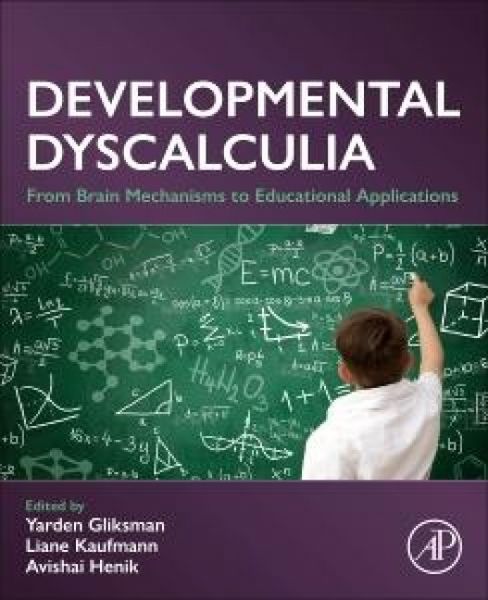
Produktbild: Developmental Dyscalculia
- 12%

Developmental Dyscalculia From Brain Mechanisms to Educational Applications

12% sparen

137,99 € UVP 158,40 €

inkl. gesetzl. MwSt., Versandkostenfrei


Beschreibung

Produktdetails

Einband

Taschenbuch

Erscheinungsdatum

09.07.2025

Herausgeber

Yarden Gliksman + weitere

Verlag

Elsevier Science & Technology

Seitenzahl

420

Maße (L/B/H)

21,8/19,6/2,3 cm

Gewicht

885 g

Sprache

Englisch

ISBN

978-0-443-22224-5

Beschreibung

Portrait

Dr. Yarden Gliksman is a faculty member in the Behavioral Sciences department at Ruppin Academic Center. She is a cognitive psychologist and an expert in learning disabilities. She has a strong background in basic and applied sciences, and over 15 years of hands-on experience in the fields of education, teacher training and learning disabilities diagnosis and interventions, specifically in the field of numerical cognition and developmental dyscalculia. She serves as an ad-hoc reviewer of peer-revied journals.
Dr. Liane Kaufman is a senior scientist at the University of Innsbruck, Austria. She is a clinical psychologist with a specialization in clinical neuropsychology. She is editor-in-chief of the scientific journal "Lernen und Lernstörungen” / "Learning and Learning Disabilities” (German-language journal that also publishes English-language manuscripts) and an ad-hoc reviewer of peer-reviewed journals. The main research interests of Dr. Kaufmann are numerical cognition, and attentional and executive processes in healthy individuals and clinical populations.
Dr. Avishai Henik is a Professor of Psychology at Ben-Gurion University of the Negev. He holds a consulting editorial position with several journals (e.g., Psychonomic Bulletin and Review, Journal of Experimental Psychology: General) and serves regularly as an ad-hoc reviewer for various journals in the field and for granting agencies. Dr. Henik has over 300 publications of which most are in peer-reviewed journals. He has edited or co-edited three books in the area of numerical cognition. A leader in the field, he was awarded a prestigious European Research Council (ERC) Advanced Researcher grant to continue his cutting-edge research on the contribution of non-countable dimensions to the development and understanding of numerical cognition.

Produktdetails

Einband

Taschenbuch

Erscheinungsdatum

09.07.2025

Herausgeber

Verlag

Elsevier Science & Technology

Seitenzahl

420

Maße (L/B/H)

21,8/19,6/2,3 cm

Gewicht

885 g

Sprache

Englisch

ISBN

978-0-443-22224-5

EU-Ansprechpartner

Zeitfracht Medien GmbH
Ferdinand-Jühlke-Straße 7
99095 Erfurt
DE
produktsicherheit@zeitfracht.de

Herstelleradresse

Elsevier Science & Technology
London Wall 125
EC2Y 5AS London
GB
tradeorders@elsevier.com

Noch keine Bewertungen vorhanden

Verfassen Sie die erste Bewertung zu diesem Artikel

Helfen Sie anderen Kundinnen und Kunden durch Ihre Meinung.

Kundinnen und Kunden meinen

Bewertungen (0)

  • Produktbild: Developmental Dyscalculia
  • Section 1 - Theoretical models for DD
    1. Domain general and mathematical difficulties
    2. An operational definition of math learning disability and dyscalculia in the framework of the CHC model of cognitive abilities and the Concordance-Discordance Model of SLD identification

    Section 2 - DD and other cognitive domains
    3. The role of language in developing mathematics and mathematical difficulties
    4. The role of working memory in developmental dyscalculia
    5. Developmental Dyscalculia and Math Anxiety

    Section 3 - Educational implications and treatment
    6. Helping students with mathematics difficulties to succeed in word problems; or: Promoting word problem-solving among students with mathematics difficulties
    7. Educational needs of children with dyscalculia
    8. Diagnosing and supporting children with difficulties in learning mathematics - a mathematics education perspective
    9. Examining the performance of dyscalculic learners in a curriculum-based mathematics assessment¿

    Section 4 - DD and inter and intra subjects’ variability
    10. Intra and inter subject variability in mathematical learning difficulties
    11. Profiles of developmental dyscalculia
    12. Individual differences in arithmetic: implications for dyscalculia
    13. Association between math and executive functions

    Section 5 - Neural correlates of DD
    14. How brain imaging findings may inform theoretical concepts of developmental dyscalculia
    15. Cerebellum, mathematics and developmental dyscalculia
    16. Behavioral genetics, molecular genetics and genetic syndromes
    17. Dyscalculia and the brain 18. Neurobiological underpinnings¿of¿developmental dyscalculia