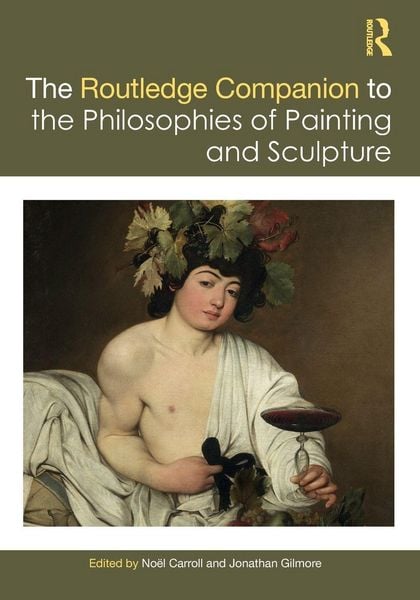
The Routledge Companion to the Philosophies of Painting and Sculpture
-
- Hardcover
- Taschenbuch ausgewählt
- eBook
-
Sprache:Englisch
54,99 €
inkl. gesetzl. MwSt.,
Beschreibung
Produktdetails
Einband
Taschenbuch
Erscheinungsdatum
19.12.2024
Verlag
Taylor & FrancisSeitenzahl
514
Maße (L/B/H)
25,4/17,8/2,7 cm
Gewicht
956 g
Sprache
Englisch
ISBN
978-1-03-232071-7
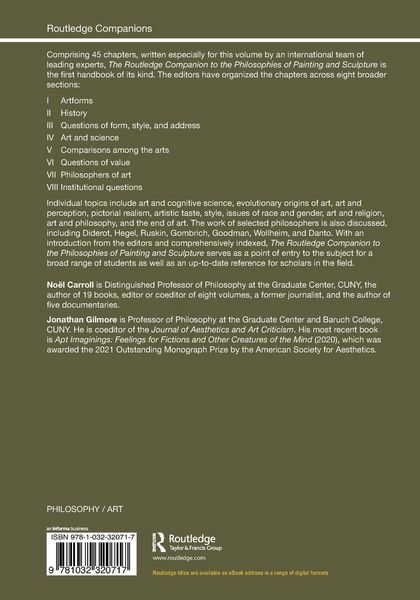
Comprising 45 chapters, written especially for this volume by an international team of leading experts, The Routledge Companion to the Philosophies of Painting and Sculpture is the first handbook of its kind. The editors have organized the chapters across eight broader sections:
- Artforms
- History
- Questions of form, style, and address
- Art and science
- Comparisons among the arts
- Questions of value
- Philosophers of art
- Institutional questions
Individual topics include art and cognitive science, evolutionary origins of art, art and perception, pictorial realism, artistic taste, style, issues of race and gender, art and religion, art and philosophy, and the end of art. The work of selected philosophers is also discussed, including Diderot, Hegel, Ruskin, Gombrich, Goodman, Wollheim, and Danto. With an introduction from the editors and comprehensively indexed, The Routledge Companion to the Philosophies of Painting and Sculpture serves as a point of entry to the subject for a broad range of students as well as an up-to-date reference for scholars in the field.
Noch keine Bewertungen vorhanden
Verfassen Sie die erste Bewertung zu diesem Artikel
Helfen Sie anderen Kundinnen und Kunden durch Ihre Meinung.
Kurze Frage zu unserer Seite
Vielen Dank für Ihr Feedback
Wir nutzen Ihr Feedback, um unsere Produktseiten zu verbessern. Bitte haben Sie Verständnis, dass wir Ihnen keine Rückmeldung geben können. Falls Sie Kontakt mit uns aufnehmen möchten, können Sie sich aber gerne an unseren Kund*innenservice wenden.
zum Kundenservice