Gutscheinbedingungen

**Gültig bis 06.07.2026 auf fremdsprachige Bücher online auf thalia.at, in der Thalia App ab einem Mindestbestellwert von 30€ und in allen Thalia Buchhandlungen in Österreich. In den Buchhandlungen nur gültig auf lagernde Ware. Einzelne Artikel können ausgeschlossen sein. Ausgenommen sind preisgebundene Artikel & eBooks. Pro Einkauf einmal einlösbar. Nur gültig gegen Vorlage oder im Onlineshop hinterlegter Bonuscard. Infos zur Einlösung in der Buchhandlung sind auf der Bonuscard-Vorteilspreisseite zu finden. Click & Collect nur bei Onlinevorabzahlung möglich. Keine Einlösung bei Scan & Go-Bezahlung. Keine Barauszahlung. Nicht kombinierbar mit anderen Aktionen und Gutscheinen. Gutschein wird auf max. 500€ Bestellwert angerechnet. Nicht gültig für Versandkosten und Services.

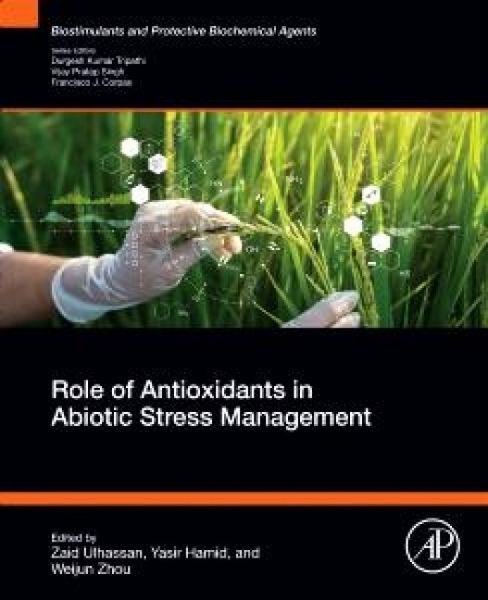
Produktbild: Role of Antioxidants in Abiotic Stress Management

Role of Antioxidants in Abiotic Stress Management

214,99 €

inkl. gesetzl. MwSt., Versandkostenfrei


Beschreibung

Produktdetails

Einband

Taschenbuch

Erscheinungsdatum

11.08.2025

Herausgeber

Zaid Ulhassan + weitere

Verlag

Elsevier Science & Technology

Seitenzahl

418

Maße (L/B/H)

27,7/21,6/2,1 cm

Gewicht

1170 g

Sprache

Englisch

ISBN

978-0-443-14139-3

Beschreibung

Portrait

Dr. Zaid Ulhassan is a Postdoctoral Researcher in the College of Agriculture and Biotechnology, Institute of Crop Science, Zhejiang University, China. In 2020, he was awarded with the International Postdoctoral Exchange Fellowship supported by China Postdoc Council and Zhejiang university, China. He received his PhD on “environmental stress physiology of plants and antioxidants metabolism” from the College of Agriculture and Biotechnology, Institute of Crop Science, Zhejiang University, China with the Zhejiang University Scholarship. Primarily, his research work is focused on the physiological, biochemical and molecular analysis of field crops in response to environmental stress conditions. Besides, he has published 6 book chapters (as first author) with reputed publishers and targeted the important aspects of plant stress responses and adaptations to environmental stresses. He has attended different international conferences and presented posters in numerous international meetings. He is actively involved in reviewing papers for international journals.

Dr. Yasir Hamid is working as an International Exchange Postdoc Fellow at College of Environmental and Resource Sciences, Zhejiang University from May 2021. In 2020, he received his PhD from Zhejiang University, China under Two High Doctoral Scholarship program of Zhejiang University. Dr. Hamid’s research focuses on agro-environmental contamination by potentially toxic elements such as cadmium, lead, arsenic, copper and chromium. His work expertise includes plant nutrition, soil chemistry and environmental sciences with specific focus on abatement of heavy metal risks and their remediation technologies. Dr. Hamid has authored around 65 peer reviewed papers in reputable international journals as a first and co-author. He has also delivered oral and poster presentations in international conferences held in Asian and European countries. Dr. Hamid is a regular reviewer of several international journals of various publishing groups. Dr. Hamid is currently collaborating with reputable scientists of environmental science field from Oman, Australia, United States, Germany and Canada for various writing projects.

Prof. Weijun Zhou is a Full Professor (Qiushi Distinguished Professor) in the College of Agriculture and Biotechnology, Institute of Crop Science, Zhejiang University, China. His research focuses on crop science, especially canola germplasm enhancement, molecular breeding, crop molecular physiology and weed control. He has published more than 150 refereed papers, 10 books/chapters and 50 conference and technical articles.  Dr. Zhou is the Executive Member of Crop Science Society of China, Oil Crops Committee of Crop Science Society of China, Weed Science Society of China, Crop Science Society of Zhejiang Province and the Deputy Head of Crop Physiology Committee of Crop Science Society of China. He spent 6 years of study and research at universities and institutes in the UK, Sweden, Germany and Japan. Prof. Zhou is a member of the board for the journals Acta Physiologiae Plantarum, Crop & Pasture Science, Journal of Integrative Agriculture, and PLoS ONE

Produktdetails

Einband

Taschenbuch

Erscheinungsdatum

11.08.2025

Herausgeber

Verlag

Elsevier Science & Technology

Seitenzahl

418

Maße (L/B/H)

27,7/21,6/2,1 cm

Gewicht

1170 g

Sprache

Englisch

ISBN

978-0-443-14139-3

EU-Ansprechpartner

Zeitfracht Medien GmbH
Ferdinand-Jühlke-Straße 7
99095 Erfurt
DE
produktsicherheit@zeitfracht.de

Herstelleradresse

Elsevier Science & Technology
London Wall 125
EC2Y 5AS London
GB
tradeorders@elsevier.com

Noch keine Bewertungen vorhanden

Verfassen Sie die erste Bewertung zu diesem Artikel

Helfen Sie anderen Kundinnen und Kunden durch Ihre Meinung.

Kundinnen und Kunden meinen

Bewertungen (0)

  • Produktbild: Role of Antioxidants in Abiotic Stress Management
  • 1. Underlying mechanisms responsible for abiotic stress responses and defense adaptation in plants: Recent advancements and future prospects

    Part 1: Role of Enzymatic and Non-Enzymatic Antioxidants
    2. Multifaceted roles in plant abiotic stress responses and tolerance mechanisms
    3. Protective roles against heavy metals or metalloids stress in plants
    4. Involvement against drought stress or water deficiency in plants
    5. Mechanisms in waterlogging tolerance in plants
    6. Contributions toward salinity stress tolerance in plants
    7. Efficacy in cold stress tolerance in plants
    8. Addressing heat stress in plants
    9. Addressing ultraviolet radiations and weak or strong light stress in plants
    10. Combating ozone stress tolerance in plants
    11. Addressing nutrient deficiencies or sufficiencies in plants
    12. Plant adaptation to hypoxia or anoxia stress conditions
    13. Addressing xenobiotics stress in plants

    Part 2: Practical Applications of Specific Antioxidants in Abiotic Stress Tolerance
    14. Novel green nanoparticles to improve the crops resilience
    15. Agronomic management approaches to enhance crop tolerance
    16. Plant defense activation via organic and inorganic molecules and biostimulants
    17. Activation of antioxidant enzymes utilizing micronutrients and phytohormones or signaling molecules
    18. Advanced target and new genome-editing approaches to improve the crops resilience against abiotic stressors
    19. Advanced genetic technologies to improve crop abiotic stress resilience
    20. Potential of soil or plant growth promotion associated microbes¿ in improving the abiotic-stress resilience of agricultural crops
    21. Conventional and Biotechnological metabolic engineering approaches to enhancing of abiotic stress tolerance in plants
    22. Molecular underpinning of plants hormonal signaling to abiotic stressors using plant chemical and synthetic biology approaches