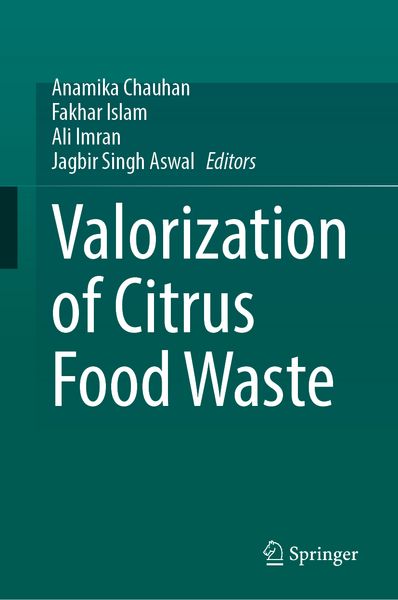
Valorization of Citrus Food Waste
-
- Hardcover ausgewählt
- Taschenbuch
- eBook
-
Sprache:Englisch
189,99 €
UVP
219,99 €
inkl. gesetzl. MwSt.,
Beschreibung
Produktdetails
Einband
Gebundene Ausgabe
Erscheinungsdatum
24.06.2025
Abbildungen
IX, 452 p. 41 illus., 36 illus. in color.
Herausgeber
Anamika Chauhan + weitereVerlag
SpringerSeitenzahl
452
Maße (L/B/H)
24,1/16/3,1 cm
Gewicht
855 g
Sprache
Englisch
ISBN
978-3-031-77998-5
The establishment of fruit juice companies in the 20th century marked the beginning of the widespread use of citrus fruits. Around 18% of the total citrus fruit production in the world is used industrially, primarily for the manufacture of juice. Citrus fruit consumption and interest are growing, and trash generation is also increasing, adding to the environmental load. Because of their unwanted and unsanitary character, discarding fruit segments without due care is hazardous to the environment. Producing citrus juice results in the creation of waste, which accounts for over 50% of the mass of fresh fruit. Peels, seeds pomace, and wastewater are all included in this waste. Fruit
peels, seeds, and pulp from ruined fruit are covered with citrus wastewater. About 10 million MT of trash are produced annually by the processing of citrus fruit worldwide, which poses a severe ecological problem. Citrus by-products are troublesome wastes because of their abundance and perishablenature. Citrus peels that are around 80%
water decay fast, attracting bugs, bacteria and mold. Citrus peel utilization is therefore essential for waste management and not only a means of boosting revenue. Citrus trash must be disposed of properly since improper disposal pollutes the land and water, further harming the aquatic habitat.
An efficient strategy for sustainable waste management is to use citrus wastes to create useful bioproducts. Numerous methods have been developed to boost the pectin recovery from citrus trash due to the continuously growing demand. Valorization of Citrus Food Waste presents the high-value compound in the citrus wastes and their extraction methods for obtaining the value-added products as well as their corresponding applications and will be useful to food scientists and industry members exploring the use of valorization process for waste fruits as new components and sources in nutraceuticals. Thisbook is a full of source for the valorization of citrus waste, the use of bioactive components and waste management.
Noch keine Bewertungen vorhanden
Verfassen Sie die erste Bewertung zu diesem Artikel
Helfen Sie anderen Kundinnen und Kunden durch Ihre Meinung.
Kurze Frage zu unserer Seite
Vielen Dank für Ihr Feedback
Wir nutzen Ihr Feedback, um unsere Produktseiten zu verbessern. Bitte haben Sie Verständnis, dass wir Ihnen keine Rückmeldung geben können. Falls Sie Kontakt mit uns aufnehmen möchten, können Sie sich aber gerne an unseren Kund*innenservice wenden.
zum Kundenservice