Gutscheinbedingungen

**Gültig bis 14.09.2026 auf Spielzeug, Schreibwaren, Filme, Geschenke & Trends, Musik, tolino eReader & Zubehör, Hörbücher, nicht preisgebundene Bücher und Kalender in der Thalia App. Einzelne Artikel können ausgeschlossen sein. Aufgrund der Buchpreisbindung sind deutschsprachige Bücher und eBooks ausgenommen. Zusätzlich ausgenommen sind Abos & Flatrates, Games, Geschenkkarten/-boxen, Shelfies, Software, Zeitschriften sowie einzelne Artikel von tonies®. Pro Einkauf einmal einlösbar. Nur gültig mit im Onlineshop hinterlegter Bonuscard. Click & Collect nur bei Onlinevorabzahlung möglich. Keine Barauszahlung. Nicht kombinierbar mit anderen Aktionen und Gutscheinen. Gutschein wird auf max. 500€ Bestellwert angerechnet. Nicht gültig für Versandkosten und Services.

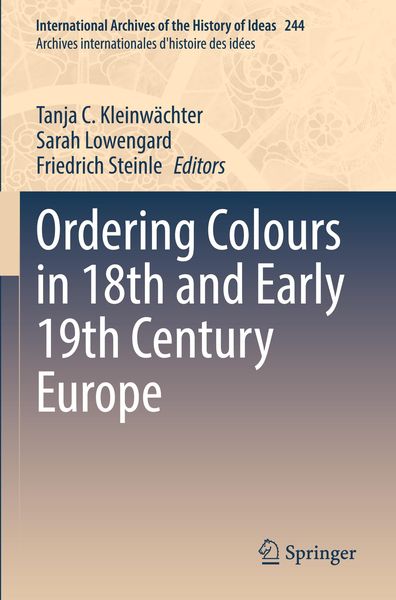
Produktbild: Ordering Colours in 18th and Early 19th Century Europe
Band 244 - 12%

Ordering Colours in 18th and Early 19th Century Europe

12% sparen

114,99 € UVP 131,99 €

inkl. gesetzl. MwSt., Versandkostenfrei


Beschreibung

Produktdetails

Einband

Taschenbuch

Erscheinungsdatum

05.10.2024

Abbildungen

VII, 201 p. 79 illus., 65 illus. in color.

Herausgeber

Tanja C. Kleinwächter + weitere

Verlag

Springer

Seitenzahl

201

Maße (L/B/H)

23,5/15,5/1,2 cm

Gewicht

330 g

Sprache

Englisch

ISBN

978-3-031-34958-4

Beschreibung

Portrait


Tanja C. Kleinwächter
studied history of science and technology as well as gender studies (Technische Universität and Humboldt Universität Berlin). Currently she is a PhD candidate at the Dept. for History of Science, TU Berlin. She was part of the project The Order of Colours. Colour Systems and Colour Reference Systems in 18th Century Europe, funded by German Research Foundation. Before embarking on the PhD she undertook research on Christian Friedrich Prangens der Weltweisheit und freyen Künste Magister Farbenlexicon (Interdisciplinary Centre for European Enlightenment Studies, MLU Halle,) as well as on Circles, Triangles, and Tables: European Colour Systematization in Science, Economy, and Art from ca 1720 to ca 1810 (Dept. of History of Science, TU Berlin).


Sarah Lowengard
is a historian of technology and sciences whose research focuses on practical and philosophical engagements with colour in the early modern West: Her special expertise is the materials sciences of material culture in the 18th century. An artisan colourmaker and art conservator as well as an award-winning historian, Lowengard resides in New York City.


Friedrich Steinle
is Professor of History of Science at Technische Universität Berlin. His research focuses on the history and philosophy of experiment, on the history of colour research, the history of electricity, and on the dynamics of scientific concepts. His books include Newton’s Manuskript ‘
De gravitatione
’ (1991) and
Exploratory Experiments. Ampère, Faraday, and the origins of electrodynamics
(2016). He is coeditor of
Scientific concepts and investigative practic
e (2012, with U. Feest),
Colour Histories. Science, art, and technology in the 17th and 18th centuries
(2015, with M. Bushart) and of
Die Farben der Klassik
(2016, with M. Dönike and J. Müller-Tamm).


Produktdetails

Einband

Taschenbuch

Erscheinungsdatum

05.10.2024

Abbildungen

VII, 201 p. 79 illus., 65 illus. in color.

Herausgeber

Verlag

Springer

Seitenzahl

201

Maße (L/B/H)

23,5/15,5/1,2 cm

Gewicht

330 g

Sprache

Englisch

ISBN

978-3-031-34958-4

Herstelleradresse

Springer-Verlag GmbH
Tiergartenstr. 17
69121 Heidelberg
DE

Email: ProductSafety@springernature.com

Noch keine Bewertungen vorhanden

Verfassen Sie die erste Bewertung zu diesem Artikel

Helfen Sie anderen Kundinnen und Kunden durch Ihre Meinung.

Kundinnen und Kunden meinen

Bewertungen (0)

  • Produktbild: Ordering Colours in 18th and Early 19th Century Europe
  • 1. Introduction Kleinwächter, Tanja, Sarah Lowengard and Friedrich Steinle.- Part I Ordering Systems and Standards.- 2 The shape of colour order systems and the evolution of colour theory  Caivano, José Luis.- 3 Materialization of vision - Colour standards in the early sciences as a practice transfer from the arts and handicrafts Karliczek, André.- Part II Visual Studies to Prove a Theory.- 4. Jacob Christoff Le Blon and Trichromatic printing: A tale of five cities Stijnman, Ad.- 5. Colour theory by Mikhail Lomonosov: From dyes and mosaics to a trichromatic idea Stanulevich, Nadezhda.- 6. Schiffermüller and Newton in sinter united - Franz Uibelakers two-colour theory (1781) Kleinwächter, Tanja.- Part III Objects in Colours/Objects and Colours.- 7. Calau’s Punic Wax, Lambert’s Farbenpyramide (1772), and prefabricated watercolour cakes Simonini, Giulia.- 8. Testing ground: Colour samples in European porcelain manufactories Szalay, Gabriella.- 9 Fighting for the best pigment! Academic colour discourses in Kassel during the 19thcentury Mävers, Sophie-Luise.- General Bibliography.- Index of Names.- General Index.