Gutscheinbedingungen

**Gültig bis 02.09.2026 auf fremdsprachige Bücher in der Thalia App. Einzelne Artikel können ausgeschlossen sein. Ausgenommen sind preisgebundene Artikel & eBooks. Pro Einkauf einmal einlösbar. Click & Collect nur bei Onlinevorabzahlung möglich. Keine Barauszahlung. Nicht kombinierbar mit anderen Aktionen und Gutscheinen. Gutschein wird auf max. 500€ Bestellwert angerechnet. Nicht gültig für Geschenkkarten, Versandkosten und Services.

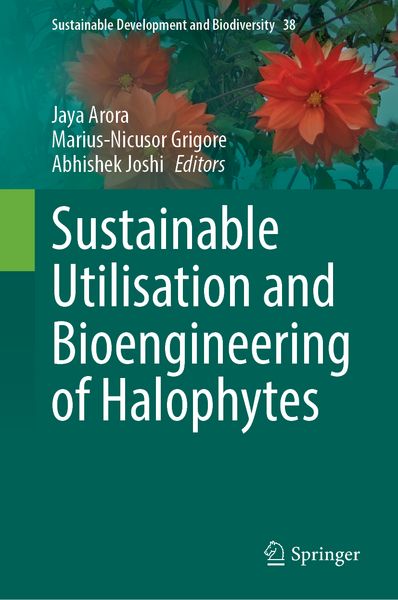
Produktbild: Sustainable Utilisation and Bioengineering of Halophytes
Band 38 - 16%

Sustainable Utilisation and Bioengineering of Halophytes

16% sparen

273,99 € UVP 329,99 €

inkl. gesetzl. MwSt., Versandkostenfrei


Beschreibung

Produktdetails

Einband

Gebundene Ausgabe

Erscheinungsdatum

15.02.2025

Herausgeber

Jaya Arora + weitere

Verlag

Springer Singapore

Seitenzahl

454

Maße (L/B/H)

24,1/16/3,1 cm

Gewicht

867 g

Auflage

1. Auflage

Sprache

Englisch

ISBN

978-981-9798-18-6

Beschreibung

Portrait

Dr. Jaya Arora, Assistant Professor, Department of Botany, Mohanlal Sukhadia University, Udaipur, India has been teaching Botany since 2012. She did her M.Sc and Ph.D. in Botany with a specialization in plant tissue culture and secondary metabolite production from Mohanlal Sukhadia University. She had qualified CSIR-NET-SRF and was awarded the Maharana Fateh Singh Award in 2000 for meritorious performance during her matriculation and the Gargi Award and Scholarship for matriculation by Govt. of Rajasthan, India, 2000. She has 14 years of research experience with one UGC start-up completed project (2013-2015) and mentored one Women Scientists Scheme-A project (2016-2019) funded by the Ministry of Science and Technology, Department of Science and Technology, Govt. of India. Currently, she is Co-PI in two different projects funded by MHRD RUSA 2.0, India. Her research group has published research papers in various international repute journals with high impact factors such as Acta Physiologiae Plantarum, In Vitro Cellular & Developmental Biology – Plant, Bioengineered, Frontiers in Plant Science, Nanomaterials, Biofuels, Biologia Futura, Horticulturae, Plants, etc. dealing with plant biotechnology, proteomics (bioactive peptides), natural products, secondary metabolite production, seed biology studies and conservation of medicinal plants. Dr. Arora has edited and authored 6 books including publications with prestigious publishing houses mainly Springer, Cham. This work was funded by various funding agencies like U.G.C., C.S.I.R, and D.S.T. Currently, she is supervising 4 Ph.D. Students and 2 students have been awarded Ph.D. degree.

Dr. Marius-Nicusor Grigore is an editor PhD at the ”Alexandru Ioan Cuza” University Press and adjunct professor at the Faculty of Psychology and Educational Sciences and Doctoral School of Biology, from ”Alexandru Ioan Cuza” University of Iași. He received his BSc and PhD in Biology, and M.Sc in Educational Sciences from Alexandru Ioan Cuza University of Iași, Romania. He was subsequently a postdoctoral fellow in the field of halophytes’ ecophysiology at the same university, as well as an invited researcher at the Polytechnic University of Valencia, Spain. His primary research interests are in the ecology, anatomy and physiology of halophytes and plant responses to abiotic (salt, drought) stress, as well as in Didactics of Biology. He has published 11 books, 9 book chapters, and over 80 peer-reviewed papers on halophytes. In 2016, he was awarded the Romanian Academy’s `Emil Racoviță` prize for the book - Halophytes: An Integrative Anatomical Study, published with Springer in 2014; Handbook of Halophytes: From Molecules to Ecosystems towards Biosaline Agriculture, Springer, was awarded the scientific merit `Nicolae Giosan` by The Academy of Agricultural and Forestry Sciences ”Gheorghe Ionescu-Șișești” București, Romania, in November 2022. He coordinated national projects and conducted many scientific missions abroad, at Polytechnic University of Valencia, Spain, in the field of biochemistry and ecophysiology of halophytes and plant responses to salt stress.

Dr. Abhishek Joshi is currently associated with research and teaching at the Department of Botany, Mohanlal Sukhadia University, Udaipur, India. He did his M.Sc and Ph.D. in Botany with a specialization in plant tissue culture and secondary metabolite production from Department of Botany, Mohanlal Sukhadia University. Joshi's doctoral research was focused on unravelling the biochemical and molecular mechanisms that enable halophytes to thrive in saline conditions. He has 10 years of research experience on halophytes occurring in Southern Rajasthan of Indian subcontinent with 1 e-book, and 34 publications in international repute journals and books, with one edited book published with a prestigious publishing house.

Produktdetails

Einband

Gebundene Ausgabe

Erscheinungsdatum

15.02.2025

Herausgeber

Verlag

Springer Singapore

Seitenzahl

454

Maße (L/B/H)

24,1/16/3,1 cm

Gewicht

867 g

Auflage

1. Auflage

Sprache

Englisch

ISBN

978-981-9798-18-6

Herstelleradresse

Springer-Verlag KG
Sachsenplatz 4-6
1201 Wien
AT

Email: GPSR Kontakt

Noch keine Bewertungen vorhanden

Verfassen Sie die erste Bewertung zu diesem Artikel

Helfen Sie anderen Kundinnen und Kunden durch Ihre Meinung.

Kundinnen und Kunden meinen

Bewertungen (0)

  • Produktbild: Sustainable Utilisation and Bioengineering of Halophytes
  • Section I. Biology and Biotechnology of Halophytes.- Chapter 1. Introduction to Halophytes.- Chapter 2. Common Halophytes of Western India and their Utilisation.- Chapter 3. Halophyte Biotechnology for Environmental Restoration.- Chapter 4. Halophyte Bioengineering for Crop Improvement.- Chapter 5. Bioengineering of Halophytes for Bioactive Molecules and Bioenergy production.- Chapter 6. Biological and Ecological aspects of Halophyte-Microbiome Interaction: Adaptation versus Climate change.- Chapter 7. Applications of endophytes associated with Halophyte for sustainable agriculture.- Chapter 8. Bioengineering of Halophytes in Türkiye: A Case Study on the Leguminous Halophytes and their Economic Potential.- Chapter 9. Salinity Stress Response in some Romanian Tree Species: A Case Study.- Section II. Genomics of Halophytes.- Chapter 10. Genetic manipulation in Halophytes for abiotic stress tolerance: An overview.- Chapter 11. Molecular Networks and Signalling Pathways in Halophytes.- Chapter 12. Mangroves: Biodiversity and Omics Insights.- Section III. Metabolomics, Proteomics and of Nanomaterials of Halophytes.- Chapter 13. Metabolomic insights into salt adaptation in halophytes.- Chapter 14. Synthesis and applications of Phytonanoparticle: Perspective on Halophytes.- Chapter 15. Green Synthesis of Metal and Metal Oxide Nanoparticles using Halophytes and Other Salt-Tolerant Plants and Their Applications.- Chapter 16. Halophytes in the Bioeconomy - new opportunity and challenge for Agriculture.- Chapter 17. Bioengineering of Halophytes: Recent advancements and Future Perspective.