Band 233
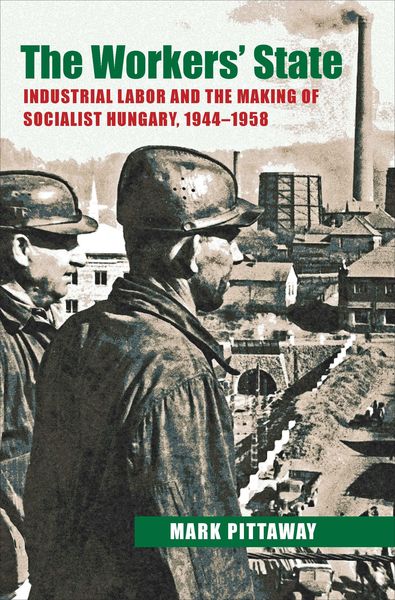
The Workers' State Industrial Labor and the Making of Socialist Hungary, 1944-1958
Aus der Reihe
Russian and East European Studies
58,29 €
inkl. gesetzl. MwSt.Beschreibung
Produktdetails
Format
Kopierschutz
Nein
Family Sharing
Nein
Text-to-Speech
Nein
Erscheinungsdatum
23.11.2010
Verlag
Nyu PressSeitenzahl
(Printausgabe)
Sprache
Englisch
EAN
9780822978121
In 1956, Hungarian workers joined students on the streets to protest years of wage and benefit cuts enacted by the Communist regime. Although quickly suppressed by Soviet forces, the uprising led to changes in party leadership and conciliatory measures that would influence labor politics for the next thirty years.
In The Workers' State, Mark Pittaway presents a groundbreaking study of the complexities of the Hungarian working class, its relationship to the Communist Party, and its major political role during the foundational period of socialism (1944-1958). Through case studies of three industrial centers-Ujpest, Tatabanya, and Zala County-Pittaway analyzes the dynamics of gender, class, generation, skill level, and rural versus urban location, to reveal the embedded hierarchies within Hungarian labor. He further demonstrates how industries themselves, from oil and mining to armaments and textiles, possessed their own unique labor subcultures. From the outset, the socialist state won favor with many workers, as they had grown weary of the disparity and oppression of class systems under fascism. By the early 1950s, however, a gap between the aspirations of labor and the goals of the state began to widen. In the Stalinist drive toward industrialization, stepped up production measures, shortages of goods and housing, wage and benefit cuts, and suppression became widespread. Many histories of this period have focused on Communist terror tactics and the brutal suppression of a pliant population. In contrast, Pittaway's social chronicle sheds new light on working-class structures and the determination of labor to pursue its own interests and affect change in the face of oppression. It also offers new understandings of the role of labor and the importance of local histories in Eastern Europe under communism.
In The Workers' State, Mark Pittaway presents a groundbreaking study of the complexities of the Hungarian working class, its relationship to the Communist Party, and its major political role during the foundational period of socialism (1944-1958). Through case studies of three industrial centers-Ujpest, Tatabanya, and Zala County-Pittaway analyzes the dynamics of gender, class, generation, skill level, and rural versus urban location, to reveal the embedded hierarchies within Hungarian labor. He further demonstrates how industries themselves, from oil and mining to armaments and textiles, possessed their own unique labor subcultures. From the outset, the socialist state won favor with many workers, as they had grown weary of the disparity and oppression of class systems under fascism. By the early 1950s, however, a gap between the aspirations of labor and the goals of the state began to widen. In the Stalinist drive toward industrialization, stepped up production measures, shortages of goods and housing, wage and benefit cuts, and suppression became widespread. Many histories of this period have focused on Communist terror tactics and the brutal suppression of a pliant population. In contrast, Pittaway's social chronicle sheds new light on working-class structures and the determination of labor to pursue its own interests and affect change in the face of oppression. It also offers new understandings of the role of labor and the importance of local histories in Eastern Europe under communism.
Noch keine Bewertungen vorhanden
Verfassen Sie die erste Bewertung zu diesem Artikel
Helfen Sie anderen Kundinnen und Kunden durch Ihre Meinung.
Kurze Frage zu unserer Seite
Vielen Dank für Ihr Feedback
Wir nutzen Ihr Feedback, um unsere Produktseiten zu verbessern. Bitte haben Sie Verständnis, dass wir Ihnen keine Rückmeldung geben können. Falls Sie Kontakt mit uns aufnehmen möchten, können Sie sich aber gerne an unseren Kund*innenservice wenden.
zum Kundenservice